Friends at Work 3.0: The Most Connected and Engaged Employees Are Carrying Workplace Stress and Are the Most In Demand

  • Employees with close personal friends at work are the most likely to search for a new role in the next year
  • Collegial relationships at work linked to the strongest overall wellbeing but higher disengagement
  •  Non‑socializers consistently report the weakest outcomes
May 14 2026

NEW YORK, May 14, 2026 – A new report and analysis from KPMG LLP, the U.S. audit, tax and advisory firm, and CivicScience, an advertising and analytics platform, finds that employees with close personal friends at work are the most engaged employees, experiencing the biggest emotional highs, and the lowest emotional lows. They are also most likely to search for a new role this year, with nearly half (42%) actively job searching in the next 12 months — nearly three times the rate of other groups.

“As AI increasingly handles more complex tasks, the cognitive and emotional demands on people in the workplace are only increasing,” said Sandy Torchia, KPMG U.S. Vice Chair of Talent and Culture. “Employees fostering close friendships at work often sit at the center of that pressure, representing a high‑demand, high‑impact segment of the workforce that combines strong market value with an outsized role inside organizations, absorbing elevated stress while driving engagement, trust, and AI adoption. Leaders who recognize this dynamic will be best positioned to keep pace as expectations on people and organizations continue to rise.”

Our research journey: Fostering friendships at work – and understanding how they shape employee experience – is an employer imperative.

Over the last three years, our research has shown that employees report that workplace friendships are critically important to their experience, mental health, and productivity. Last year, through a conjoint analysis, we found that employees value close friendships at work equal to roughly a 20% salary premium. The 2026 research builds on those findings to look more closely at the nuance of experience and wellbeing through a collaboration with CivicScience and their well-tested Wellbeing Index (WBI).

This analysis examines how four different types of workplace relationships shape how employees feel, perform, and persist at work. These include close personal friends (relationships that extend beyond work hours), workplace friends (social interaction primarily during the workday), collegial relationships (friendly interaction without a personal connection), and employees who do not socialize at work.

Methodology Note: Using the CivicScience Wellbeing Index (WBI) in a workplace context, the study analyzes four types of relationships: The survey was fielded April 17–22, 2026 among employed U.S. adults (sample sizes vary by question, ranging from n=558 to n=1,354).

Employees with close personal friends at work are the most engaged across multiple dimensions, combining high engagement with high emotional intensity.

Torchia: "The people absorbing the most pressure, adopting AI, building the most trust, and carrying the culture are also the ones most likely to walk out the door. When they leave, the pressure doesn't disappear – it just moves to people less equipped to handle it. That is a risk most organizations are not actively managing, and in a workplace that is only going to get more demanding, they can't afford not to."

  • Employees with close personal friends experience the strongest emotional highs, reporting the highest levels of happiness (82–83%) and excitement (65–66%), while also carrying the strongest emotional lows, including elevated stress (63–68%) and sadness (47%).
  • Despite that intensity, they deliver the strongest outcomes: they are the most engaged group at work (49% say they are “always engaged”), most likely to turn to AI for questions compared to other groups (35%), most likely to say they are focused on skill development (87%), and among the most trusting at work (47% say they trust their company a lot and 39% say they trust their CEO a lot).
  • They are also the most active in the job market. More than two in five (42%) employees with close personal friends say they are very likely to search for a new job in the next 12 months — reflecting a confident, highly mobile segment of the workforce that remains deeply engaged while staying connected to external opportunities.
  • Employees with close personal friends are also more likely to manage other employees (55%).
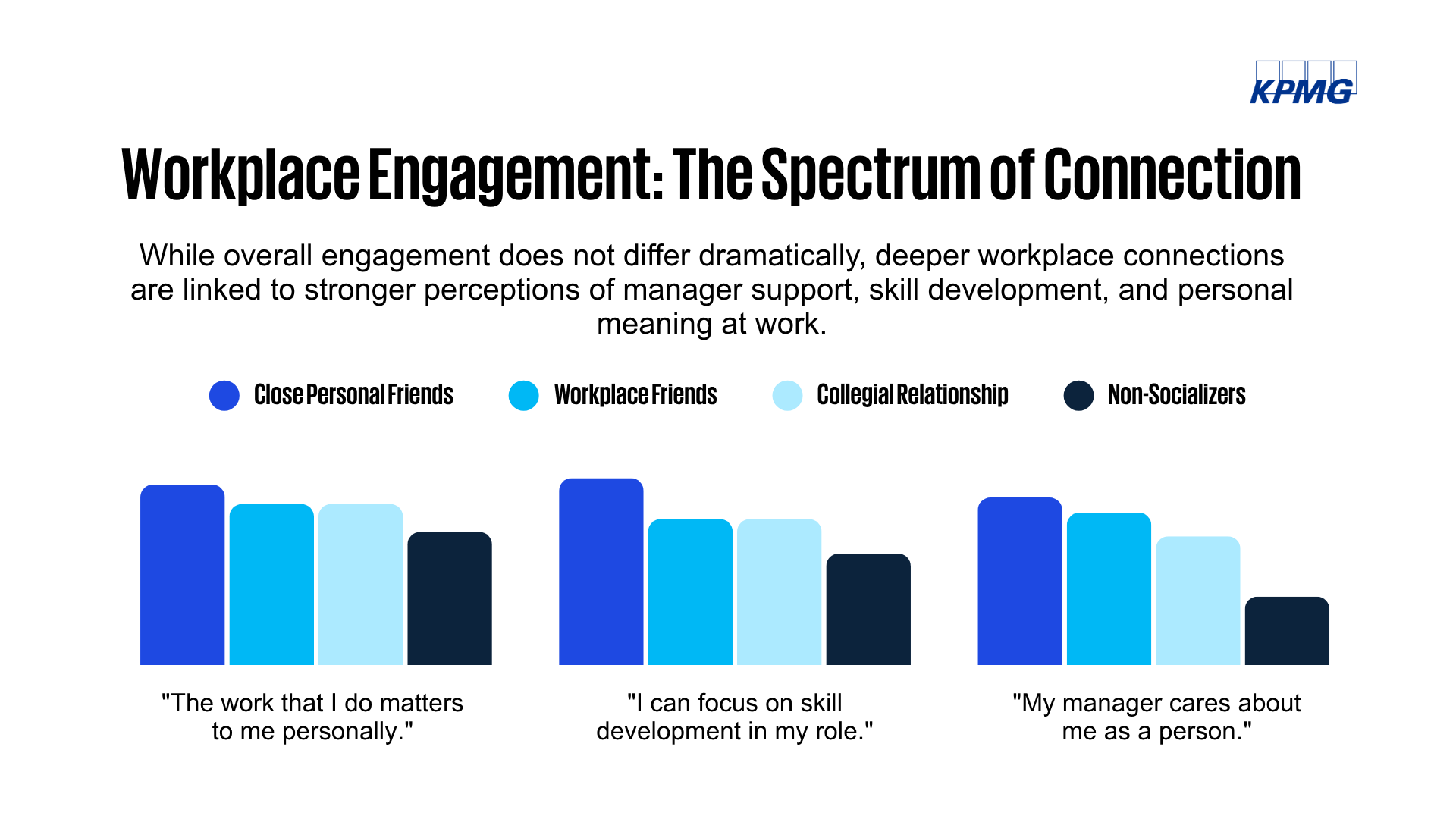
Across the spectrum of relationships at work, there are meaningful differences in how engagement is experienced, supported, and sustained as workplace connection increases.

  • Nearly eight in ten employees (78%) with close personal friends say their manager cares about them as a person, compared with 71% of those with workplace friends, 60% of those with collegial relationships, and just 32% of non‑socializers.
  • 87% of employees with close friends say they can focus on skill development in their role, compared with 68% among employees with workplace friends or collegial relationships and 52% of non‑socializers.
  • 84% of employees with close friends say the work they do matters to them personally, compared with 75% of those with workplace friends or collegial relationships and 62% of non‑socializers.
  • Engagement also extends beyond the workplace: employees with close personal friends are four times as likely to volunteer weekly (32%) as every other group (8%).

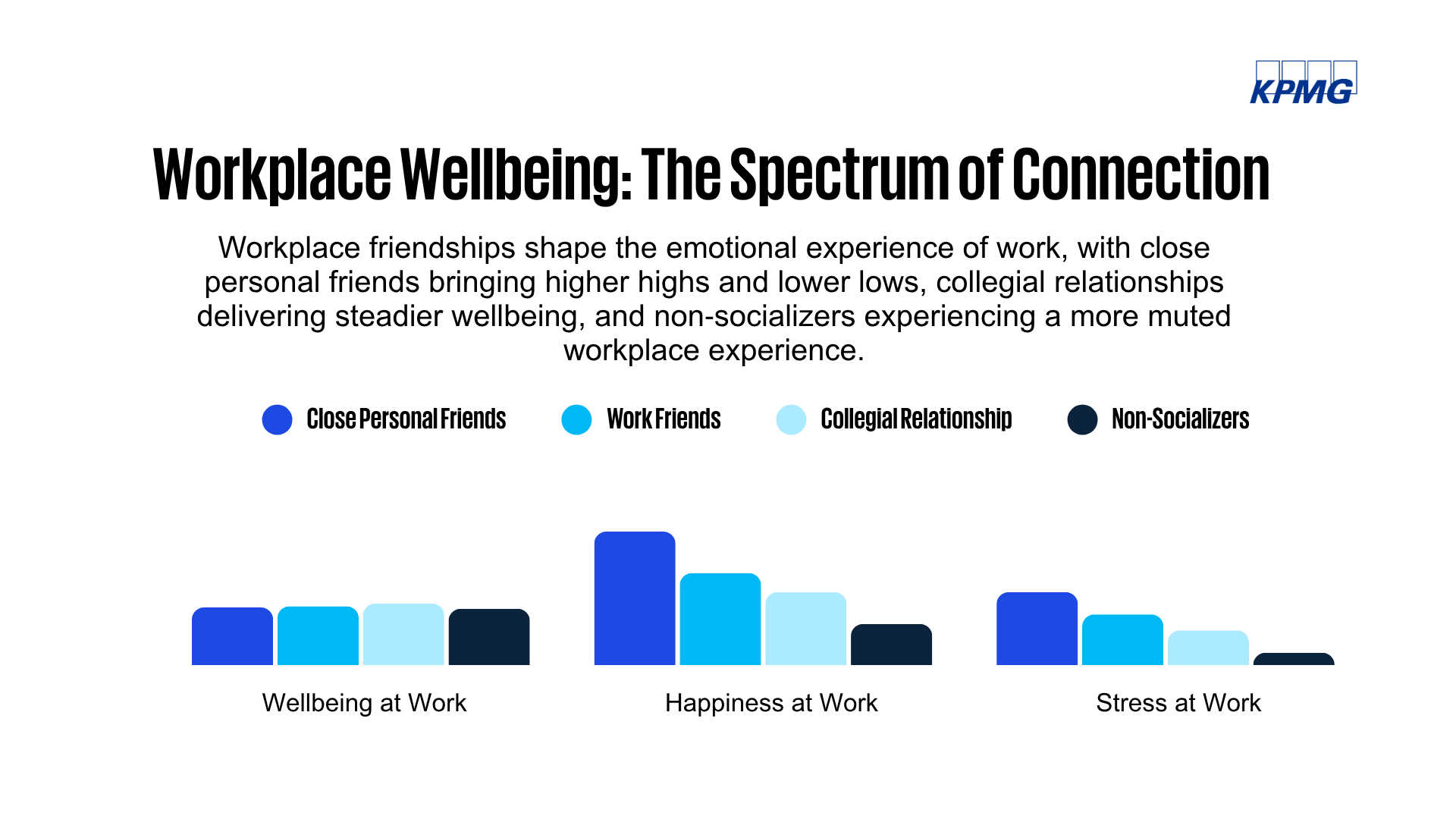
Friends at work shape the emotional experience of work, with distinct benefits and tradeoffs depending on the type of connection.

Torchia: “Human connection at work is a force multiplier. It amplifies emotion, both the highs and the lows, but it’s also what fuels performance, trust, and resilience. Less connection comes at the cost of everything that makes organizations thrive.”

  • Close personal friends experience higher emotional highs and lows, while employees with workplace friends tend to report more happiness (69%) and excitement (50%) at work and significantly less sadness at work (26%) than those with collegial relationships or no workplace relationships — indicating a more emotionally buffered experience.
  • Employees with collegial relationships may have found a relative sweet spot, reporting the highest overall wellbeing at work (59.4) and the lowest levels of negative emotion, including sadness (22%) and fear (22%).
  • Non‑socializers do not report lower engagement — 35% say they are “always engaged,” close to other groups — but their experience is more muted. Far fewer report strong feelings of happiness (48–53%) or excitement (35–37%), only 32% say their manager cares about them as a person, and 37% say they have no one to talk to about their mental health.

Friends@Work 3.0

Download below!

Click here!

About KPMG LLP

KPMG LLP is the U.S. member firm of the KPMG global organization of independent member firms providing audit, tax and advisory services. The KPMG global organization operates in 138 countries and territories and has more than 276,000 people working in member firms around the world. Each KPMG firm is a legally distinct and separate entity and describes itself as such. KPMG International Limited is a private English company limited by guarantee. KPMG International Limited and its related entities do not provide services to clients.
 
KPMG is widely recognized for being a great place to work and build a career. Our people share a sense of purpose in the work we do, and a strong commitment to increasing access to education and opportunity, advancing mental health, and supporting community vitality. Learn more at www.kpmg.com/us.

About CivicScience

CivicScience is an advertising and analytics platform built on the world's largest database of real-time consumer sentiment and declared intent. Powered by AI-enabled survey technology engaging millions of U.S. respondents every week, CivicScience helps leading brands and agencies activate and measure high-performing advertising — reaching custom audiences of over 165 million consumer profiles across premium digital, online video, and connected TV environments. Real Voices. Superior Advertising. Thriving Media.

Media Contact

For media inquiries, contact Katy Reddin (kreddin@kpmg.com) and Alyssa Mora (alyssamora@kpmg.com).

Q&A

QuestionAnswer
Do workplace friendships influence behavior outside of work?Yes—employees with close personal friends are 4x more likely to volunteer weekly (32%) compared to other employees (8%), signaling stronger connection, purpose, and engagement beyond the workplace.
Do employees with strong workplace relationships perform differently?Yes—87% of employees with close friends prioritize skill development (vs. 52% of non-socializers), 35% use AI tools, and 55% manage others, placing them at the center of growth, innovation, and leadership.
How do workplace friendships impact trust in leadership?Employees with close friends show higher trust, with 47% saying they trust their company a lot and 39% saying the same about their CEO—significantly higher than less connected groups.
Do workplace friendships improve employee engagement?Strongly—49% of employees with close friends say they are “always engaged,” compared to 35% of non-socializers, highlighting a clear link between relationships and sustained performance.
Which workplace relationships lead to the best overall wellbeing?Employees with collegial relationships report the highest wellbeing score (59.4) and the lowest levels of negative emotion, including sadness (22%) and fear (22%), suggesting a more balanced experience.
What type of employees are most at risk of leaving their jobs?Highly connected, high-performing employees are most at risk—42% are actively job searching, and 55% already manage others, reflecting both strong demand and elevated responsibility.
Are employees without workplace friendships less engaged or supported?Not significantly less engaged—35% say they are “always engaged”—but they report weaker support and wellbeing: only 32% say their manager cares about them, 48–53% report happiness (vs. 82–83% with close friends), and 37% say they have no one to talk to about their mental health.
Do workplace friendships increase stress or burnout?In some cases—employees with close friends report high happiness (82–83%) and excitement (65–66%), but also elevated stress (63–68%) and sadness (47%), reflecting a more intense emotional experience.
Why are the most engaged employees also the most likely to leave?These employees combine high engagement (49% always engaged), strong trust (47%), and growth focus (87%) with higher stress (63–68%), making them both high-performing and more likely to explore new opportunities (42% job searching).
Are employees with close friends at work more likely to job search?Yes—42% of employees with close personal friends say they are likely to job search in the next year, nearly 3x the rate of less connected groups, despite being among the most engaged and highest performing.

Thank you!

Thank you for contacting KPMG. We will respond to you as soon as possible.

Contact KPMG

Use this form to submit general inquiries to KPMG. We will respond to you as soon as possible.
All fields with an asterisk (*) are required.

Job seekers

Visit our careers section or search our jobs database.

Submit RFP

Use the RFP submission form to detail the services KPMG can help assist you with.

Office locations

International hotline

You can confidentially report concerns to the KPMG International hotline

Press contacts

Do you need to speak with our Press Office? Here's how to get in touch.

Headline