Policy in Motion: Insights for navigating with confidence

Your resource for the latest on trade, tariff and regulatory policy changes.

Be ready for what's next

The policy landscape is constantly evolving, with new regulatory, fiscal and legislative changes impacting businesses and industries. Staying ahead requires being proactive and informed. KPMG has provided these resources to help businesses anticipate and navigate these shifts, turning challenges into opportunities. Explore how to stay ahead in a world where public policy is always in motion.

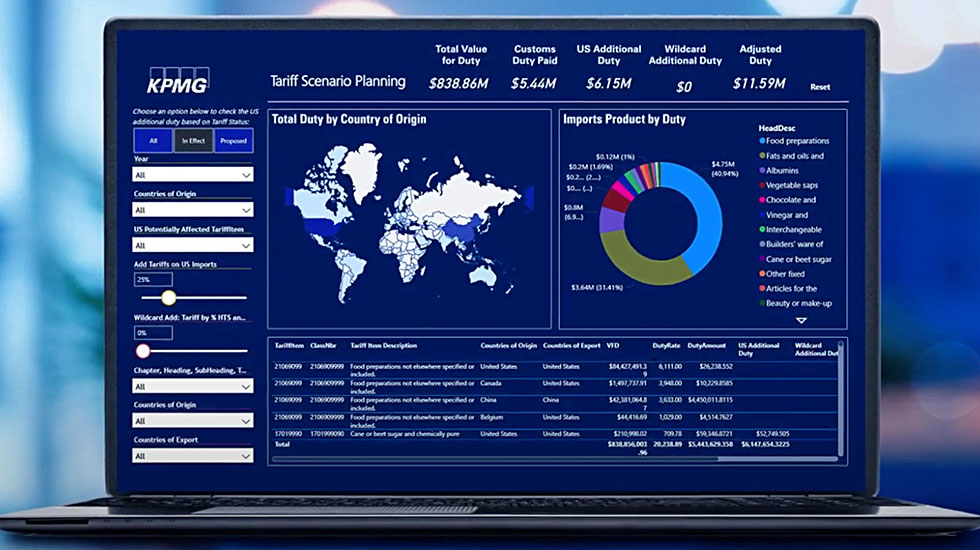
Spotlight: KPMG Tariff Modeler

The ability to adapt trade strategies amid evolving tariffs is crucial, as is the need to make smart, fast trade decisions. The KPMG tariff modeler offers real-time insights into trade data, helping businesses manage complexity and stay ahead. Let KPMG trade and customs professionals assist in enhancing your trade strategy and informing next steps.
Learn more

Featured Insights

How does recent policy change affect your business?

New legislation and regulations are rapidly transforming industries. This collection presents KPMG's latest insights on the implications for your operations, strategy, and growth.

Global Economic & Geopolitical Outlook webcast

Join us on December 17, 2025, 9:00 AM PST | 12:00 PM EST

Whether you're managing currency exposure across multiple markets, timing capital deployment, recalibrating supply chain strategies, or pressure-testing investment assumptions, you will want to understand how these global dynamics interact, and what they mean for your organization. This webcast brings together KPMG’s regional Chief Economists, Global Geopolitics Lead, and Global Head of Deal Advisory to provide the strategic intelligence that can inform your decisions throughout 2026.

Webcasts

In the news

 
  • Fed is likely to lower rates only two more times, even under Trump’s next chair pick
    The survey shows the average outlook is for two more quarter-point cuts this year, or 50 basis points, with no reductions expected yet for 2027. With the survey coming in the wake of US tariff threats over Greenland, several respondents also wrote in “geopolitical risk” as a major area of concern. “Policy uncertainty acts as a tax on the economy,” said Diane Swonk, chief economist at KPMG. “It causes paralysis. I was hopeful policy uncertainty would abate as we move into 2026. Thus far, that has not been the case.”
    Jan 27, 2026
  • Tax changes create new savings opportunities for LI businesses
    Updated payroll tax rules will necessitate a compliance review for many companies, with positive outcomes for some. “Payroll tax changes in Nassau and Suffolk will reshape labor costs for larger employers, while smaller corporations get operating leverage from the $5,000 threshold, freeing up cash that was tied up in quarterly payments,” explains Aaron Balken, senior manager, state and local tax, asset management, and New York tax controversy lead at KPMG. According to Balken, the impact of the new rules will be felt across many of our area’s largest employers, but it may also produce tangible benefits for some smaller firms.
    Jan 23, 2026
  • Trump’s OBBBA reshapes tax planning for New Jersey businesses
    The OBBBA will have “broad impact not only in 2025 and 2026 but in years to come,” according to Robert Trenery Jr., a tax partner at KPMG. “It permanently extends and modifies key provisions of the 2017 Tax Cuts and Jobs Act, while also introducing new reforms.” The new legislation is characterized by staged implementation, with different provisions taking effect through 2025, 2026 and 2027, he explained. For calendar-year businesses whose 2025 tax year already closed by the time the full implications became clear, opportunities for strategic planning remain available, he added.
    Jan 12, 2026
  • U.S. dollar weakening is bad news for countries that use the euro
    Kenneth Kim, senior economist with KPMG, links the strengthening euro and weakening U.S. dollar to weaker demand for European exports and the risk of excessively low inflation in the Eurozone, which could pressure the European Central Bank to lower interest rates if inflation continues to fall. The euro’s rise to around $1.20 makes European exports more expensive, weighing on already sluggish European growth and posing particular challenges for export-dependent Germany, while also complicating the ECB’s upcoming monetary policy decisions.
    Jan 28, 2026

Meet our team

Connect with us to learn how we can help you manage risk and regulation in a way that earns and inspires stakeholder trust.

Image of Diane C. Swonk
Diane C. Swonk
Chief Economist, KPMG US
Image of John P. Gimigliano
John P. Gimigliano
Principal, Washington National Tax, KPMG US

Thank you!

Thank you for contacting KPMG. We will respond to you as soon as possible.

Contact KPMG

Use this form to submit general inquiries to KPMG. We will respond to you as soon as possible.
All fields with an asterisk (*) are required.

Job seekers

Visit our careers section or search our jobs database.

Submit RFP

Use the RFP submission form to detail the services KPMG can help assist you with.

Office locations

International hotline

You can confidentially report concerns to the KPMG International hotline

Press contacts

Do you need to speak with our Press Office? Here's how to get in touch.

Headline