
Rolling a boulder uphill: Structural change watchlist
July 8, 2026
The economy is not standing still. It is moving, but the movement is harder to see and harder to sustain. Each inch of progress now requires greater force.
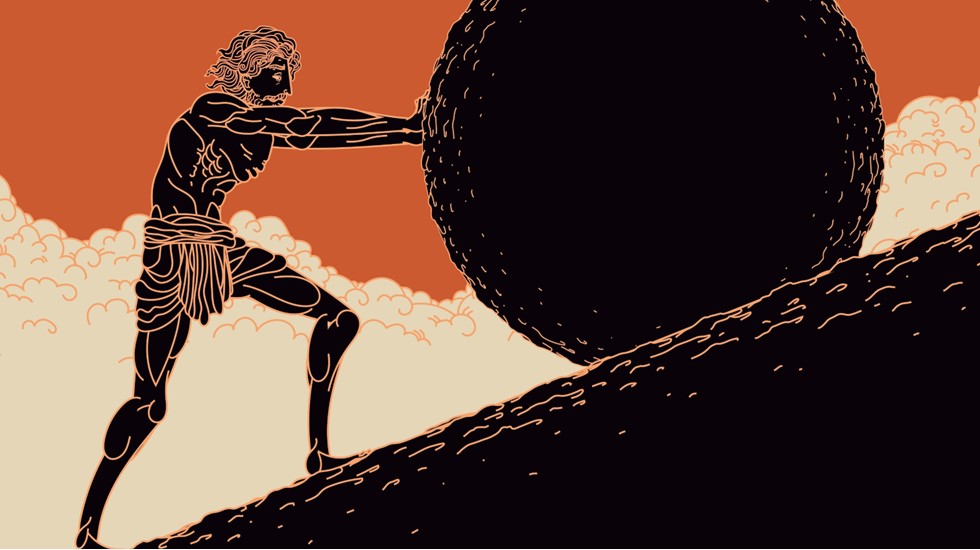
That is the lesson of Sisyphus, condemned by the Ancient Greek gods for cheating death not once, but twice. The gods sentenced him to constant, repetitive motion with no relief. He was tasked with rolling a boulder uphill - forever. Gravity would nullify his efforts.
The old world of cheap imports, open trade and relative certainty has given way to a steeper slope. Inflation adds drag and every shock leaves more debris behind.
The climb is steeper because the wind has shifted. Capital is no longer cheap, trade is fragmented, inflation has found a higher floor and shocks cause fault lines in the path.
Households feel the incline first. Prices remain too high, housing is in a state of suspended animation, and financial cushions have thinned.
The AI boom casts light on the horizon, but its glow is uneven. The costs arrive now in chips, power, cooling and capital; the productivity dividend remains a promise still gathering form.
Policymakers are left with a narrower path. The Federal Reserve may have to inflict more pain to derail inflation. Congress has less fiscal room nor a commitment to fix our fiscal woes.
This is not an economy on the edge of collapse. It is an economy with fewer cushions. It can grow, but gains erode more rapidly. Blows leave lingering bruises.
This Economic Compass provides our annual structural change watchlist, which could best be titled “The Great Inversion.” The forces that once kept inflation in check and softened the economy’s landings have reversed; they now add heat and stress.
The result is an economy that is more exposed to shocks and bouts of inflation. The risk of a financial market correction has risen. Even the AI boom is losing some of its luster.
Top 10 structural shifts
1. Uncertainty has become endemic.
Bouts of uncertainty used to arrive like a storm: visible, violent but temporary. Damage could be repaired and left in the past.
Now it hangs like fog. Firms and households cannot see far enough to plan, so they slow down. The cost is not just delayed spending; it is delayed commitment.
Businesses wait to hire, invest and expand. Households postpone moves, purchases and risk-taking. Temporary caution hardens into restraint.
That leaves scars. Investment stalls, planning horizons shorten and strategy gives way to triage. Fed officials must navigate with lagged data and weaker signals.
The labor market feels the chill first. Hiring slows, quits fall and new entrants, including many recent graduates, absorb the hit.
Poor visibility raises the risk of a policy misstep. The Fed may not have cut rates as aggressively in late 2025 if it had known that underlying inflation would flare in early 2026.
2. The Fed is chasing a moving target.
The forces that pinned rates near zero are reversing. The old policy playbook is less reliable and the neutral rate harder to read.
For years, excess savings helped do the Fed work and lower the floor under the non-inflationary fed funds rate. Boomers were accumulating assets. China was recycling its surplus into Treasuries and investors treated US debt as the safest game in town.
That world is disappearing. Boomers are drawing down savings. China’s savings glut has thinned, while central banks the world over are buying fewer Treasuries.
Hedge funds and more price-sensitive investors have picked up the slack. That has created a higher floor under interest rates than we had in the past.
3. Inflation has a new floor.
The Fed spent fifteen years trying to coax inflation up to 2%. That world is gone, and the burden of proof has shifted from generating inflation to containing it.
Old disinflationary tailwinds are fading. Cheap goods from China are less abundant, lean supply chains are being traded for resilience, unstable weather patterns are disrupting production and low-cost energy can prove fleeting.
The AI boom is adding to those inflationary pressures. Investments in data centers are bidding up the costs of everything from electricity to consumer electronics.
That does not mean inflation runs away. It means the floor is higher and stickier. A 3-4% inflation world is no longer a tail risk when supply shortages keep prices elevated and inflation expectations become unmoored.
Rate hikes can suppress demand; they cannot add housing supply, reroute ships, repair crops or expand the grid. Restoring 2% inflation would therefore require more pain in output and employment than it once did.
4. The Fed’s reach has narrowed.
The Fed can still move markets. It has a harder time moving the real economy, especially when asset gains are concentrated, credit is less forgiving and housing is in short supply.
Rate cuts work first through financial conditions, lifting stocks, bonds and home values before they lift paychecks. That helps households with assets.
The problem is that gains are highly concentrated. The top 1% of households control roughly half of corporate equities and mutual fund shares; the bottom half owns only a sliver.
That asymmetry matters. Rate cuts boost wealth first and most for those who already have it. Rate hikes spread more broadly.
Credit gets more expensive, asset values suffer and loan collateral erodes. Low- and middle-income households and small businesses are hit hardest. Hiring suffers.
Housing complicates the Fed’s job. The Fed can lower mortgage rates; it cannot build homes.
Worse yet, lower rates pull buyers into the market before enough supply comes on line. The mismatch between supply and demand lifts home values.
Those who cannot buy must rent. Excesses in the apartment market are being absorbed, which could add to rents and further boost shelter costs. What was a drag on inflation becomes an accelerant.
5. Debt is mounting and fiscal space is shrinking.
Debt held by the public eclipsed the economy in size for the first time since WWII in early 2026. That leaves less room to borrow when the next shock hits.
Our fiscal problem is not one bill; it is the pileup. Rearmament, debt service, aging and more frequent shocks are arriving as borrowing costs stay elevated.
We are not alone. Much of the global economy is operating with high debt levels, little room to maneuver and a commitment to spend more on defense.
The peace dividend is ending in a world of hot wars, fragile supply chains and higher borrowing costs. Global military spending neared $3 trillion in 2025, the eleventh straight annual increase.
The new defense infrastructure is particularly costly. Drones, precision munitions, satellites, cyber and digital attacks require ongoing capital outlays, not a one-time investment.
Those demands are colliding with interest costs. The nonpartisan Congressional Budget Office estimated that net interest on the public debt surpassed $1 trillion for the first time in fiscal 2025. It was the third largest government spending category - it outstripped defense.
Every dollar spent servicing debt is a dollar not spent on defense, disaster relief, infrastructure or recession support. More spending is flowing into mandatory programs, which are dominated by retirees.
Little is spent on children or young adults. Cuts in R&D funding for major universities has winnowed the ranks of students pursuing graduate degrees. That undercuts one of our strongest competitive advantages - higher education.
The result is a weaker fiscal multiplier. Each dollar of stimulus buys less growth, crowds out more private investment and leaves less capacity for the next shock.
The dollar’s reserve status remains the silver lining, helping contain long-term rates and preserving some fiscal flexibility. However, privilege is not permanence. If that premium erodes, even slowly, the interest burden climbs, which limits the ability to stimulate with spending or tax cuts.
6. Aging is a double-edged sword.
Aging is no longer a distant risk. It is already limiting the supply of workers, while it adds to the federal deficit.
A smaller working-age population keeps labor markets tighter, even in downturns. That complicates the Fed’s decision rule on monetary policy. It is one reason that unemployment is low, despite weak employment gains.
The risk is not as high as it was in the 1970s, but is still worrisome. The result is that the labor market could fuel inflation even if the economy stumbles. That is similar to the stagflation of the 1970s.
Meanwhile, fewer workers are paying into Social Security and Medicare just as more retirees are drawing benefits. Curbs to immigration add to those shifts. It holds the unemployment rate down by further shrinking labor supply, while worsening the math on deficits and debt.
Foreign-born workers participate in the labor market at higher rates than native-born, while funding social insurance system. Less immigration means less labor supply and fewer contributors.
The Social Security trust fund - the excess that is paid in by current workers - is estimated to be depleted as soon as 2032. The program would not disappear, but benefits would be limited to incoming revenue.
The result is either a 22% across the board cut in benefits or major reforms to the program. Congress has a lot of work to do.
7. Inequality deepens downturns and slows recoveries.
Inequality is not just a fairness problem. It changes how downturns spread and recoveries take hold.
Low-income households have the thinnest cushions and the highest propensities to spend. When prices jump or hours get cut, they pull back quickly, often before the pain is visible in the economic data.
That makes downturns sharper and recoveries slower. The people hit first are least able to wait for help. Policies that would shorten the downturn - fiscal stimulus, retraining and childcare - get trapped in zero-sum political fights.
Those who pay the most in taxes are least affected. They do not want to pick up the bill for those who are hardest hit by economic downturns. Those shifts stoke political divisions and backlash.
Firm concentration adds to inequality. Superstar firms can protect margins, mute wage gains and bottle up opportunity. Inequality stops being just a symptom; it becomes a brake on growth and deepens the downturns that follow.
That puts more pressure on AI to deliver broad productivity gains that lift wages, not just valuations. The problem is that the AI dividend arrives later than the bills.
8. AI has a sequencing problem.
AI will no doubt prove transformative. The problem is timing. The cost of the infrastructure is arriving faster than productivity growth can be scaled.
Chips, power, water and debt are costly. They are crowding out other investments and spilling over into other prices. The recent jump in consumer electronics is but one example - they were falling in price for decades.
AI demand is growing faster than the models can become more efficient. Token costs can outstrip the costs of an employee.
The danger is that we have a boom financed with borrowed time. The upside could be enormous, but the downside would arrive before the economy has rebuilt its shock absorbers.
AI stocks have begun to falter. A major market correction cannot be ruled out. The resulting downturn is likely to be much worse than the fallout from the tech bubble bursting in the early 2000s and it would occur with few tools to right the ship.
9. Chokepoints are replacing global buffers.
Trade once made shocks to the global economy more diffuse. A loss in demand in one economy was offset by gains elsewhere.
That flexibility is being lost. Tariffs, export controls and retaliation do not just raise costs; they narrow the lanes through which goods, capital and inputs can move.
What once looked like insurance now looks like another source of fragility: a smaller spare tire for a rougher road.
The Strait of Hormuz shows how low that threshold has fallen. A narrow waterway carries an outsized share of global energy flows. Even the threat of disruption can move fuel prices, transportation costs and inflation expectations worldwide.
The risk extends well beyond the region itself. Markets can react before an actual shortage occurs, turning a localized flashpoint into a broader economic shock.
China is the best example outside energy. Tariffs may reduce one form of dependence, but retaliation can tighten access to rare earths, batteries, solar components and machinery that are hard to replace quickly.
The result is a world where disruption travels through bottlenecks instead of around them. That adds insult to injury in a world already grappling with higher inflation and thinner buffers.
More tariffs. More retaliation. More chokepoints. Less insurance. The global system is no longer absorbing stress; it is amplifying it. Shock absorbers have become shock transmitters.
10. Trust is the final constraint.
Every fix on this list requires trust; people need to believe that institutions will deliver on their promises. Without that confidence, even technically sound policy can lose traction.
That trust is thin. Pew puts trust in the federal government near historic lows: 22% in 2024 and 17% in 2025, down from 73% when the question was first asked in 1958.
Low levels of trust weaken policy itself. The Fed’s credibility at reducing inflation has been diminished, which makes inflation harder to derail. Fiscal bargains become more difficult and global coordination deteriorates.
Nationalism intensifies, adding to frictions at the border, while the electorate itself becomes more divided. Few believe their interests are being represented in a world where wealth and influence are more concentrated.
It is fertile ground for conspiracy theories. Once you doubt the people or institutions whose job is to tell you what’s true - government, media, science, experts - unofficial explanations feel more appealing.
Conversely, conspiracy theories undermine trust. They sow the seeds of doubt, even in institutions unrelated to the original sin. That generalized distrust makes it easier to believe in cover-ups everywhere - even if conspiracies contradict one another.
That is the trap: the very forces that demand reform also makes it more difficult to accomplish. The boulder does not just roll back; fewer hands are willing to push it uphill again.
What rebuilds trust? Transparency, accountability and time. Trust lost is not easily reclaimed. It took decades to erode and can take even longer to rebuild.
Bottom Line
The economy has not stopped moving, but every inch now takes more force. Inflation has a higher floor, rates are no longer pinned near zero, fiscal space is thinner and shocks move faster through a system with fewer cushions to absorb them.
The boulder is heavier, the hill is steeper and the climb falls hardest on those with the fewest buffers. The supports that once made the economy more forgiving - cheap capital, open trade, low inflation, fiscal room and institutional trust - are no longer carrying the same weight. Some have cracked; others have become part of the burden.
We are not alone. Many of the problems we face are global in scope. The trust that once united countries to solve them has frayed. The result is more chokepoints and friction in a system which once had few. Inflation is not a risk; it is becoming a constant state.
Sisyphus was condemned to push forever; we are not. We still have choices about the hill we climb, the weight we carry and who is left to shoulder it. Better buffers, smarter investments and a broader AI dividend could leave the economy more resilient than it is today. That will take discipline, imagination and empathy - a rare currency in a fractured world. Be kind; pay it forward.
Economic Forecast — July 2026
Dive into our thinking:
Explore more



Subscribe to insights from KPMG Economics
KPMG Economics distributes a wide selection of insight and analysis to help businesses make informed decisions.
Meet our team