Financial Services Bank Regulatory Tailoring
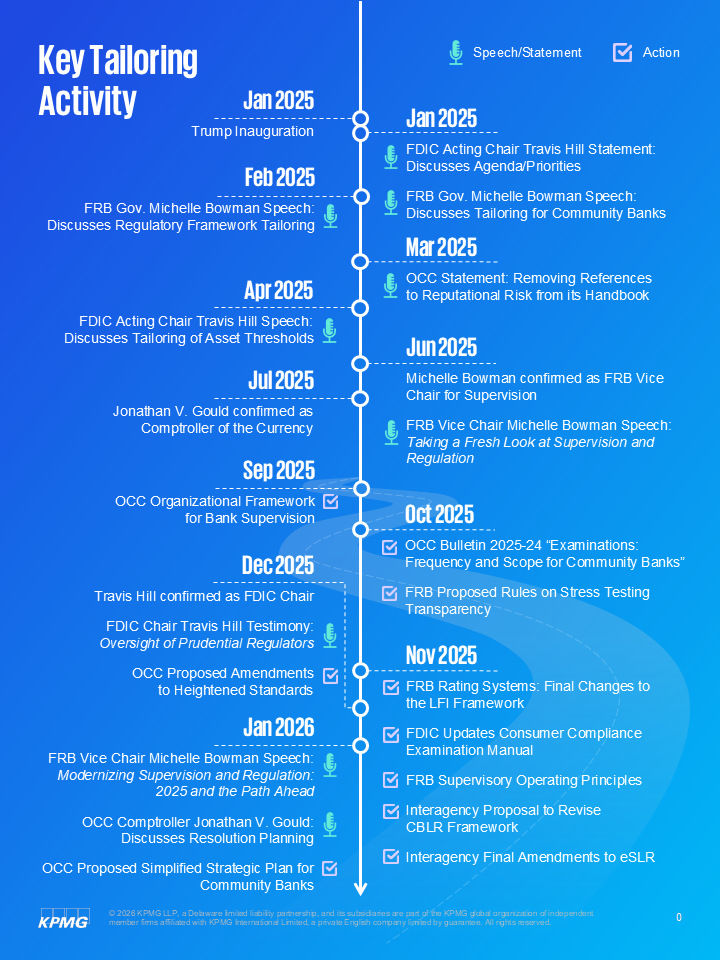
From statements to action

KPMG Regulatory Insights
- Supervision: Banking regulators continue to execute against their agendas to tailor supervision and enforcement guidelines and practices in order to focus on material financial risks; anticipate increased federal and state interagency coordination/reliance to streamline exams.
- Safety and Soundness: Although changing regulatory requirements are intended to alleviate regulatory burden, expectations for safe and sound operations remain, potentially putting greater responsibility on bank risk management and the role of credible challenge.
- Volume of Change: All banks, and especially community banks, may be challenged to keep pace with and implement the high volume of regulatory changes.
A year into the new administration, shifts in agency leadership and an active regulatory agenda—reflected through speeches, rulemakings, withdrawals, and rescissions—spotlight “tailoring” as one of the defining themes of the regulatory landscape for financial institutions. In addition to deregulatory measures including numerous withdrawals of proposed guidance and regulations, prudential regulators have set on a course of tailoring many existing requirements to reduce regulatory burden based on banks’ size, complexity, and risk profile.
Notable trends in tailoring efforts by the Federal Reserve Board (FRB), Federal Deposit Insurance Corporation (FDIC), and the Office of the Comptroller of the Currency (OCC) include:
- Supervision and Enforcement
- Thresholds and Calculations
- More to Come
Supervision & Enforcement
Together and separately the FRB, FDIC, and OCC signal ongoing focus on tailoring supervision and enforcement to promote safety and soundness and financial stability. Recent activities aim to refocus bank supervision on “early detection and remediation of material financial risks.” Regulatory actions are outlined in the table below.
Topic | Description/Example |
|---|---|
Safety & Soundness |
|
Ratings Systems |
|
Streamlined Examination Processes |
|
Bank Supervision |
|
Thresholds & Calculations
Rulemakings across agencies intend to tailor long-standing regulatory thresholds and/or calculations applicable to banks. Historically, many of these regulatory thresholds and/or calculations were not adjusted to evolve with the size of institutions. The table below highlights key areas of related regulatory changes.
Topic | Description/Example |
|---|---|
Enhanced Supplementary Leverage Ratio (eSLR) | Interagency Final Rule: Amendments modifying the measure (eSLR standard) used to calculate the buffer standards for U.S. bank holding companies identified as global systemically important bank holding companies (GSIBs) and their subsidiary depository institutions. (FRB, FDIC, OCC) |
Community Bank Leverage Ratio (CBLR) | Interagency Proposed Rule: Revising the CBLR framework by lowering the required minimum CBLR from 9 percent to 8 percent, estimating 475 additional community banks would qualify to participate in the framework. (FRB, FDIC, OCC ) |
Heightened Supervisory Guidelines | OCC Proposed Rule: Increasing the applicable asset threshold for heightened supervisory standards from $50 billion to $700 billion, reducing the number of covered banks from 38 to just 8. |
Community Reinvestment Act (CRA) Strategic Plans | OCC Proposed Guidance: Simplifying the process for community banks (banks with total assets up to $30 billion) interested in requesting that the OCC evaluate their CRA performance under a strategic plan. OCC proposes sample elective goals, separated by satisfactory and outstanding ratings, across 5 broad areas. |
FDIC Indexing | FDIC Final Rule: Signaling the first of a multi-phase effort to reevaluate thresholds within the agency’s regulations. Raises and indexes more than 20 regulatory thresholds (e.g., increasing asset levels for mandatory annual audits from $500 million to $1 billion, and internal control assessments from $1 billion to $5 billion). |
Capital Requirements | FRB Proposed Rule: Including changes to the models to be used for the 2026 stress test (e.g., credit risk models). |
More to Come
In recent speeches, banking agency leaders emphasized further considerations in tailoring regulatory requirements. Possible near-term actions include:
- Reconsidering the application of regulatory thresholds such as making adjustments based on nominal GDP or nuanced single-metric thresholds to better align statutory, regulatory and supervisory requirements with underlying risk. (FRB)
- Changing requirements for de novo institutions formation to support community banks and enhancing the speed and certainty of the branch approval process. (FDIC)
- Modernizing risk-based capital requirements, including implementing the 2017 Basel reforms (commonly known as Basel III Endgame). (FRB, FDIC, OCC)
- Streamlining CIDI resolution planning by reviewing guidance, formally proposing or rescinding any binding requirements, and ensuring regulatory concepts (RCAP, RCEN, RLAP, RLEN) are grounded in sound legal and analytical foundations. (OCC)
- Separating the community bank oversight program from frameworks for larger and regional banks. (FRB)
“Banking inherently involves risk. The regulatory framework aims not to eliminate risk, but to ensure the safe and sound management of risk. With proper prioritization, regulators and examiners can foster robust risk management while enabling banks to innovate, grow, and serve their customers, communities, and the broader U.S. economy.”
— Michelle W. Bowman
Vice Chair for Supervision
Federal Reserve Board
January 7, 2026
“As reflected in the OCC's mission, national banks and federal savings associations are responsible for operating in a safe and sound manner, providing fair access to financial services, treating customers fairly, and complying with applicable laws and regulations. The business of banking does not include planning for one's failure.”
— Jonathan V. Gould
Comptroller of the Currency
Office of the Comptroller of the Currency
January 16, 2026
“The Council is committed to supporting efforts to modernize supervisory and regulatory frameworks for banks and credit unions. Going forward, regulation and supervision should address material risks, enhance transparency, and reduce unnecessary burdens—particularly for community banks… We cannot have regulation through supervision…we need to have clear guidelines for tailoring.”
— Scott Bessent
Secretary of the Treasury
Department of the Treasury
February 4, 2026
“For banks between $10 billion and $30 billion in assets, the FDIC is now applying a hybrid approach with additional attention compared to point-in-time institutions, but fewer reviews, fewer dedicated examiners, and more tailored monitoring than institutions in the continuous examination process.”
— Travis Hill
Chairman
Federal Deposit Insurance Corporation
December 2, 2025
Dive into our thinking:
Explore more

Get the latest from KPMG Regulatory Insights
KPMG Regulatory Insights is the thought leader hub for timely insight on risk and regulatory developments.
Meet our team