Fed firmly on hold for April
Prices are too high for too many.
April 20, 2026
The Federal Open Market Committee (FOMC) – the policy making arm of the Fed – is expected to stay on the sidelines at its April meeting. The persistence of inflation amidst the collateral damage of the war in Iran on energy prices and the threat to supply chains has left inflation as a greater threat to the economy than unemployment.
Inflation concerns have even reached some of the more dovish members of the committee, such as Governor Christopher Waller, who recently stressed that he was comfortable with staying on the sidelines. He did caution along with other Fed leaders that the labor market could deteriorate and become a bigger concern. Even Governor Stephen Miran, who is holding onto his board seat, has scaled back his estimate for rate cuts this year.
A dueling mandate
Many Fed leaders are clearly worried that their dual mandate could come into tension. That happened last year in the wake of new tariffs, immigration curbs, policy uncertainty, AI innovations and the six-week government shutdown.
We entered the year with a tailwind of fiscal and monetary stimulus. Financial markets have rallied on any positive signs regarding peace talks. However, the closure of the Strait of Hormuz has disrupted supply chains the world over. The blockade has attributes that echo the pandemic, which ups the risk of a more persistent bump in inflation, not the “look through” type of inflation central bank leaders talk about.
Hence debate within the Fed regarding the need to signal its options on the next move; it could be up or down. There is legitimate concern among hawks that inflation could persist even if the labor market remains in a state of suspended animation or worse, unemployment rises.
This is not the 1970s but the lessons of that horrible period of stagflation are hardwired into the collective consciousness of those who lead the Fed. The era was preceded by an extended period of inflation, made worse by fiscal and monetary stimulus. The Fed cut interest rates due to political pressure to shore up the labor market only to see inflation move higher, profit margins compress and layoffs accelerate.
Full employment was not attainable or sustainable until inflation was derailed. That is why we are the only central bank with a dual mandate. All other central banks were restructured in the wake of that era to focus on inflation first. The success of those efforts across central banks since then has been contingent upon that focus and independence from political interference. Those who bowed to political interference suffered worse economic outcomes, which eventually undercut the political ambitions of elected officials. Hungary is a recent example.
Unemployment is horrific and scarring, but inflation is terminal. It can metastasize - a word I use cautiously as a cancer survivor – and erode the foundation of an economy. Inflation is the most regressive of taxes and hits those who can afford it least. It is not a cure for government debt; it is a disease that can spread and become chronic if not tamed.
Systemic labor market weakness
Further complicating the Fed’s calculus is trying to determine how much of the weakness in the labor market can be cured with interest rate cuts. If the weakness we are seeing is due to a new round of uncertainty on the policy front, then rate cuts will fail to spur the demand for workers and fail to cure what ails the labor market. Factors fueling that uncertainty include new tariffs, the upcoming renegotiation of the USMCA and how AI might restructure existing business models. However, there is a risk that those factors stoke credit demand and more persistent inflation.
That is in addition to the up-front costs of AI innovations. The large language models need more data from which to learn. Data centers are costly and add to inflation before the productivity growth associated with AI can be achieved. Backlash is growing as they add stress to already stretched energy grids and are being cited by large firms for layoffs- that seeds political backlash.
Even efforts to force hyperscalers to secure their own energy needs can add to inflation. Data centers with their own dedicated natural gas supplies consume up to four times that of data centers that tap existing grids. That pushes up the cost of natural gas for all who rely upon it.
Intense political pressure
Further complicating the conditions under which the Fed must decide what its next move will be is intense political pressure. A judge has found “zero” evidence of wrongdoing by Fed Chairman Jay Powell, yet the Department of Justice investigation targeting him has not been dropped.
The case on whether the president can fire Fed Governor Lisa Cook has yet to be ruled on by the Supreme Court. That ruling is due in June, although the justices seemed to question the administration's arguments during the hearing in January.
Kevin Warsh is scheduled for a confirmation hearing with the Senate Banking committee on April 21. His nomination was delayed due to lagging financial disclosures. The documentation of his wealth was incomplete. He has vowed to place his nine figure assets in a trust. His wife is worth more than a billion, which is another issue that will come up in the hearing.
Republican Senator Tom Tillis of North Carolina has vowed to hold up his confirmation until the DOJ investigation into Powell is closed. That could delay the leadership transitions at the Fed. Powell announced at the last meeting that he would stay on as interim chair, pro tempore, until Warsh is confirmed. He will not vacate his board position, which lasts until January 2028, until the investigation into him is dropped.
The next three months will be pivotal for the Fed, its composition and how members think about whether or not the next move will be up or down on rates. We could see a signal pointing to optionality on rate decisions; participants have been debating the need for that since late last year. The economy looks like growth accelerated in the first quarter, which is welcome news.
What is unwelcome is inflation, which has compounded over five years and is beginning to undermine the Fed’s inflation-fighting credibility. The level of prices is too high for too many to make ends meet. That is a challenge for whomever is at the helm of the Fed. I do not envy that person. The current and next Fed chair have an unenviable job.
We could see a signal pointing to optionality on rate decisions.
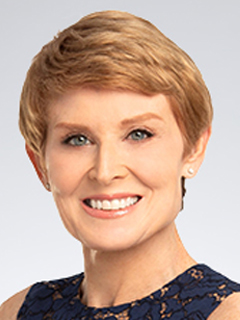
Diane Swonk
KPMG Chief Economist
Explore more



Subscribe to insights from KPMG Economics
KPMG Economics distributes a wide selection of insight and analysis to help businesses make informed decisions.
Meet our team