Decoding the emotional blueprint: How human factors drive technology adoption
Explore how human emotions and perceptions shape technology adoption, trust, and control in our digital world. Learn key consumer insights.

As we navigate through an increasingly digital world, the intersection of technology and human emotion plays a pivotal role in the adoption of new innovations. Dystopian narratives like "The Terminator" (1984), "I, Robot" (2004), "Blade Runner 2049" (2017), and television shows like “Black Mirror” have significantly shaped public perceptions, instilling a collective fear and suspicion towards advanced technology. These fictional narratives frequently cast technology as a potential menace, triggering real-world responses such as a friend who turns off their microphone during confidential conversations, a colleague who shuns new software out of fear of becoming obsolete, or a sports enthusiast who refrains from sharing health data with apps. These behaviors reflect deep-seated fears impacting technology adoption.
Technology is more than just a tool or ancillary product—it’s something that is deeply integrated into the fabric of our daily lives and, in some cases, becomes a reflection or an extension of our sense of self. From the way we communicate and work to how we manage our health, technology amplifies the unique characteristics that make consumers human; however, not all technologies find their way into our routines with the same ease. Some are embraced quickly, while others face reluctance or even rejection. This variation can be attributed to how technology triggers an emotional reaction, plays off a preconceived notion or perception, and meets (or fails to meet) a core need. KPMG Ignition conducted a set of surveys in September and October of 2025 seeking to understand this crucial interplay driving consumer acceptance.
Consumers rely upon, but don’t trust, technology
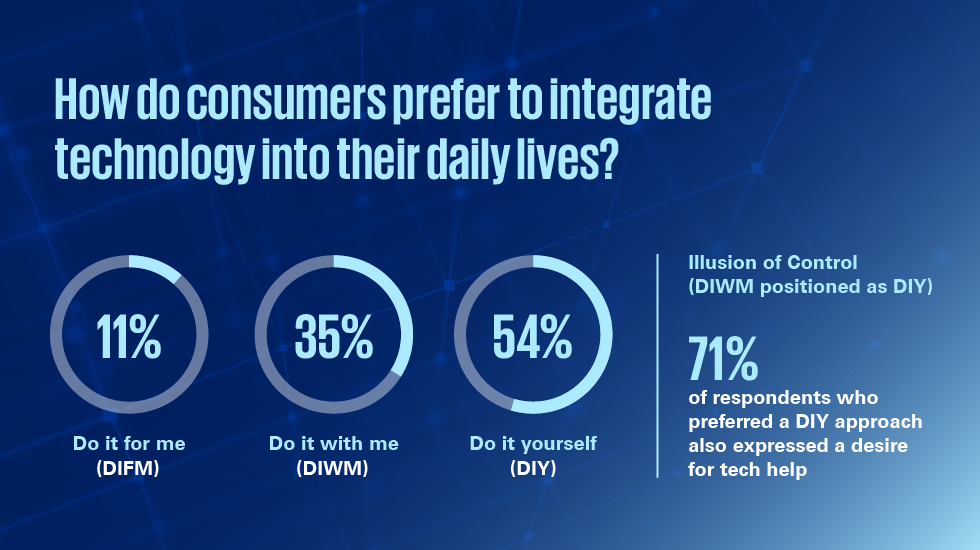
While reliance on technology grows, trust does not necessarily follow: only 11 percent of consumers trust technology to make decisions for them, even if it improves their efficiency and accuracy.1 Similarly, “how safe and secure a technology is” is the most important factor when using a technology.
This lack of trust extends to concerns over control, with many consumers fearing a loss of autonomy over their data and decision-making processes and, by extension, their lives in general.
As consumers integrate, by default or choice, technology into their day-to-day lives, we’ve observed three distinct attitudes. The largest group, comprising 54 percent of consumers, prefers a Do It Yourself (DIY) approach, valuing full control over their technology use and expressing a desire for customization and manual management. The second group, 35 percent of consumers, opts for a Do It with Me (DIWM) approach, seeking a balance by using technology that allows for personal intervention while enjoying some level of automation. The final, smaller segment of 11 percent embraces the Do It for Me (DIFM) model, favoring complete technological autonomy for maximum convenience and efficiency.
For businesses, understanding these preferences and the specific adoption styles of their target consumer is crucial. This knowledge not only guides the development and customization of products but also shapes effective marketing strategies and service offerings, ensuring that technology solutions are aligned with consumer expectations and comfort levels regarding control.
The control factor and making it matter
The relationship between preference and behavior is complicated by a "say-do gap," where a consumer's perception of control can be more influential than the reality of it. While 46 percent of consumers state they are more likely to adopt technology that grants them control, their actions often tell a different story. This gap is most evident in the self-identified "Do It Yourself" (DIY) group. Although 54 percent of consumers place themselves in this category, preferring no technological assistance, nearly three-quarters of them chose a "Do It with Me" (DIWM) approach when presented with specific daily scenarios.1 This suggests that even when consumers conceptually resist automation, the practical value offered by technology can easily tip the scales toward adoption.
What are these drivers that add value? Even when consumers identify as preferring less assistance from technology, the scales tip toward automation and greater trust in technology when high-value needs are met.1 These needs can be considered across six pivotal life domains: Growth, Efficiency, Social Connectivity, Health and Wellness, Security, and Leisure. Each category reflects a core area in a consumer’s life that technology can enhance.

Technologies that promote personal and professional development, such as AI-driven educational tools and skills assessments, are quickly integrated into daily routines.

Tools that streamline everyday tasks and decision-making processes, from smart home devices to AI in resource management, resonate well with consumers looking to optimize time.

Digital solutions that enhance communication and foster community building, like social media platforms and collaborative tools, strengthen social bonds.

Health-focused technologies that monitor and promote physical and mental health are becoming indispensable, especially those that offer personalized insights.

Technologies that ensure security and stability, including those offering financial advice and risk management, provide peace of mind and are valued for their protective qualities.

Technologies that focus on enhancing recreational activities, hobbies, and leisure planning enrich free time and promote personal satisfaction.
Direct benefits to any of these core needs can motivate consumers to relinquish some level of control. For instance, 55 percent of consumers were open to using technology that shares their data in exchange for personalized apparel shopping recommendations. Additionally, a study by the Journal of Medicine shows that users of health and fitness apps are willing to share personal data and give up some privacy control in return for personalized health insights and recommendations.2
We see there is a balance in the level of ownership consumers are willing to give up and the benefits they receive from it. By understanding and addressing these core consumer needs, businesses can enhance the relevance and appeal of their technologies, creating more targeted and effective solutions that resonate with their audience, ultimately driving higher adoption rates and fostering customer loyalty. The way they frame technology, empower users, choose vocabulary, and manage exposure are all critical elements in triggering adoption.
What drives control
The perception of control is a dynamic construct. Studies in brand adoption demonstrate that people who feel low control over different aspects of their lives prefer a brand that acts as a helper (DIWM) rather than a provider (DIFM)3—an observation that is immediately applicable to technology adoption. But first, where does this feeling of low control come from? Stakes, sense of self or identity, and perceived intimacy emerge as the driving forces that guide the lever of empowerment consumers seek with their technology:
- Stakes: Areas that demonstrate a level of complexity, fragility, or risk in the lives of consumers, such as health or finance, sway many to prefer DIWM. On the other hand, stability lends itself to less independent decision-making. Areas such as grocery shopping and regular errands have less complexity, enabling a willingness to cede more control and allow for automation and DIFM.1
- Identity: A study by MIT shows that delegating activities to smart products is especially undesirable for tasks that are core to one’s self-expression. Car enthusiasts don’t want self-driving cars. Fashion enthusiasts don’t want algorithms buying clothes for them.4
- Intimacy: When technology feels intimate and ever present, such as the relationship many hold with their cell phones or a beloved app, we give more of our attention to them and, over time, afford them greater trust. With increased trust comes a willingness to relinquish oversight; for example, people might be comfortable with personal mobile apps tracking data and usage, but might be suspicious when work applications or a less familiar technology product requests the same access.1
So, what does the interplay of these factors mean? Understanding where stakes, identity, and intimacy lie for consumers offers insight into a pathway for adoption. For companies, positioning technologies in high stakes and intimate categories as aides and enabling the consumer as the one responsible for or in control of positive outcomes will enable a greater sense of trust and adoption.
The deal with demographics
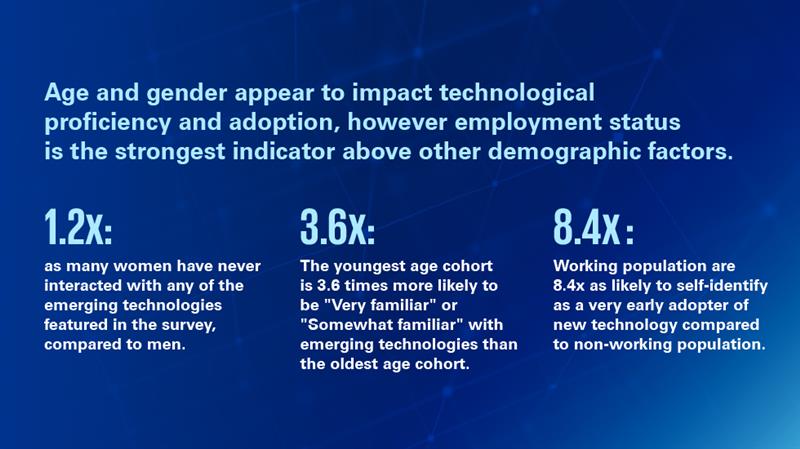
In addition to the individual’s perceptions, the value placed on the technology, and the role of emotions and selfhood, demographic factors also play a crucial role in technology adoption.
Age and gender significantly influence individuals’ desires for control over technology. According to our study, as age increases, familiarity with emerging technologies tends to decrease. Younger individuals are generally more receptive to new technologies and less concerned about privacy and control compared to older adults. Furthermore, there are noticeable differences in technology adoption and control preferences between men and women. Our survey found that 23 percent of women, versus 16 percent of men, have never interacted with any of the emerging technologies featured in the survey. Overall, men are generally more willing to adopt new technologies and relinquish control for perceived benefits, whereas women tend to be more cautious and place a higher value on maintaining control.1
Interestingly, employment status emerges as a more significant demographic factor for adopting emerging technologies, compared to age or gender. Employed individuals are more likely to adopt and trust new technologies. Their regular interaction with technology in the workplace diminishes their need for control as they experience firsthand the tangible benefits over time.
Flipping the script: When our work experiences become our expectations

Historically, the adoption of new technologies often began in resource-rich environments such as government sectors and large corporations, gradually trickling down to the public as these innovations became more affordable and user-friendly. With the rise of the internet in the 1990s, consumer markets began adopting new technologies directly, often independently of and even before the workplace embraced them. However, in today’s sophisticated technological landscape—where advanced systems like generative AI are costly, complex, and, to some, creepy—workplaces are re-emerging as crucial hubs for technological adoption. For decision-makers, this underscores the importance of leveraging workplace environments to foster familiarity and trust in new technologies, effectively bridging the gap between advanced technological capabilities and broad consumer accessibility.
The workplace environment provides valuable lessons in both enhancing benefits and reducing barriers to technology adoption. Workplaces link technology adoption to tangible rewards, such as promotions and professional growth opportunities, which could be mirrored in consumer technology by developing loyalty programs or gamified rewards that offer tangible benefits such as discounts or exclusive features. They also improve efficiency, emphasizing and promoting specific time-saving features of technology products to enhance lifestyles by freeing up time for personal activities. On the barrier side, workplaces often absorb the high costs of new technology, which could be replicated in the consumer sector through flexible pricing models such as subscriptions or financing options. Security concerns are mitigated by the endorsement of technology by reputable employers, a strategy that can be adapted by establishing robust security measures and privacy protections in consumer products. Additionally, workplaces manage the lack-of-training barrier by sponsoring training sessions, a strategy that can be adopted for consumer technology by offering comprehensive online tutorials, user guides, and customer support.
For decision-makers, leveraging these insights from workplace environments can be instrumental in bridging the gap between advanced technological capabilities and broad consumer accessibility. By applying strategies that workplaces use to streamline and accelerate technology integration, the integration of cutting-edge technologies into everyday use is enhanced, maximizing both adoption rates and operational efficiencies. These efforts will ensure that as technology evolves, it remains accessible, trusted, and beneficial to a broad and diverse consumer base.
Final thoughts
The journey of technology adoption is intricately linked to consumer emotions, particularly their desire for control. Technological advancements hold the promise of enhanced efficiency and improved quality of life, but their widespread acceptance hinges crucially on how well they resonate with consumer perceptions and emotional needs. For decision-makers, this necessitates a focused strategy that empowers the consumer through thoughtful design and empathetic tactics that build trust and cultivate the feeling of partnership between human and technology. By prioritizing these psychological aspects and ensuring technologies are transparent, user-friendly, and adaptable, businesses can effectively overcome resistance to adoption. This strategic approach not only promotes acceptance but also transforms potential user apprehension into enthusiasm, positioning technology as a trusted partner in progress rather than a perceived threat. For leaders, it is essential to integrate these insights into their deployment models, especially by learning from workplace adoption patterns that minimize barriers and maximize the benefits of new technologies, ensuring smoother transitions and greater alignment with user expectations.
About the research
KPMG Ignition employed a data-driven approach to develop insight related to technology sentiment, use, and adoption. The hypotheses guided the design of a comprehensive survey conducted in September of 2025 (n = 1,000) and a follow up survey in October 2025 (n = 1,019), targeting a randomized nationally distributed sample of adults in the United States.
The survey included both quantitative measures and open-ended questions on participants' experiences with various existing and emerging technology. The follow up survey explored nuances between the answers of the original survey.
Sources:
- KPMG Ignition Technology Adoption Tracker Survey, October, 2025
- ResearchGate, "Fitness Tracker Information and Privacy Management: Empirical Study," November, 2021
- Knowledge at Wharton, "How Control Impacts Brands," September, 2014
- MIT Sloane Management Review, “Smart Product Breakthroughs Depend on Customer Control,” February, 2023
Meet our team