Quantum Sensing for healthcare and life sciences
Exploring how advanced sensing enables earlier disease detection, improved imaging fidelity, and more precise, real-time patient monitoring.
Learn moreHelping leaders navigate what’s real today, what’s next, and how to prepare with confidence.
Quantum technologies are moving from theory to early, measurable impact. While fully fault-tolerant quantum computers remain a longer-term horizon, advancements in post-quantum cryptography (PQC), quantum optimization, and quantum sensing are already shaping enterprise decision-making today.
KPMG Quantum brings together our latest thought leadership, research collaborations, and service offerings to help organizations understand what matters now, what’s coming next, and how to prepare in a way that is practical, risk-aware, and outcome-focused.
"We are at a critical inflection point where rapid quantum computing advancements, fueled by governments, VCs, and startups, are accelerating the arrival of the quantum era. This rapid progress poses an immediate and profound risk to current encryption standards. Consequently, navigating the transition to Post-Quantum Cryptography (PQC) is no longer a distant concern; it is an urgent business imperative that organizations must address today."
Richard Entrup
Managing Director, Enterprise Innovation & Head of Emerging Solutions, KPMG
A clear view of the quantum landscape:
Separating near-term action from long-term potential
Quantum is not one technology—and it is not one timeline.
KPMG’s perspective on quantum is grounded in realism. The quantum landscape spans multiple domains and modalities, each maturing at a different pace and requiring a different response from business and technology leaders:
Understanding these differences is essential to making informed investments and avoiding both hype and inaction.
as a near-term, enterprise-wide security and compliance priority.
leveraging hybrid quantum-classical approaches to deliver early performance gains for complex, high-dimensional problems.
creating new data streams and enabling novel commercial applications across industries.
| PQC readiness assessments and quantum exposure analysis |
| Development of regulator-aligned PQC roadmaps and migration plans |
| Risk, regulatory, and governance alignment |
| Quantum strategy and targeted use-case identification |
| Hybrid quantum-classical experimentation and proofs of value |
| Capability building through discovery sessions and executive education |
Our approach emphasizes realistic timelines, measurable outcomes, and alignment with existing enterprise architectures—helping organizations move from awareness to structured, compliant execution.
Be among the first to explore KPMG’s automated approach to Post-Quantum Cryptography risk assessment.
"With regulatory deadlines like CNSA 2.0 and NIS2 already in motion, organizations know they need to act — but many don't know where to begin. Q-Prep Rapid Assessment gives security leaders a clear starting point for their post-quantum journey, combining AI-driven analysis with deep cryptographic expertise to cut through the complexity and turn uncertainty into a prioritized action plan."
Mick McGarry
US Offering Leader, Cybersecurity Protection Services
Helping organizations assess exposure, meet regulatory expectations, and execute PQC transformation
Post-quantum cryptography (PQC) is no longer optional. It is a planning, security, and compliance requirement. Quantum computing introduces the “harvest now, decrypt later” threat, where adversaries collect encrypted data today with the intent to decrypt it in the future. For organizations with long-lived data, critical infrastructure, or regulatory exposure, the window to act is already open.
This urgency is increasingly reinforced by regulators and policymakers. In the U.S., the Quantum Computing Cybersecurity Preparedness Act requires agencies to inventory quantum-vulnerable systems and define transition timelines, while financial regulators are signaling expectations for crypto agility, formal migration planning, and executive accountability. PQC has moved from a technical consideration to a mandated enterprise transformation.
Organizations must now address several foundational realities:
Move from awareness to execution with a structured approach to assessing risk, planning migration, and securing your organization for the quantum era.
"Every organization I talk to knows quantum security is coming — what they don't know is where they stand today. That's where we start. A cryptographic inventory, a clear picture of your exposure, and a roadmap that fits your timeline and your budget. Quantum security doesn't have to be overwhelming. It just has to start."
Dr. Lekshmy Sankar
Head of Quantum Security, KPMG US
KPMG’s Quantum Research is grounded in one principle: translating advanced quantum capabilities into measurable business outcomes. Through collaboration with leading technology providers, academic institutions, and innovation ecosystems, KPMG advances applied research that connects technical innovation to enterprise use. Central to this approach is its partnership with the Chicago Quantum Exchange, where KPMG works alongside universities, national labs, and industry partners to develop enterprise use cases, build workforce capabilities, and accelerate responsible adoption of quantum technologies across sectors including finance, healthcare, energy, and cybersecurity.
As enterprise technology investments increasingly concentrate around AI, organizations are encountering real constraints—rising compute costs, energy demands, and diminishing performance gains as models scale. KPMG’s research focuses on how quantum techniques can complement—not replace—classical systems by addressing complex optimization and machine learning problems that strain traditional architectures.
Collaborative research initiatives, including work with IBM and Kipu Quantum, demonstrate that hybrid quantum–classical approaches can already deliver measurable gains on real-world problems. These models extend existing AI capabilities—enhancing, not replacing, classical methods—to improve prediction accuracy and decision-making in high-complexity environments.
What the research indicates:
Together, these insights position quantum optimization as a pragmatic extension of enterprise AI strategy—focused on targeted, high-value use cases rather than wholesale system replacement. KPMG’s research portfolio reflects this approach, combining ecosystem collaboration with applied experimentation to help organizations move from exploration to informed adoption.

Quantum sensing leverages quantum mechanics to measure time, motion, gravity, and magnetic fields with unprecedented precision. Unlike quantum computing, many sensing applications are already moving into real-world deployment—enabling new forms of data that were previously inaccessible and creating immediate downstream value across industries.
Emerging applications include telecommunications and satellite systems (enhanced positioning, navigation, and timing), healthcare and life sciences (high-resolution imaging and monitoring), and infrastructure and energy (subsurface mapping and asset integrity analysis). These capabilities generate high-fidelity data streams that enhance analytics, improve decision-making, and strengthen operational resilience.
Exploring how advanced sensing enables earlier disease detection, improved imaging fidelity, and more precise, real-time patient monitoring.
Learn moreHighlighting next-generation PNT capabilities and network resilience—supporting more accurate synchronization, secure communications, and critical infrastructure reliability.
Learn moreExamining how subsurface mapping, environmental monitoring, and asset integrity analysis can improve operational visibility and risk management across energy and infrastructure systems.
Learn moreKPMG Quantum Research brings together original research and external collaboration to explore how emerging quantum capabilities translate into real-world impact. Combining KPMG-authored work with contributions from leading academic and research institutions, this body of work showcases foundational developments shaping enterprise risk, security, and computational strategy. From translating theoretical breakthroughs into practical implications to examining new approaches to quantum algorithms and performance, these research efforts provide a deeper, technically grounded perspective on what quantum means for organizations today—and what lies ahead. Additional research contributions will continue to expand this body of work.
Ready to move from theory to measurable results?
Access the full PDF to review the study and results demonstrating how quantum enhanced machine learning is delivering measurable performance gains on real hardware today.
Proven performance gains, grounded in real hardware
Access the full study, “Quantum‑enhanced satellite image classification,” to explore the methodology, results, and analysis demonstrating how quantum‑enhanced machine learning delivers measurable accuracy improvements on real hardware today.
"Quantum preparedness starts now. The game-changing implications of quantum computing are pushing this fast-emerging technology into the spotlight… from eventually cracking today’s data encryption protocols to providing exponentially greater computing power.”
Dr. Aaron Kemp
US Quantum Leader, KPMG US
Featured quantum insights
Action-oriented thinking for emerging quantum capabilities
Enterprise-focused perspectives to help organizations understand quantum impact and prepare for what’s next.
KPMG Quantum Insights brings together research and perspectives on how quantum computing is reshaping risk, security, and enterprise strategy. Grounded in applied research and real-world experience, this collection helps organizations understand both the opportunities and urgent challenges as quantum capabilities advance.
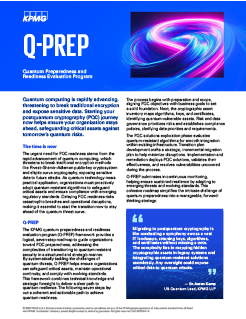
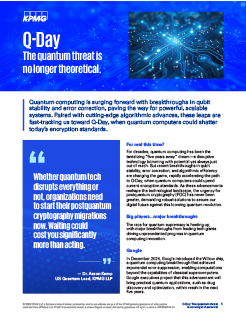
The collection provides practical guidance through frameworks such as KPMG’s Quantum Preparedness and Readiness Evaluation Program (Q-PREP), helping organizations identify vulnerabilities, prioritize risk, and execute phased transitions. From the path toward “Q-Day” to shifting security standards, these insights highlight why quantum readiness is a present-day priority—while also addressing broader implications across data privacy, compliance, and industry transformation.

Explore the featured insights below to understand how quantum is impacting security, data, and operations—and what actions your organization can take now.
Q-PREP
Quantum Preparedness and Readiness Evaluation Program.
Q-Day
The quantum threat is no longer theoretical.
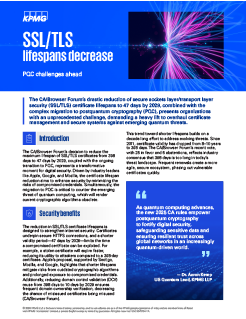
SSL/TLS lifespans decrease
PQC challenges ahead.
Quantum computing
Preparing for thefuture
Quantum computing and data privacy
What your privacy team needs to know now
Quantum sensing in pharma
Accelerating drug discovery and precision medicine
Quantum sensing in action
Elevating positioning, timing, and communication networks
Revolutionizing telecommunications
How satellite technologies are enhanced by quantum sensing
KPMG Quantum and Enterprise Innovation events are designed to move the conversation on quantum technologies from theory to enterprise action. Through curated forums, executive sessions, and global industry engagements, KPMG convenes clients, technologists, academics, and ecosystem partners to focus on what organizations can do now as quantum capabilities begin to intersect with real business risk and opportunity.

Flagship programs such as the 2026 KPMG Quantum Consortium bring together industry leaders, researchers, and clients to address both risk and opportunity—spanning post-quantum cryptography, ecosystem exposure, and emerging enterprise use cases with a clear focus on practical application. This approach extends to targeted executive forums like the Post Quantum Readiness Forum in Chicago, where leaders align on immediate priorities including PQC migration, cryptographic risk, and enterprise readiness. KPMG’s quantum programming also spans broader platforms such as the 2026 Tech and Innovation Symposium and global forums like Quantum Tech World in Boston, connecting enterprise, government, and research leaders around real-world deployment and ecosystem collaboration.


A defining characteristic of KPMG’s quantum programming is its outcome-oriented approach. Sessions are structured to support decision-making—helping leaders understand where quantum drives tangible impact today, how to sequence investments, and how to embed quantum into broader technology, risk, and transformation strategies.

The goal is not exploration for its own sake, but informed execution—equipping organizations to move from experimentation to readiness as quantum technologies mature.
A must-attend event for forward-thinking leaders
The people shaping the future of technology
Stay informed on the evolving quantum landscape through our quantum webcast series, featuring executive discussions on emerging risks, security implications, and enterprise readiness.ur latest thinking on how to realize the many benefits of integrating Quantum optimization and AI across your enterprise.
Explore KPMG POVs and reports for practical guidance on how quantum technologies are shaping enterprise risk, security, and strategy—and what organizations can do now to prepare.
Organizations that act early—by understanding exposure, experimenting responsibly, and building internal capability—will be better positioned as quantum technologies mature.
Connect with our KPMG Quantum Research team to explore how quantum optimization and PQC readiness apply to your organization.
The newly formed KPMG Quantum Research group focuses on translating cutting edge quantum science into operational, enterprise ready AI capabilities. The team works at the intersection of quantum computing, AI, and business transformation—advancing practical applications that deliver measurable value today while preparing organizations for future quantum advantage. The group is led by Dr. Aaron Kemp, Senior Director, Quantum Research, and Richard Entrup, Managing Director and Head of Emerging Solutions. Together, they bring deep expertise in quantum technologies, enterprise innovation, and go to market strategy, with a shared focus on turning research breakthroughs into scalable, real world solutions.