
KPMG Regulatory Insights
- Ripple Effect: Mainstream adoption of digital assets/cryptocurrencies has prompted an increase in new entrants to the banking sector and related de novo charter applications.
- Rising Alternatives: Focus on innovation and “open-mindedness” may give rise to expanded use and types of novel charters to meet strategic objectives (e.g., managing cost of funds, offering new product lines).
- Reality Check: Federal Reserve consideration of "skinny" master account signals an effort to adapt to market shifts associated with non-traditional charter types and/or business models.
- “Revolutionary Road”: Forthcoming regulations for payment stablecoins will introduce changes that may reshape traditional banking, including disruption to deposits, payment processes (including cross-border), lending activity, and fee income, along with potential for legal challenge.
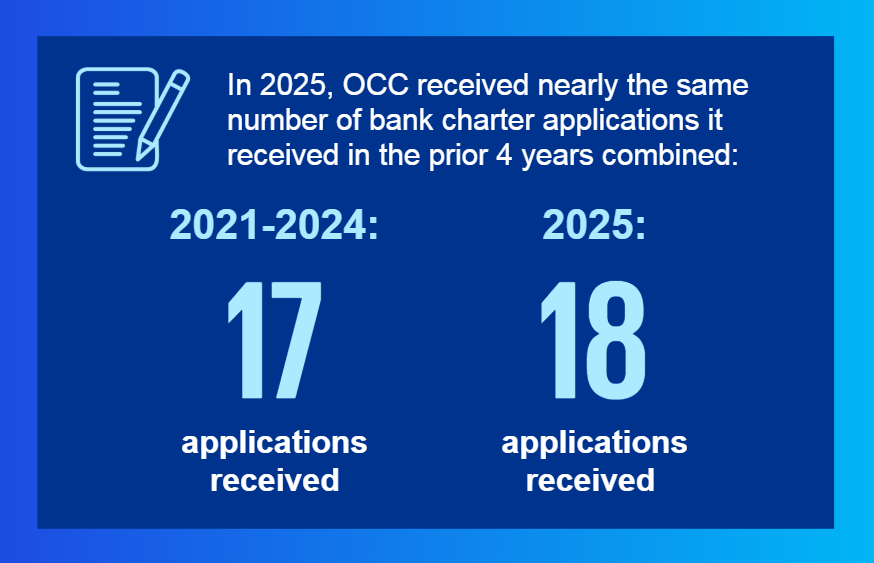
Throughout 2025 regulatory agency leadership has championed competition and innovation within the banking industry with particular interest in new entrants. In public statements they encourage new charter applications with discussions of/plans for faster reviews, streamlined processes, and an “open-minded” approach.
Momentum is building, driven in part by the proliferation of fintechs and the greater acceptance of digital assets, as well as operational strategies (e.g., lower cost of funds, decoupling from partner banks, access to payment rails, transition from state to national charter). Activity will likely be pushed further by rulemakings facilitating payment stablecoins and potential legislation to establish a federal framework for cryptocurrencies.
Bank charters give license to depository institutions and certain other financial institutions to provide bank-like products and services, such as accepting deposits, making loans, and safeguarding assets. Such charters may be obtained at the federal or state level and cover “full service” banking activities or be limited in purpose to allow only a subset of financial services. The type of charter obtained determines the regulatory framework under which a financial depository institution operates (see Appendix).
The number and types of companies seeking bank charters is increasing with a non-trivial number seeking access to more limited/special purpose activities.
Recent activity at the federal level includes:
1

OCC Chartering Activity
2

FDIC Insurance Application Activity (ILCs)
3

Related Developments
(including the GENIUS Act, FRB Master Accounts, NCUA Charters)
Dive into our thinking:
Explore more

Get the latest from KPMG Regulatory Insights
KPMG Regulatory Insights is the thought leader hub for timely insight on risk and regulatory developments.
Meet our team