FS Fast 5: Outsmarting AI in financial crimes
Key insights to move your financial crimes agenda forward in financial services.
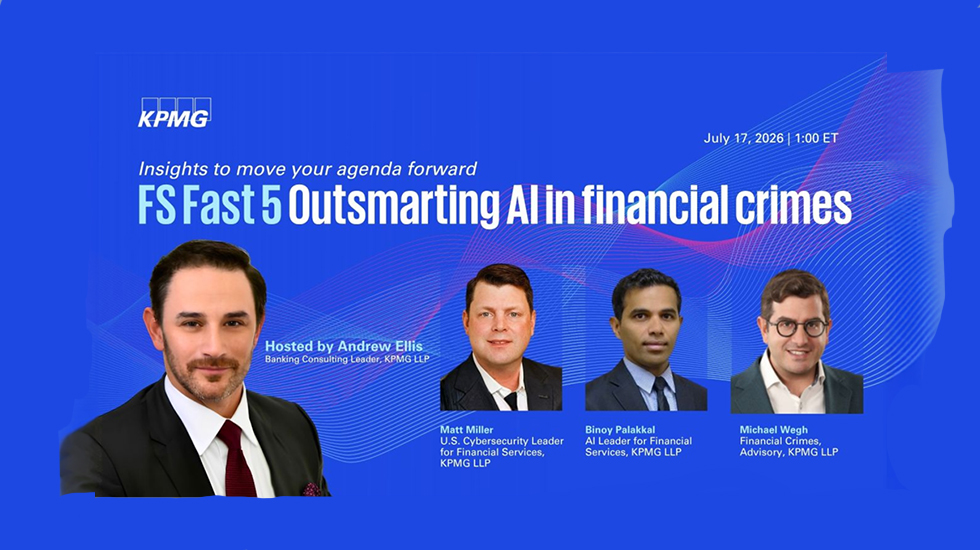
A New Era of Financial Crime
Financial crime has entered a fundamentally new phase defined by the industrial-scale deployment of AI as an offensive weapon. Deepfakes now target call centers, C-suite executives, and hiring pipelines alike while autonomous agents decompose illicit transactions into thousands of micro-movements across digital asset networks, circumventing the monitoring controls institutions have spent years building.
The same generative and agentic AI capabilities fueling criminal innovation are now available to institutions at scale. The question is no longer whether AI will reshape financial crime compliance — it is whether your organization will deploy it with the speed, discipline, and human judgment required to stay ahead.

The typologies being exploited three weeks ago may already have been superseded by more advanced variants and static defenses can no longer keep pace.
Key themes: What the discussion covered
1

Deepfakes as an enterprise-grade threat
Deepfake technology, originally developed for legitimate creative purposes, is now being systematically re-leveraged to breach call centers, impersonate CFOs in wire transfer schemes, gain unauthorized system access, and infiltrate organizations through recruitment fraud. What was once experimental is now operationally scaled.
“It only takes a few seconds of voice to be able to create a deepfake of it.”
-Matthew P. Miller US Cybersecurity Leader for Financial Services, KPMG LLP
2

Agentic AI: The next crime vector
Autonomous AI agents are being deployed to break large illicit transactions into micro-movements across blockchains and digital asset networks—effectively automating the structuring of financial crime at a scale that defeats conventional transaction monitoring. Organizations must now think in terms of behavioral policing, not just credential verification.
3

Fighting AI with AI: The defense imperative
Institutions are beginning to deploy GenAI as a sparring partner, building red-team environments, running continuous vulnerability scanning, and using tools like Mythos to identify and chain attack vectors before adversaries can exploit them. The goal is not just reactive detection, but proactive resilience.
4

Synthetic data and model integrity
Training AI financial crime models requires synthetic data environments that faithfully replicate real-world transaction patterns, not simplified subsets that fail to reflect how crime actually propagates. Getting this wrong means deploying models tuned to a caricature of the threat, not the threat itself.
5

Convergence of cyber and financial crime
One of the most consequential shifts underway is the maturation of the connectivity between cybersecurity and traditional financial crime functions. As deepfake-enabled fraud attacks both the technical layer and the identity layer simultaneously, siloed organizational structures are no longer sufficient.
6

Agentic KYC: Efficiency at scale
Financial institutions are now deploying agentic capabilities to automate KYC workflows, using LLMs to read and synthesize unstructured policy documents and complete due diligence in a fraction of the time previously required. Speed and accuracy are no longer at odds.
“Trying to use agents to actually beat agents is the new thing in KYC.”
-Binoy Palakkal AI Leader for Financial Services, KPMG LLP
FS Fast 5 to move your agenda forward
Five focused takeaways drawn directly from the live discussion—distilled to help financial services leaders act with greater speed, precision, and confidence.
01
Offense wins games. Defense wins championships.
Match their agility—or fall behind.
02
AI is your ultimate sparring partner.
Use GenAI to stress-test defenses before adversaries do.
03
The next threat vector is “Agentic.”
Crime evolves from credential theft to behavioral fraud.
04
AI augments intuition. It doesn’t replace it.
Human judgment grows rarer and more valuable.
05
Trust is the ultimate currency.
In a deepfake era, identity verification is everything.
FS Fast 5 Replay Hub
Explore the series' episodes for strategic insights to help you stay ahead of industry change in financial services.
Subscribe to receive the latest from KPMG Forensic
Helping organizations in their efforts to achieve the highest level of integrity and to manage the cost and risk of litigation, investigations, and regulatory enforcement actions.


Meet our team
Strengthen your defenses and stay ahead of evolving threats. Learn more from KPMG LLP.