The rural health data imperative
Moving from fragmented care to a connected healthcare ecosystem

A generational shift in rural healthcare
The Rural Health Transformation Program (RHTP) represents a rare opportunity to reshape how rural healthcare is funded, delivered, and sustained. With $50 billion invested over five years, the program is not just an infusion of capital—it is a mandate for transformation.
At its core, this transformation is not about buildings, beds, or even workforce alone. It is about data.
The success of rural health transformation will ultimately depend on whether states and providers can build a modern, integrated data infrastructure that turns fragmented information into actionable insight—and insight into better outcomes.
The mandate: Data at the core of rural health transformation
The Centers for Medicare & Medicaid Services (CMS) has made clear that technology, interoperability, and data-sharing are central to the program’s design. Investments are designed to:

Improve data sharing and interoperability

Enable real-time care coordination

Support technology-enabled care models, including telehealth and AI

Strengthen cybersecurity and digital infrastructure
This signals a fundamental shift: data is no longer a supporting function—it is the foundation of rural health transformation.
Expanding the scope: real-world data requirements
Research indicates that an estimated 20 percent of health outcomes are linked to clinical care; the remaining 80 percent stem from social, economic, environmental, and behavioral factors. Because of this reality, the real-world data requirements for the RHTP go far beyond traditional clinical metrics.
To truly transform rural health, a comprehensive approach should encompass:
- Clinical outcomes
- Access to care and utilization
- Workforce capacity and sustainability
- Financial sustainability
Crucially, non-traditional data sources are becoming equally—if not more—vital, including non-medical drivers of health (NMDOH), community feedback, and economic indicators. This expanded view is critical to building a more complete and actionable understanding of rural health needs.
The opportunity: connected data ecosystems
The program creates an opportunity to move from fragmented systems to connected ecosystems.
State leaders can:
- Build integrated, statewide data platforms
- Enable cross-provider collaboration and regional networks
- Connect clinical and NMDOH
- Shift to value-based, outcomes-driven care models
- Leverage AI and predictive analytics to extend workforce capacity
A connected ecosystem enables proactive, coordinated, and data-driven care delivery across communities.
From data collection to decision intelligence
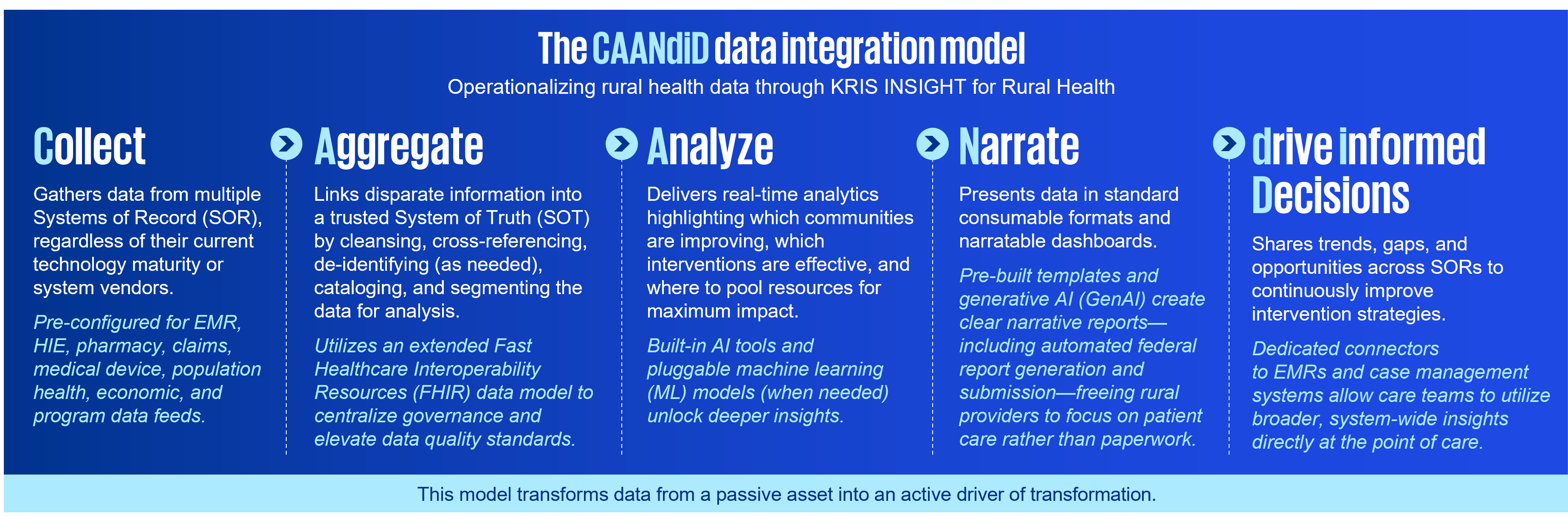
To fully realize this opportunity, states must move beyond incremental technology upgrades and build a truly integrated data foundation. By converting fragmented inputs into actionable intelligence, a comprehensive data integration model supports both real-time decision-making and federal reporting requirements. Ultimately, it provides a practical framework for shifting from isolated silos to coordinated, data-driven rural health strategies.
KPMG Resource Integration Suite (KRIS) INSIGHT for Rural Health provides a robust data integration foundation tailored for rural health initiatives. It empowers states and communities to collect a wide array of data from multiple systems of record, aggregate it into a centralized system of truth, and translate it into real-time analytics and standardized reporting. By supporting interoperability, advanced analytics, and federal reporting requirements within a single platform, KRIS INSIGHT reduces administrative burdens, enables data-driven decision-making, and supports program sustainability.
How KPMG can help
KPMG LLP is uniquely positioned to help states and rural health systems navigate the complex landscape. With decades of experience at the intersection of government, healthcare, and technology, we are a versatile, agile team with a tested track record in executing complex, large-scale data-driven transformations. We combine deep industry knowledge with cutting-edge, AI-enabled solutions to help drive sustainable, long-term impact for rural communities.
KRIS INSIGHT for Rural Health
A strong data integration foundation is vital for modernizing rural healthcare. KRIS INSIGHT for Rural Health is designed to power a connected ecosystem, equipping state agencies and local providers with the tools to manage, monitor, and leverage data effectively. It enables stakeholders to track data flow across disparate systems, identify gaps early, and deliver trusted reporting—shifting rural health networks from reactive compliance to proactive, data-driven insights. KRIS INSIGHT for Rural Health helps states turn fragmented information into actionable insights. By serving as a centralized engine that automates federal report generation, it lifts the heavy administrative burden of compliance. This helps rural providers meet mandated guidelines, retain vital funding, and focus on what matters most: patient care.
Designed with flexibility in mind, the KRIS INSIGHT for Rural Health is a highly scalable application that grows alongside your initiatives—from initial pilot sites to full statewide rollouts—without the need for complex system rebuilds or data migrations. It can be quickly deployed and configured to meet the specific integration and operational needs of different states and clinics. Crucially, the platform is built to support strict federal security requirements, including Health Insurance Portability and Accountability Act (HIPAA), Federal Information Processing Standards (FIPS), and Code of Federal Regulations (CFR) compliance, helping ensure sensitive health data remains protected at every level.
Data as the catalyst for transformation
The CMS RHTP is more than a funding initiative—it is a call to redesign rural healthcare for the future. But transformation will not be achieved through funding alone. It will be achieved through data—connected, trusted, and actionable.
The success of rural health transformation depends on a state’s ability to collect, interpret, and act on meaningful data. When states invest in strong data analytics infrastructure, including health information exchanges, advanced tools such as AI, and remote monitoring capabilities, rural communities gain the ability to overcome long standing barriers. These investments support better patient outcomes, greater operational efficiency, and improved financial stability. They also create the foundation for personalized and proactive care that can strengthen the health and resilience of rural populations for years to come.
The RHTP offers a rare opportunity to renew and strengthen rural healthcare. Yet the degree of its success will ultimately be determined by the strength and maturity of the data analytics systems that support it. Building integrated, intelligent, and accessible data infrastructure is not a secondary task. It is the essential engine that will drive meaningful change and help ensure that every dollar invested delivers measurable improvements in access, quality, and outcomes for the millions of people who rely on rural health systems. The question is no longer whether to invest in data. It is whether rural health systems can afford not to.
Dive into our thinking:
Explore more insights





Meet our team