

As the world accelerates its climate ambitions, global trade is entering a new chapter. With 195 signatories to the Paris Agreement, countries are setting their own emissions reduction targets — some moving faster than others. Europe, as a leader in climate action, is driving change with the European Green Deal and the landmark Carbon Border Adjustment Mechanism (CBAM).
The EU CBAM is in force — Is your business prepared?
The EU’s path to climate neutrality: The role of CBAM
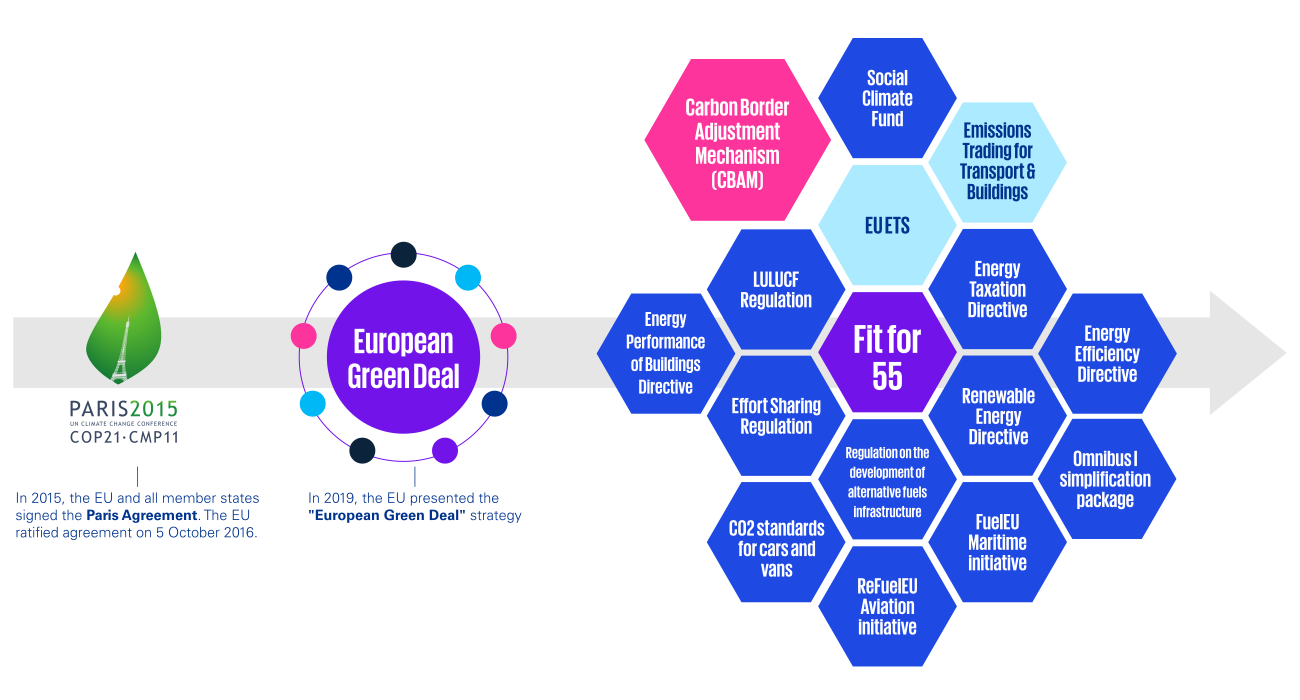
Europe’s goal to become the first climate-neutral continent by 2050 is shaping policy and regulation across industries. The European Green Deal, launched in 2019 and adopted in 2020, is a roadmap of tax and non-tax policy initiatives designed to achieve this ambitious target. It set the stage for the Fit for 55 package, which aims to cut emissions by 55 percent by 2030 compared to 1990 levels.
As part of the Fit for 55 package, the European Union (EU) is revamping its Emissions Trading System (ETS), expanding its scope, tightening the annual cap and phasing out free allowances. While these measures accelerate decarbonization, they also raise carbon prices and risk shifting production or purchases to countries and territories with weaker climate rules (carbon leakage).
To address this, the EU introduced the Carbon Border Adjustment Mechanism (CBAM). Effective since October 2023, CBAM imposes a carbon charge on certain imports, matching the cost faced by EU producers under the ETS and replacing free allowances for high-risk sectors. This levels the playing field, encourages global decarbonization, and protects EU industry from unfair competition.
Recent CBAM simplifications, officially adopted in October 2025, introduced changes such as a de minimis threshold and reduced administrative burden for businesses.
CBAM at a glance
- Effective dates: Regulation entered into force on 17 May 2023; reporting obligations began 1 October 2023. Omnibus simplifying CBAM entered into force on 20 October 2025.
- Purpose: CBAM imposes a carbon price on certain imports, aligning them with EU Emissions Trading System (ETS) charges, and encourages global decarbonization.
- Recent updates: In June 2025, EU institutions agreed on amendments to CBAM under the Omnibus I simplification package, including a de minimis threshold and measures to reduce administrative burden.
What products are affected?
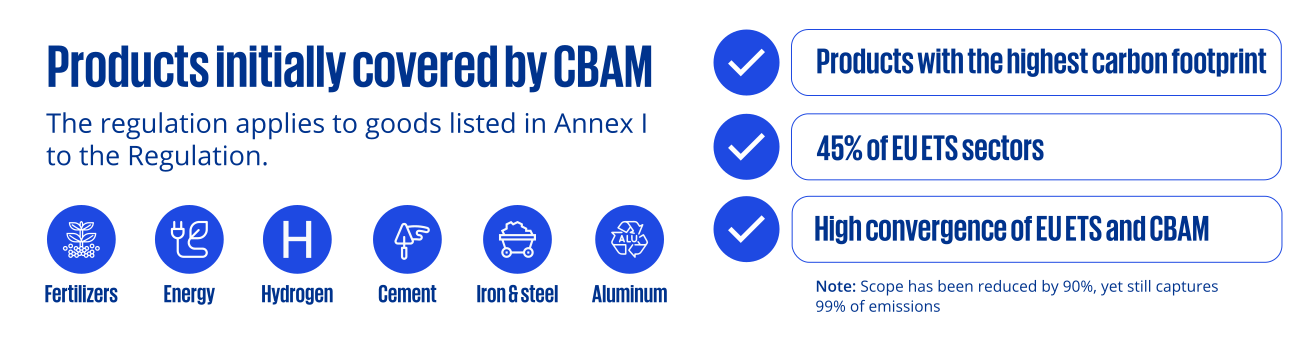
CBAM currently applies to carbon-intensive goods imported from outside the EU, including:
- Cement
- Electricity
- Fertilizers
- Aluminum
- Iron and steel
- Hydrogen
- Selected upstream and downstream iron, steel and aluminum products
Key exemptions and thresholds
Under the Omnibus simplification, importers with less than 50 tons of covered goods are exempt from CBAM, excluding 90 percent of importers while still capturing 99 percent of carbon emissions. Importers above this threshold are fully subject to CBAM unless other exemptions apply. The threshold is reviewed annually and may be adjusted to maintain the 99 percent
Key Points
- The threshold does not apply to electricity and hydrogen.
- Electricity generated within the Exclusive Economic Zone (EEZ) or continental shelf of an EU member state is now excluded from CBAM.
- Imports from countries participating in or are linked to the EU ETS (currently Iceland, Norway, Liechtenstein, Switzerland and five other territories) are excluded.
- If actual emissions data is used to determine CO2 emissions, any carbon price paid in the country of origin can be deducted from the CBAM charge. If default values are used, only the default carbon price for that country, as published by the EU Commission (starting in 2027), will be considered.
- By 2030, CBAM is expected to expand to all sectors covered by the EU ETS.
CBAM implementation timeline
Transitional phase (From 1 October 2023 to 31 December 2025)
- Importers must report direct and indirect emissions for covered goods, but no financial obligations apply during this time. This step is likely to pose challenges for many companies, as necessary IT solutions for recording and determining carbon dioxide equivalent (CO2e) emissions are often lacking.
- Quarterly CBAM reports are required, detailing imported quantities, direct and indirect embedded emissions (reporting on indirect embedded emissions is initially only for cement, electric power and fertilizer), and carbon taxes paid in the country of production.
Operational phase (From 1 January 2026)
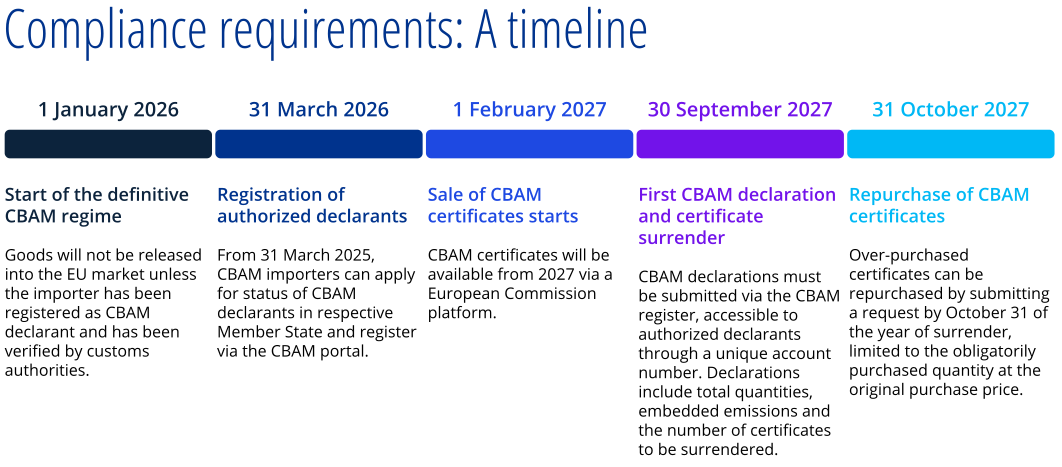
- 1 January 2026 —Start of definitive regime: CBAM obligations take effect. Importers must be or become authorized CBAM declarants to import covered goods.
- Under the Omnibus simplification, importers may continue importing after 1 January 2026 if they apply for authorization by 31 March 2026.
- 31 March 2026 — Authorization deadline: Final date to apply for authorized declarant status. After this date, only authorized declarants can release CBAM goods for free circulation.
- Throughout 2026: Importers must collect verified emissions data for CBAM goods, using actual verified values or EU default values.
- 1 February 2027 — Certificates available: The EU central platform opens for the sale of CBAM certificates, managed by the European Commission.
- 30 September 2027 — First CBAM declaration and surrender: Importers must submit the first annual CBAM declaration and surrender certificates for all 2026 imports.
- Certificates for 2026 must be purchased retroactively from 1 February 2027, priced at the average quarterly EU ETS price for 2026.
- From 2027 onward: Importers must hold certificates covering at least 50 percent of year-to-date embedded emissions at the end of each quarter.
- 31 October (annually): Deadline to request repurchase of surplus certificates — any remaining certificates are cancelled thereafter.
Key requirements:
- Calculate emissions using verified actual or EU default values.
- Verify actual data through an accredited verifier (if not using registered producer or default data).
- Purchase certificates via the EU central platform once available.
- Submit annual CBAM declaration by 30 September each year.
- Surrender certificates equal to verified embedded emissions by 30 September.
What does the CBAM mean for business?
CBAM introduces new compliance requirements and financial obligations for importers of covered goods. The transitional phase focuses on emissions reporting, while the operational phase will require the purchase and surrender of CBAM certificates. Companies must prepare for retrospective financial obligations for 2026 imports, with payments due in 2027.
Immediate actions for your business
- Understand CBAM compliance requirements and potential impact: Early and accurate collection of emissions data across supply chains is essential to assess how CBAM will affect your business and to ensure compliance with evolving regulations.
- Review global supply chain and CN (HS) codes for in-scope products: Conduct a strategic review of your sourcing, supply chain, and customs processes, focusing on identifying products subject to CBAM and evaluating the availability of necessary data.
- Prepare for reporting obligations and registration: Factor CBAM costs into budgets and forecasts now to avoid surprises, and ensure your organization is ready to meet new reporting and registration requirements.
- Engage with in-scope vendors: Collaborate closely with suppliers affected by CBAM to facilitate data sharing and compliance and monitor regulatory updates as CBAM scope and requirements expand.
Key actions for your business from 2026-2027
- Calculate embedded direct and indirect emissions: Establish robust processes for calculating the embedded emissions of imported goods, using either actual values or default values as permitted under CBAM.
- Verify actual emissions values: Where actual values are used, ensure verification is conducted by a certified test center to meet regulatory standards and support accurate reporting.
- Acquire CBAM certificates: Secure the necessary CBAM certificates from the relevant CBAM authority to cover the carbon cost of imports and maintain compliance with EU regulations.
- Prepare and file annual CBAM declarations: Develop systems to prepare and submit the annual CBAM declaration by May 31 each year, ensuring all required information is complete and accurate.
How KPMG can support your CBAM journey
Whether you’re based within the EU or trading with the EU, we encourage companies to consider their own decarbonization strategies — whether to ensure preparedness for upcoming legislation or to make operations future-ready for medium- and long-term global developments.
KPMG member firms offer integrated support to help you navigate CBAM and broader decarbonization challenges. Our multidisciplinary teams combine expertise in Climate Change, Global Trade & Customs, ESG, and Tax & Legal to deliver practical, tailored solutions.
Our services include:
- Emissions measurement, monitoring and reporting
- CBAM compliance strategy and implementation
- Renewable energy procurement and energy efficiency
- Circular economy and sustainable supply chain management
- Tax and legal advisory
- Technology solutions for data management and reporting, including our CBAM Trade Data Check
- Climate risk assessment and resilience planning
- Support for sustainable financing, capital raising and M&A
Please note that some services may not be available to KPMG audit clients and their affiliates or related entities.
Watch previous webcasts

Connect with us
- Global
- Europe
- Asia Pacific
- Americas
- Africa
- Show all


Mike Hayes
Climate Change and Decarbonization Leader, Global Head of Renewable Energy
KPMG in Ireland


Justyna Wysocka-Golec
Partner, Advisory, ESG, Decarbonization and Biodiversity Team Leader
KPMG in Poland


Ganesan Kolandevelu
Partner, Consulting, ESG Reporting Leader
KPMG in Thailand


Richard Huang
Managing Director, KPMG Carbon Resource Assurance and Advisory Services Co., Ltd.
KPMG in Taiwan

Ha Do
Head of Government and Public Sector & Head of International Development Advisory Services (IDAS), Asia Pacific
KPMG in Vietnam


Marcus Vinicius
Head of Tax, KPMG Brazil, and South America Cluster Leader, Tax & Legal*
KPMG in Brazil


Mike Hayes
Climate Change and Decarbonization Leader, Global Head of Renewable Energy
KPMG in Ireland
Justyna Wysocka-Golec
Partner, Advisory, ESG, Decarbonization and Biodiversity Team Leader
KPMG in Poland
Richard Huang
Managing Director, KPMG Carbon Resource Assurance and Advisory Services Co., Ltd.
KPMG in Taiwan
Ha Do
Head of Government and Public Sector & Head of International Development Advisory Services (IDAS), Asia Pacific
KPMG in Vietnam
Marcus Vinicius
Head of Tax, KPMG Brazil, and South America Cluster Leader, Tax & Legal*
KPMG in Brazil
1 https://treaties.un.org/Pages/ViewDetails.aspx?src=TREATY&mtdsg_no=XXVII-7-d&chapter=27&clang=_en
2 https://commission.europa.eu/strategy-and-policy/priorities-2019-2024/european-green-deal_en
3 https://ec.europa.eu/commission/presscorner/detail/en/IP_20_1599
4 https://ec.europa.eu/commission/presscorner/detail/en/IP_21_3541