Skip to navigation

      It is against a backdrop of great economic and geopolitical uncertainty that we carried out this year’s study of 68 private banks in Switzerland. The results are clear and positive: Swiss private banks are performing very well.

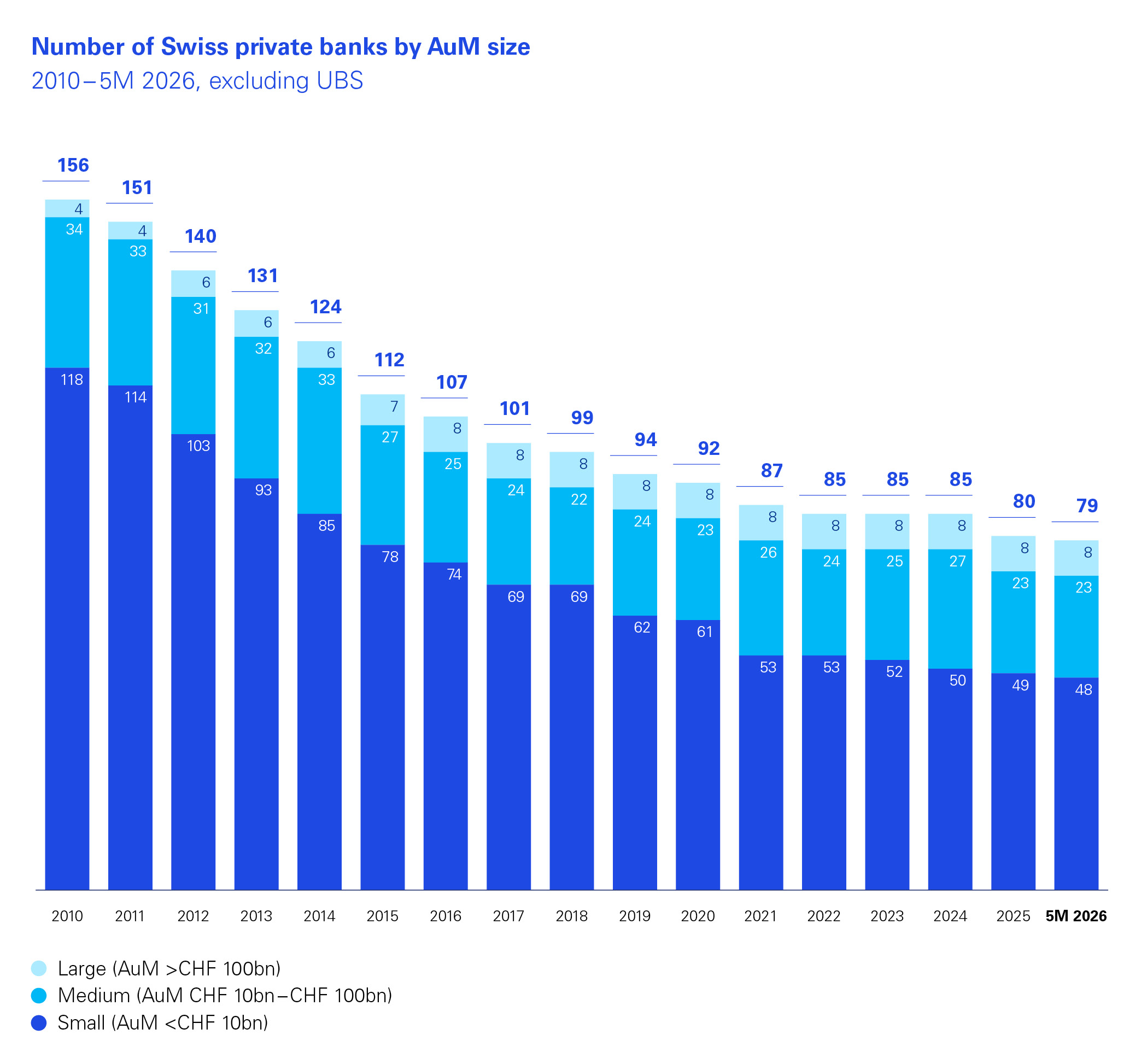
      While banks may be struggling to maintain profitability and cost-income (C/I) ratios, they achieved a significant increase in net new money (NNM) last year, and assets under management (AuM) are at a record high. Consolidation also picked up pace, as the number of banks fell to 79 in 2026 – down from 156 in 2010.

      AI is one of the hottest topics around, and we wanted to provide analysis based on fact rather than speculation. We therefore surveyed a number of private banks on their use of AI, and the HSG Institute of Management and Strategy performed a deep dive as part of this study.

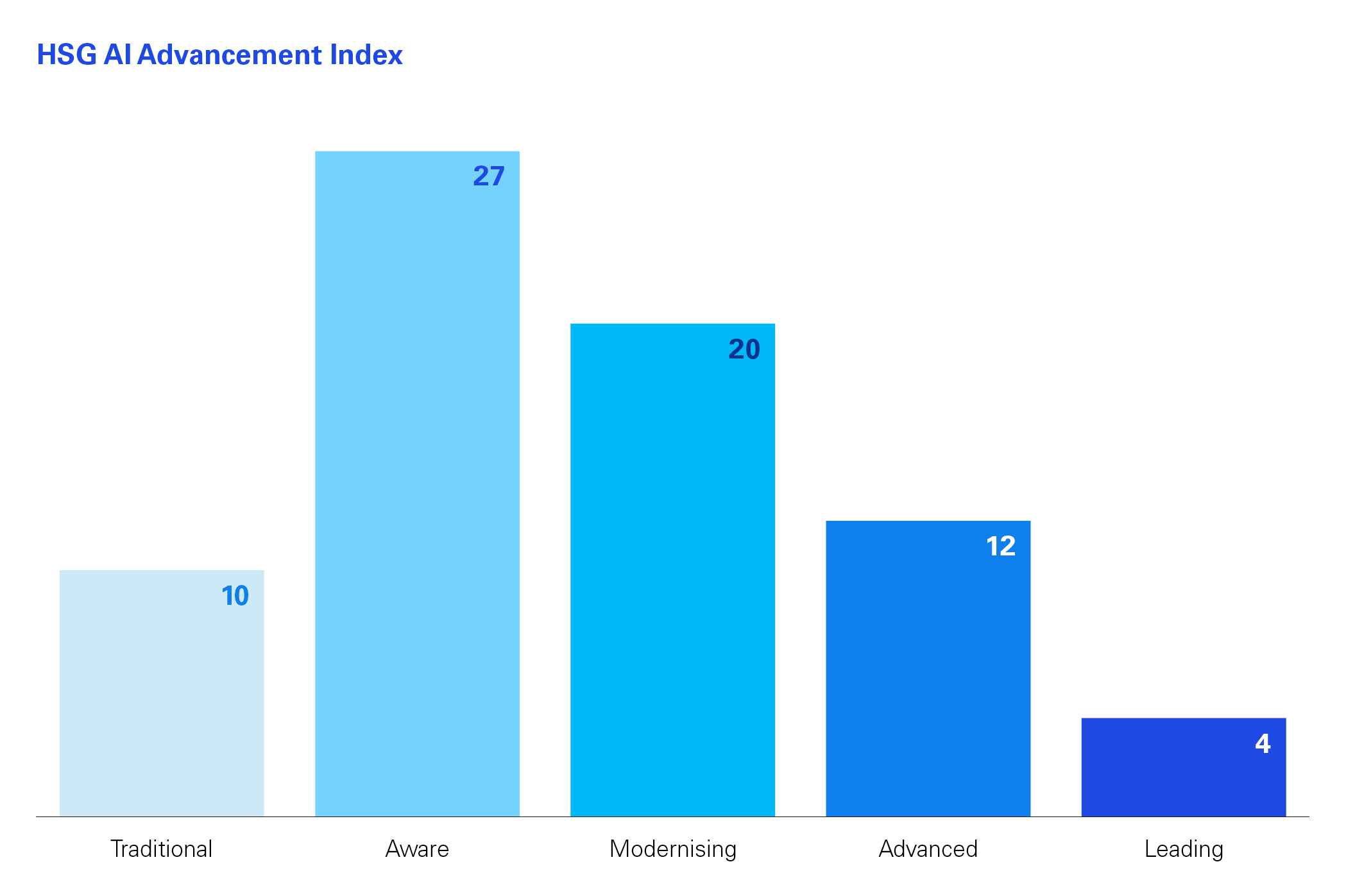
      Their new AI Advancement Index categorizes Swiss private banks based on their AI maturity and finds that only a handful are advanced or leading.

      "Private banks are performing very well despite geopolitical uncertainties and a fall in Swiss interest rates. The question is whether they may underestimate the potential offered by AI."
       

      Christian Hintermann
      Partner, Financial Services


      Clarity on Swiss Private Banks

      Clarity on Swiss Private Banks

      Key messages

      • Larger players drive consolidation as the number of banks falls below 80

        2025’s deal market delivered a number of noteworthy transactions, including the acquisitions of Banque Thaler and Cité Géstion, It also showed growing interest by foreign banks in entering the Swiss market, underlining the country’s safe haven status.

        2026 saw Safra Sarasin’s purchase of Saxo Bank close, with AuM of CHF 105bn – the largest deal since 2013. Overall, it is the larger banks that are driving an uptick in consolidation.

      • NNM helps fuel record high AuM

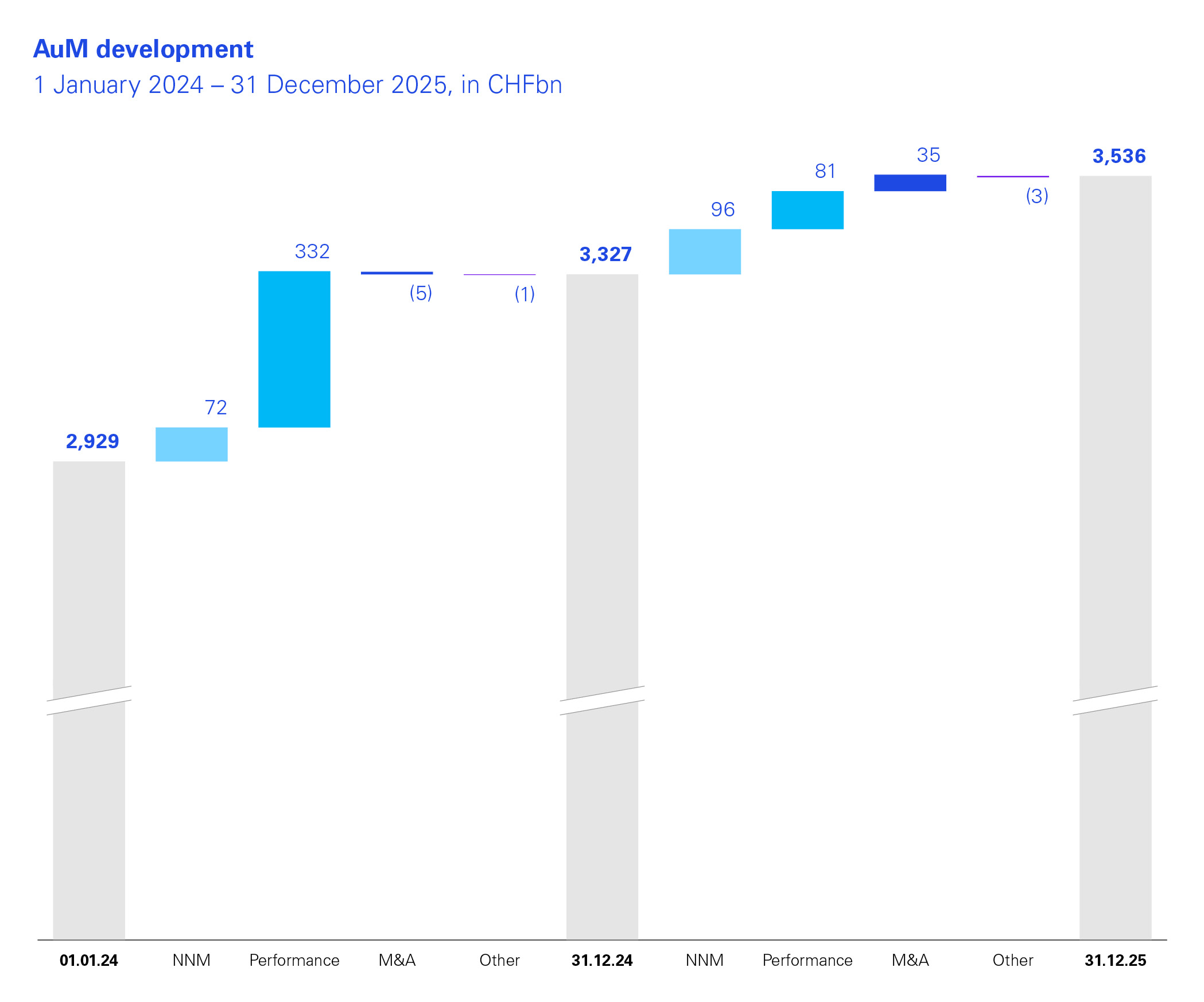
        AuM of the 68 banks in our sample hit CHF 3.5tn at the end of 2025. NNM was a key enabler of this increase – at just over CHF 96bn, NNM was more than one-third higher than in the prior year.

        All sizes of banks performed well, with small banks growing NNM by almost 60%, medium banks almost sustaining the high levels they generated in 2024, and large banks growing NNM by 53%. M&A also played its part, adding CHF 35bn compared to a cumulative CHF 6.5bn in 2021-2024.

      • AI use is widespread, but limited impact to date

        AI is firmly on Swiss private banks’ agendas, though investment remains at a relatively early stage. 34 banks responded to our short supplementary survey regarding their use of AI, which showed that the number of banks investing more than CHF 500k in AI is expected to double in 2026.

        While AI is used primarily for administrative tasks currently, there is significant potential for advanced applications such as the use of multi-agents or revenue optimization.

      • Strong performances, but no improvement in profitability

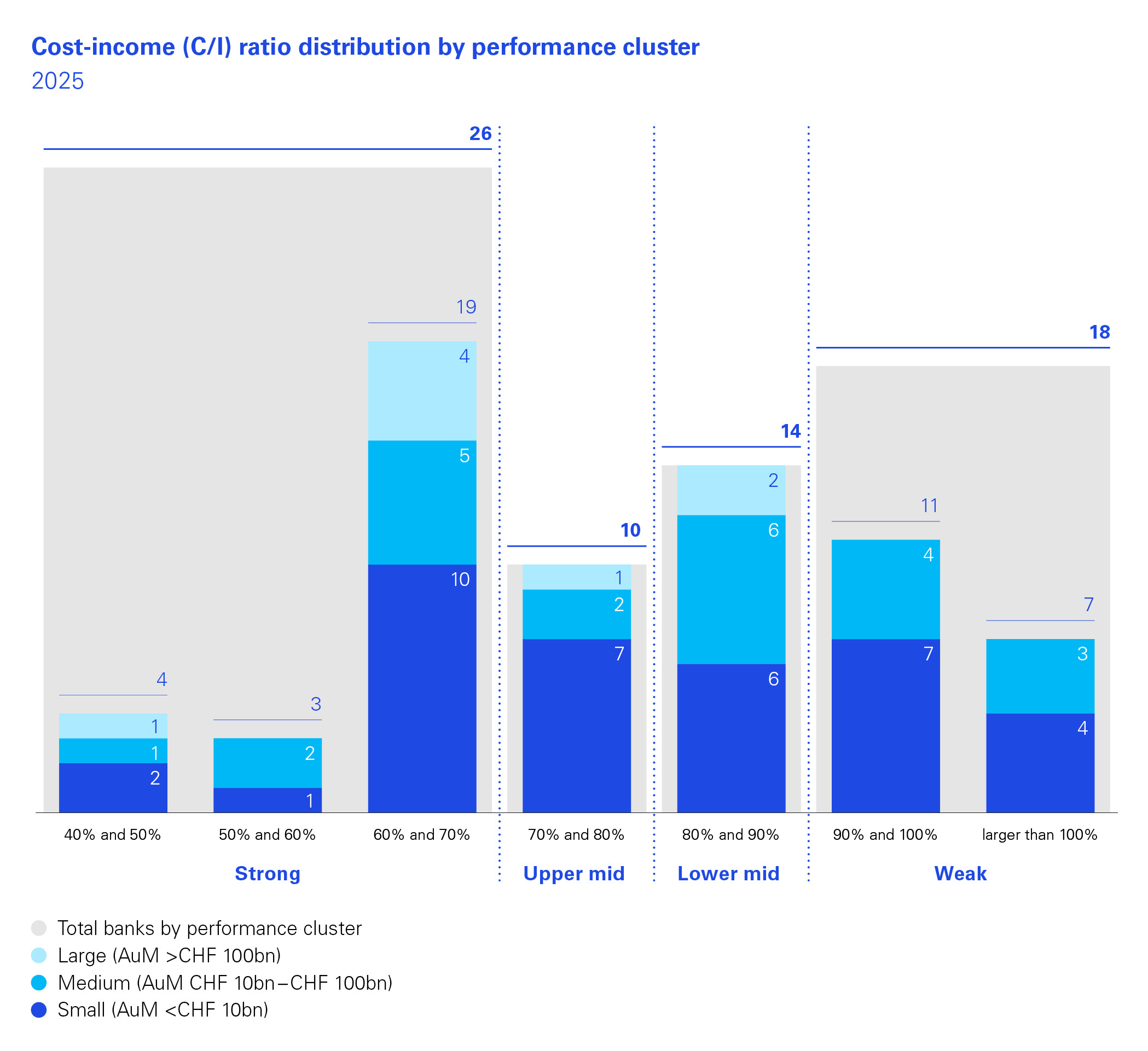
        As the tailwind of high interest rates slowed, banks still performed strongly – though gross profits did not rise despite record levels of AuM. More than half of banks achieved a cost-income (C/I) ratio of below 80%, making them strong and upper-mid performers.

        Large and small banks continued to perform well, though large banks failed to make efficiency gains, while medium banks saw C/I increase and profits fall. 

      • Advanced AI capabilities are focused on a small group of frontrunners

        The AI Advancement Index developed by the HSG Institute of Management and Strategy shows that advanced AI capabilities remain concentrated among a relatively small group of frontrunners (only 16 of 73 banks are categorized as advanced or frontrunner).

        These banks have explicit AI strategies, formal governance structures, transformation programs, and targeted technology investments to develop “AI First” strategies. The question is whether a greater proportion of banks can turn fragmented tool adoption into a well-governed, scalable, and strategically meaningful capability. 

      • Efficiency remains flat over the past five years

        Looking at how much revenue banks generated for each CHF 1bn of AuM, and the costs of servicing those client assets, the result show a remarkably flat trend for 2021-2025. The median for small banks peaked in 2023 and 2024 thanks to a rise in interest income and stable commission income margins.

        But almost no medium or large bank managed to grow commission income, and most banks do not appear to prioritize efficiency increases in more successful times. Only banks with significant performance issues sought to cut costs in order to reduce losses and increase their survival prospects.


      Number of private banks

      The number of banks fell from 85 to 80 in 2025 as the result of UBP acquiring Societe Generale’s Swiss private banking business, CA Indosuez acquiring Banque Thaler, BNPP converting its Swiss subsidiary to a branch of the French bank, IHAG returning its banking license following the sale of its client book to Vontobel, and the merger of One Swiss Bank and Gonet & Cie.

      The forced liquidation of MBaer Merchant Bank in early 2026 left 79 banks by the end of May 2026.

      number of swiss private banks > Click on the image to enlarge it
      • Outlook

        It will be interesting to see if the market becomes a ‘winner takes all’ market or if some niches will continue to exist profitably on a smaller scale. We believe some small and medium-sized banks will be entry points for international financial groups seeking to offer their clients a safe haven.


      AuM development

      2025 ended with AuM at a record high of CHF 3.5 trillion. NNM was strong in absolute terms at CHF 96.0bn.

      M&A had a strong positive impact for the first time in years. The aggregate impact of M&A over the previous four years was CHF 6.5bn; the impact in 2025 alone was around CHF 35bn.

      Strong NNM development across all size clusters is likely supported by Switzerland’s reputation as a safe haven. Large banks increased their NNM to CHF 66.6bn (52.7% higher than 2024), medium banks kept NNM flat at CHF 23.3bn (5.0% lower), and small banks grew NNM from CHF 3.8bn to CHF 6.2bn (61.4% higher).

      These figures show that medium banks continued their strong performance of 2024, large banks recovered from a weak 2024, and small banks were able to further increase already strong NNM.

      aum development > Click on the image to enlarge it

      Median NNM development

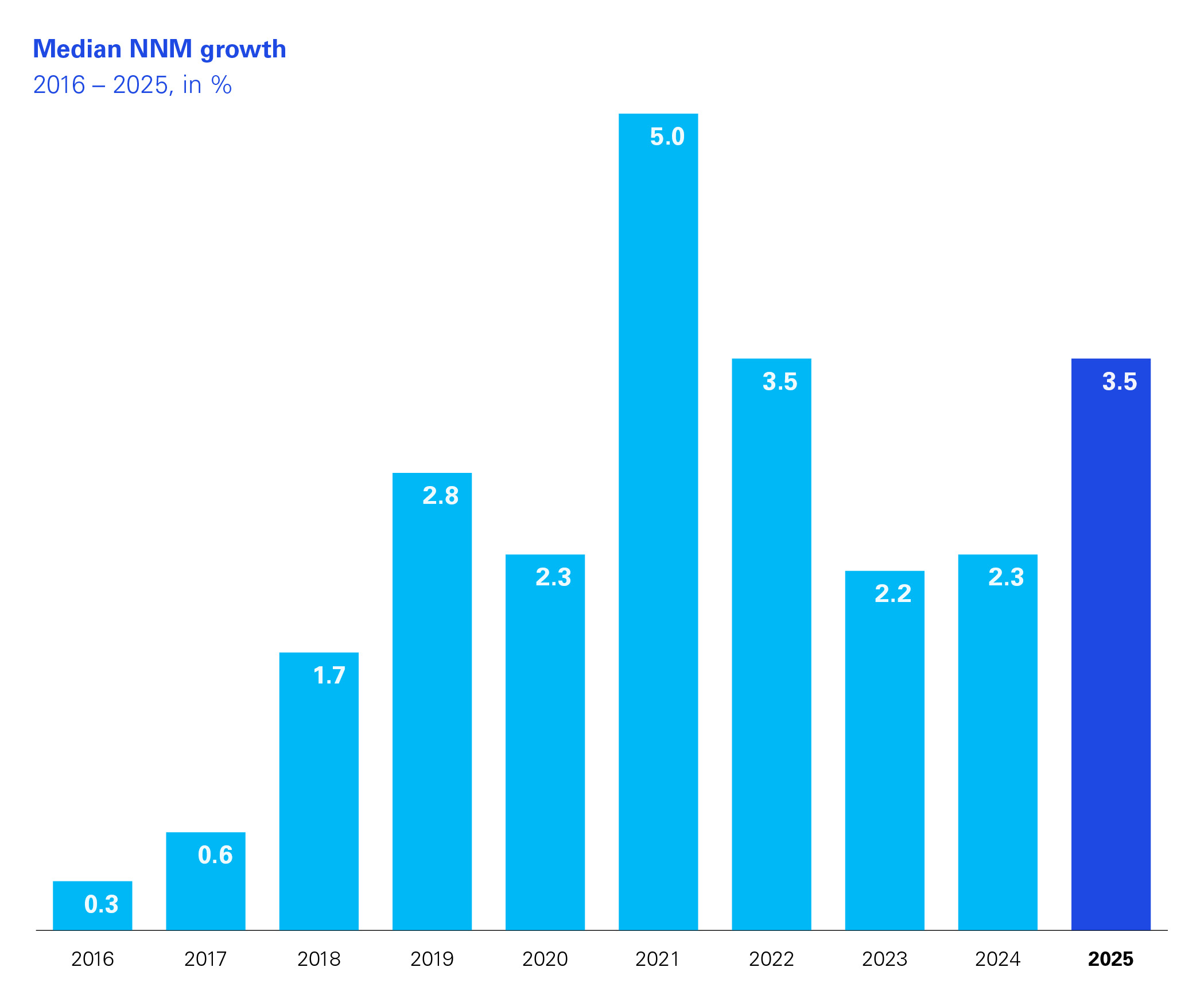
      Median NNM rose from 2.3% in 2024 to 3.5% in 2025, with 39 out of 67 banks growing their NNM.

      While large banks contributed the highest NNM in absolute terms, they achieved the lowest median NNM at 2.2% (1.4% in 2024). NNM is relatively stable among large banks, with only two banks reporting negative NNM in one year in the past three.

      Several Big 8 banks communicate NNM targets, generally in the range of about 3%-5%. Given levels achieved historically, this is a stretch target. Only two of the Big 8 achieved more than 3% NNM in each of the past three years.


      nnm development > Click on the image to enlarge it

      Deployment or piloting of AI solutions

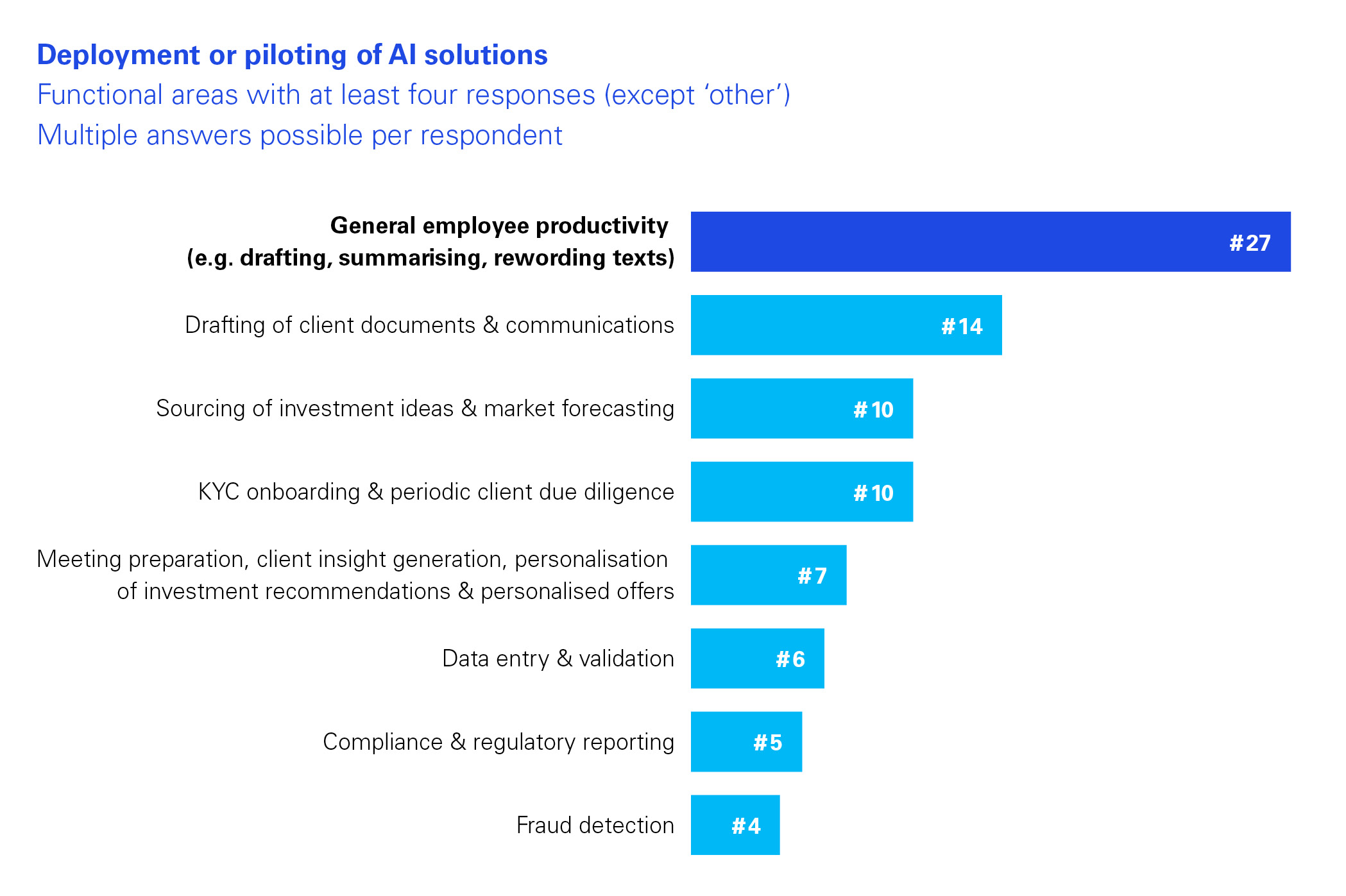
      Four-fifths of banks already run AI in production, predominantly to support individual tasks rather than to transform end-to-end business processes. Adoption is concentrated in a narrow set of use cases, particularly general employee productivity such as drafting client communications. More advanced applications such as the use of multi-agents or revenue optimization play only a minor role so far.

      Only around 18% of banks invested more than CHF 500k in AI in 2025. This reflects directly in outcomes, with most respondents attributing no measurable cost reductions and almost no revenue increase to AI. One Big 8 bank stood out by indicating a 5% cost reduction in 2025. The proportion of banks investing more than CHF 500k is expected to rise to 32% in 2026.

      deployment piloting AI solutions > Click on the image to enlarge it

      AI Advancement Index

      Complementing our survey on the use of AI among Swiss private banks, the HSG Institute of Management and Strategy at the University of St.Gallen carried out further analysis to deep-dive into selected aspects of AI adoption among Switzerland’s private banks.

      Swiss private banking is entering the age of artificial intelligence from a position of both strength and structural conservatism. The sector’s traditional model has been built around trust, discretion, and relationship-driven advice – strengths that remain central to its value proposition, yet that also make the adoption of AI a more delicate strategic challenge than in many other financial services businesses.
       

      HSG Analysis

      HSG Analysis

      Read the full analysis, incl. methodology

      AI advancement index > Click on the image to enlarge it

      Cost income ratio distribution

      With Switzerland’s return to a very low interest rate environment, interest income was down 20%.

      This combined with rising personnel expenses to push C/I ratios up to a median of 78.2% (75.6% and 74.2% in the two prior years) – though this is well below historical levels of above 80%. 

      More than half of banks (36) achieved a C/I ratio of below 80%. The strong cluster grew by one bank, while the upper-mid cluster shrank by eight banks. The best performing bank had a C/I of 44.8% and the weakest had 125.7%.

      Eighteen banks had a C/I of more than 90%, with most of these having high recurring C/I ratios. This group of banks is where a business model review should be performed or a sale could be considered.

      As in previous years, a large proportion of these banks are subsidiaries of foreign banks (10 of 18).

      ci ratio > Click on the image to enlarge it

      Interested in more data and graphics about Swiss private banks?


      Clarity on Swiss Taxes

      Clarity on Swiss Private Banks

      Strong and steady. As banks post strong performances, how could AI shape their futures?


      Meet our FS banking experts

      Pascal Sprenger

      Partner, Head of Financial Services, Member of the Executive Board of Directors

      KPMG Switzerland

      Christian Hintermann

      Partner, Financial Services

      KPMG Switzerland

      Nicolas Moser

      Partner, Financial Services

      KPMG Switzerland


      Financial services

      We support you in achieving your business goals through leading expertise and technologies in financial services.