KPMG in India can help turn your ESG aspirations into action. Our ESG solutions are both holistic and practical. With capabilities that span the enterprise, we can help instill sustainable innovations across your business and help you gain a competitive edge. Our deep multidisciplinary expertise across critical issues—including green strategies, climate resilience, energy transition, reporting, sustainable finance, and social impact can help create the right blueprint for integrating ESG into all verticals of your organisation. We go beyond strategy, working with you at each step of your ESG transformation to unlock new value as you build a sustainable future.
Environmental
Focuses on an organisation’s net-zero strategy, stewardship of the natural environment, recycling practices, emission control, and conservation of resources.

Social
Inspects an organisation’s management of relationships with its employees, suppliers, customer, stakeholders, and the community at large.

Governance
Considers the organisation’s management structure, executive compensation, internal controls, and stakeholder rights.


KPMG in action
The impact we promised and delivered
From Tariff Headlines to Business Decisions


ESG solutions and services


Driving growth with ESG trends
- Roundtable on SBTi v2.0
- Our Impact Plan
- Engineering impact through innovation: Unlocking CSR capital for scale
- Business Today India's Most Sustainable Companies Summit & Awards
- Building a circular economy ecosystem in India
- India Sustainability Mission 2.0
- India’s Development journey and the circular economy
- CII CFO Roundtable
- Sustainable skies
- Decoding taxation and ESG
- Government to greenlight incentives to drive green steel output
- Digital mining: Transforming the mining value chain
- How AI is becoming the backbone of ESG compliance
- Sustainable development
- Climate risk

The transition to net-zero is no longer just about setting targets, it’s about demonstrating how those targets will be achieved through credible transition plans, stronger governance, transparent disclosures, and verifiable progress.
Ira Gupta Tuteja
Advisor - CSR, Corporate Citizenship
KPMG in India
We believe that the UN’s Sustainable Development Goal 4 (Quality Education), is a powerful enabler of all other SDGs. Recognising this transformative potential, we support initiatives across education, employment, and entrepreneurship, aligned with our global commitment to empower 10 million disadvantaged youth by 2030, helping them build resilient futures and participate meaningfully in the economy and society.

Innovation-led CSR represents an important next frontier for creating impact at scale. While CSR capital has delivered meaningful grassroots outcomes, its ability to address complex systemic challenges will depend on building a strong and credible pipeline of innovation-led solutions.
This requires deeper ecosystem partnerships, sharper problem-solution fit, patient capital, and robust mechanisms to de-risk and measure impact. The roundtable reaffirmed that the opportunity ahead is not just to fund innovation, but to actively enable it to scale responsibly and sustainably.

AI and sustainability need to work hand in hand to create a better future for humanity. A better balance of both can help create a climate friendly future, green cities and positive social impact.

Sandeep Paidi
Partner, Government & Public Services (G&PS); Lead - Health, Human & Social Services (HHSS) and Office Managing Partner – KPMG in Hyderabad
KPMG in India
Circular economy depends on how everyday systems manage materials, waste and resources. The foundations of building a circular economy ecosystem in India have been underway for a few years now. However, without clear measurement, it becomes difficult to recognise the full value of these efforts.
Going ahead, we need improved mechanisms to track and quantify the environmental impact of circular activities. The challenge is to strengthen institutions and create reliable systems so that the environmental benefits generated can be clearly valued, verified and scaled.

Large infrastructure projects in major cities typically undergo robust ESG diligence aligned with environmental standards. The challenge becomes more complex in smaller cities, where projects such as water supply initiatives are often limited in scale. For these smaller projects, the cost of extensive project administration and compliance can be disproportionately high. There are also capacity constraints at the local level, across government agencies, private players, and advisors, particularly when it comes to having skilled resources to carry out consistent ESG diligence across multiple projects.
The absence of reliable data, established baselines, and mature models further adds to the complexity. In this context, automating diligence processes remains difficult until foundational data and capability gaps are addressed.

Nilachal Mishra
Partner and Head, Government & Public Services (G&PS), National Leader - Government and Infrastructure
KPMG in India
India’s development journey is entering a new phase, where the country’s growth story will be increasingly shaped by how efficiently we use our resources.. The size of our population and the pace of economic activity are placing increasing pressure on natural resources, ecosystems, and waste management systems.
The circular economy offers an alternative to the 'take-make-dispose' model. The output of one industry becomes the input for another. As India works towards its net zero commitment by 2070, measurable environmental benefits become increasingly important. When emissions reductions from recycling, waste recovery, and resource efficiency are measured and recognised within credible carbon frameworks, they can also support economic value.
- Sumit Kapoor
- Ummehaani

Businesses today face rapid, unpredictable changes: new products, regulatory shifts, talent competition, ESG, and tech transformation. The pace of “unknown unknowns” or “Black Swan events” is accelerating at an unprecedented pace. Naturally, traditional risk models find it difficult to keep up with that pace as they assume stability and predictability in businesses and operating landscape. AI is emerging as a new risk nervous system helping with fraud detection, cyber defence, supply chain resilience and more. Future operating model of risk management must consider the four-dimensional lens of probability, severity, interconnectedness, and velocity; which helps with real-time intelligence and simulation of multiple futures.
At KPMG we continue to assist our clients stay ahead of the curve through our AI led risk management capabilities – converting noise to signals and doubts to trust.

Third-Party Risk Management (TPRM) has traditionally been fragmented and siloed across departments, sometimes reduced to check-in-the-box compliance. As supply chains are more interconnected and interdependent today, by integrating ESG, regulatory, reputational, cyber and financial risk parameters into a unified framework, organisations can move from reactive to predictive risk management. However, challenges remain: data quality and availability, integration with legacy systems, regulatory compliance and explainability, and change management. Overcoming these hurdles with Artificial Intelligence makes it possible to connect the dots across all risk types, so companies can stop playing catch-up and start leading with confidence, trust, and adaptability.
- Vivek Rahi
- Jodhbir Sachdeva

India’s SAF journey will be built on the intelligent use of our abundant feedstock base - from agricultural residues and municipal solid waste to press-mud and used cooking oil. With technology pathways such as HEFA, alcohol-to-jet and FT moving towards scale, it is important that we develop multiple pathways in parallel, as no single route can meet our long-term needs. The key will be establishing viable supply chains and long-term offtake frameworks involving airlines, OMCs, and technology providers.

India's aviation sector is at a defining moment, balancing rapid growth with climate responsibility. Even as airlines induct new fuel-efficient aircraft, overall fuel use continues to rise with expanding capacity. Sustainable Aviation Fuel offers the most scalable path towards decarbonisation and presents India with a strategic opportunity to lead this transition.
The Indian automotive Industry has a massive opportunity in harnessing sustainability-led growth. The Indian automtive This can open new markets and increase export penetration in others. A low-carbon manufacturing push can drive huge growth and acceleration.

Secondary steel producers contribute more than 50% of the domestic steel production, and because of the scale, relevance and contribution without decarbonising this sector, India can’t achieve its net zero goals.
These producers use electric arc furnaces and induction furnaces; the latter tend to be more rudimentary operationally, with potential to address operational efficiencies and utilise greater renewables & scrap.

Advancing towards sustainability: The emergence of green mining technologies and practices
The Indian mining industry has been embracing greenmining technologies and practices – from electrification and automation to regenerative and water-efficient solutions – to drive sustainablity across operations and supply chains. The star rating system instituted by the Ministry of Mines, Govt of India (MoM) through Indian Bureau (IBM) for implementation of Sustainable Development Framework (SDF) has been working as an excellent impetus in this regard.
A more concerted effort to resolve challenges around efficient resource utilisation by:
- promoting beneficiation of low-grade ore,
- adoption of renewable/hybrid energy sources,
- mine closures as per approved plan through policy guidelines, and
- adoption of global best practices
can drive this mission towards sustainability even more strongly, reinforcing the need for collaborative innovation and ESG integration in mining.
The global economic paradigm is changing as companies are under tremendous pressure from people across the world to account for the social impact of their businesses. Moreover, endless growth with profit as the sole metric is no longer sustainable. The consequences of social and environmental imbalance are mostly seen in the long term. If allowed to go unchecked, the disruption caused may cause a significant dip in growth and corporate valuations.
Regulators and policymakers can support the transition for MSME into sustainablity by establishing digital public infrastructure for ESG reporting and certification, providing tax benefits and accessible financing for MSMEs and enabling learning at scale for greenskills programmes.
Central banks across the world are looking at embedding climate risk guidelines into financial frameworks. RBI came up with the draft guidelines for India last year. This has been followed up by the climate finance taxonomy, greenwashing guidelines, and carbon credit scheme. It's a realisation that there are massive risks are ahead of us unless we act with speed and at scale.
Hear from the experts
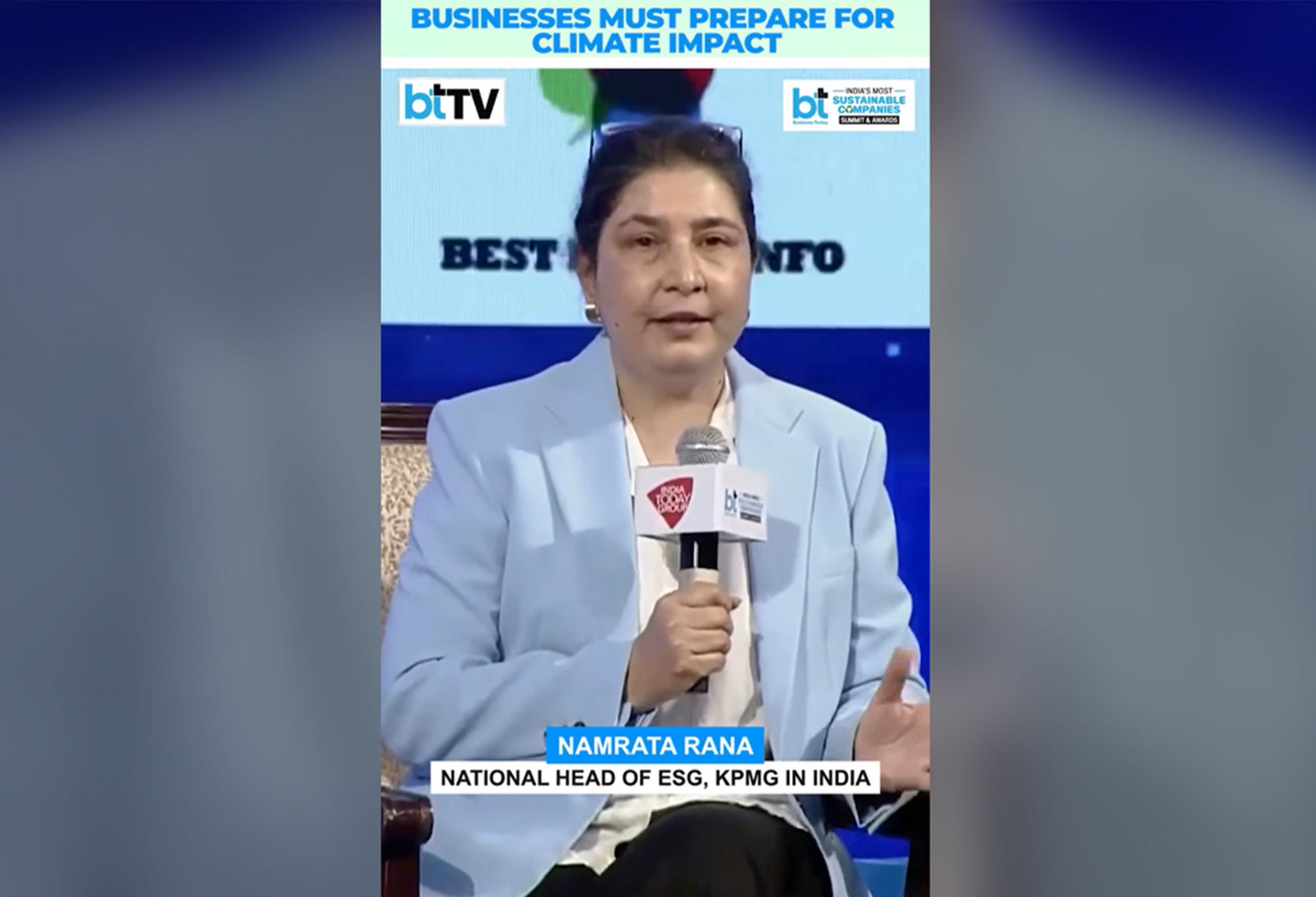
Business Today India's Most Sustainable Companies Summit & Awards | Namrata Rana
Climate risk is becoming a key factor in lending decisions worldwide, with central banks pushing for its integration into financial assessments. They also highlighted RBI's draft guidelines requiring companies to evaluate climate-related risks and opportunities.
India Insights
Our insights is your gateway to thought leadership and in-depth reports. Explore our curated collection of valuable content, where we delve into complex business challenges, share industry trends, and provide actionable insights.
Something went wrong
Oops!! Something went wrong, please try again
Making every day awesome at KPMG
Global insights
ESG viewpoints
A webcast series dedicated to helping leaders stay connected on top-of-mind ESG issues.



Media
KPMG Impact Plan
We believe that sustainable growth is the only way to build a successful business and have a lasting positive impact on our environment and society. That’s why we’ve published our ESG commitments in Our Impact Plan.

Key Contacts