

In determining how to account for holdings of cryptoassets, a company needs to:
- identify its rights and obligations attached to the cryptoasset;
- assess the main purpose of holding the cryptoasset; and
- apply judgement in identifying the relevant accounting standard and developing an accounting policy.
The rights and obligations attached to cryptoassets and companies’ reasons for holding them can vary. Therefore, it is important that a company assesses the accounting for a cryptoasset based on the specific facts and circumstances.
Many cryptoassets are accounted for as intangible assets under IAS 38 Intangible Assets or as inventories under IAS 2 Inventories. Relevant considerations under these accounting standards are discussed further below.
In some cases, cryptoassets may be in the scope of another accounting standard. For example:
- a stablecoin that gives the holder the right to redeem it for cash may be a financial asset under IFRS 9 Financial Instruments; or
- a cryptoasset that represents an ownership interest in an underlying asset may be accounted for under the accounting standard applicable to the underlying asset (e.g. IFRS 9, IAS 16 Property, Plant and Equipment or IAS 38).
The following diagram sets out the measurement approaches for cryptoassets in the scope of IAS 2 and IAS 38.
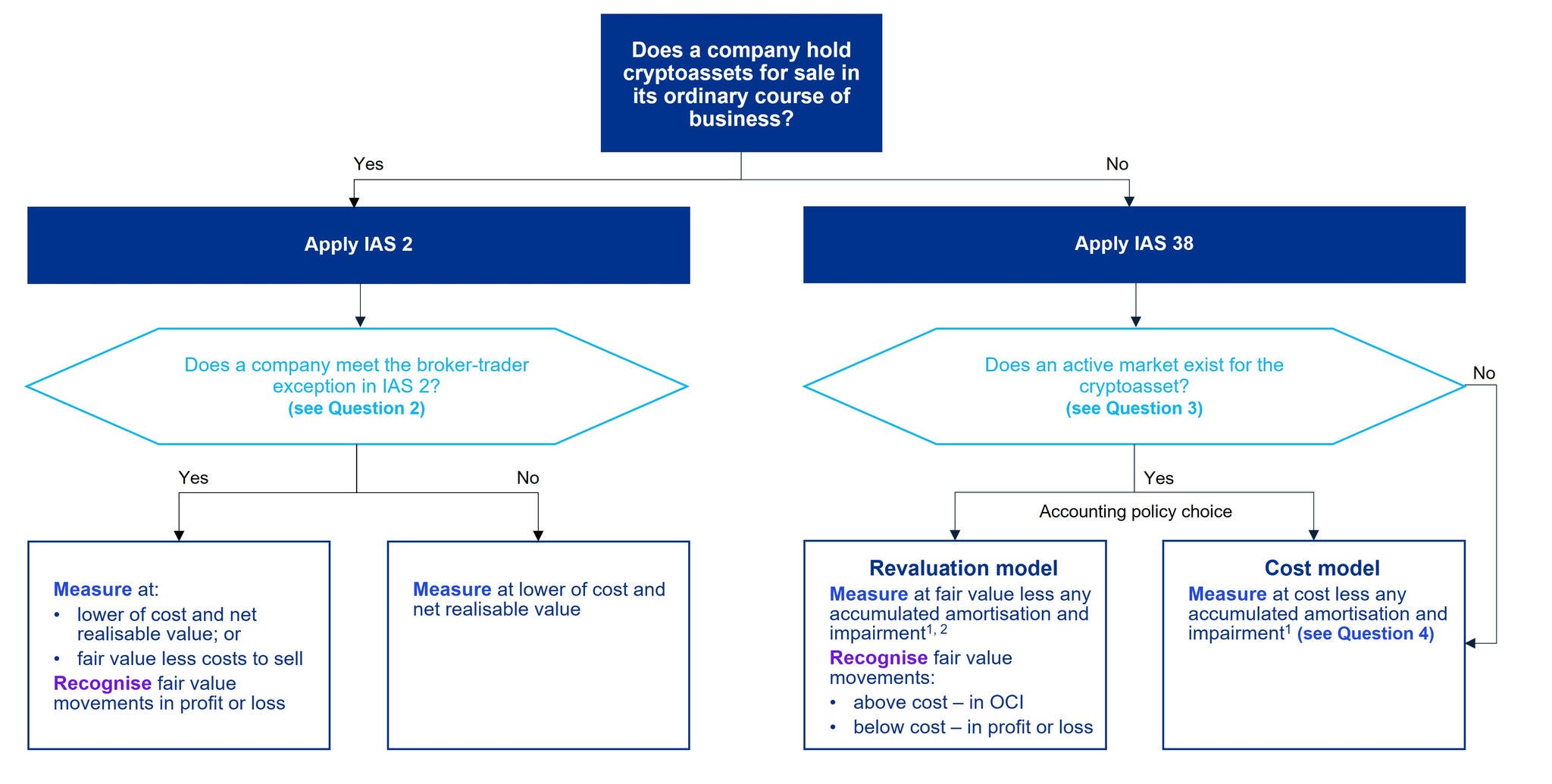
1 Typically, no amortisation is expected for crypto assets; they are tested for impairment.
2 Fair value is the price that would be received to sell an asset in an orderly transaction in the principal (or in its absence, most advantageous) market at the measurement date. See Question E25 in our Fair value measurement handbook for further guidance on challenges that may be encountered in identifying the principal (or most advantageous) market for a cryptoasset.
Your questions answered
Yes, but it is limited and relates only to cryptoassets with certain characteristics.
The IFRS Interpretations Committee discussed cryptoassets with all of the following characteristics (referred to by the Committee as ‘cryptocurrencies’):
- a digital or virtual currency recorded on a distributed ledger that uses cryptography for security;
- a cryptocurrency that is not issued by a jurisdictional authority or other party; and
- the holding of the cryptocurrency does not give rise to a contract between the holder and another party.
The Committee noted that cryptocurrencies with the features above meet the definition of an intangible asset in IAS 38 and generally do not meet the definition of cash or other financial assets. Therefore, a company generally applies IAS 38 to holdings of cryptocurrencies, unless they are held for sale in the ordinary course of business, when IAS 2 applies. For further discussion, see IFRIC Update June 2019.
Yes, if:
- the cryptoasset is considered a commodity; and
- the company is acquiring the cryptoasset with the purpose of selling in the near future and generating profit from fluctuations in price or broker-traders' margin (i.e. the company is acting as a broker-trader).
A commodity is not defined in IAS 2 but it is generally characterised by being traded and fungible. Many well-known cryptoassets (e.g. Bitcoin, Ether and XRP) would be considered commodities under IAS 2; however, less common cryptoassets may not.
In assessing whether it acts as a commodity broker-trader, a company needs to interpret the term ‘near future’. In our view, this assessment may vary from company to company and the factors considered in this assessment should include the company’s business model.
Yes.
Cryptoassets accounted for as intangible assets can only be measured at fair value under the revaluation model in IAS 38 if there is an ‘active’ market. Appendix A of IFRS 13 Fair Value Measurement defines an active market as one “in which transactions take place with sufficient frequency and volume to provide pricing information on an ongoing basis”.
Judgement is required to determine whether transactions take place with sufficient frequency and volume. It depends on the specific facts and circumstances of the market for the cryptoasset.
It depends.
A company may have acquired interchangeable cryptoassets at different times and costs (i.e. a company’s holding is made up of multiple units of the same cryptoasset purchased at different points in time).
IAS 38 is silent on how a company determines the carrying amount of interchangeable assets – e.g. to calculate a gain or loss on disposal. In some cases, it is feasible to identify and track the specific units sold or transferred – e.g. when individual assets have unique identification numbers. Conversely, if it is not feasible to identify and track the specific units, then in our view, a company should apply the guidance for determining cost formulas for inventories by analogy under the hierarchy for selecting accounting policies. We believe that a reasonable cost allocation method may be used – i.e. average cost or first-in, first-out. A company should apply the elected accounting policy consistently.
For cryptoassets accounted for as inventories, IAS 2 provides guidance on cost formulas.


© 2026 KPMG IFRG Limited, a UK company, limited by guarantee. All rights reserved.