

Crypto mining refers to the process used in a proof-of-work blockchain (e.g. Bitcoin) to validate transactions and secure the blockchain.
In a proof-of-work blockchain, crypto miners compete to solve complex puzzles. The first miner to solve the puzzle earns the right to validate and add the next block to the blockchain.
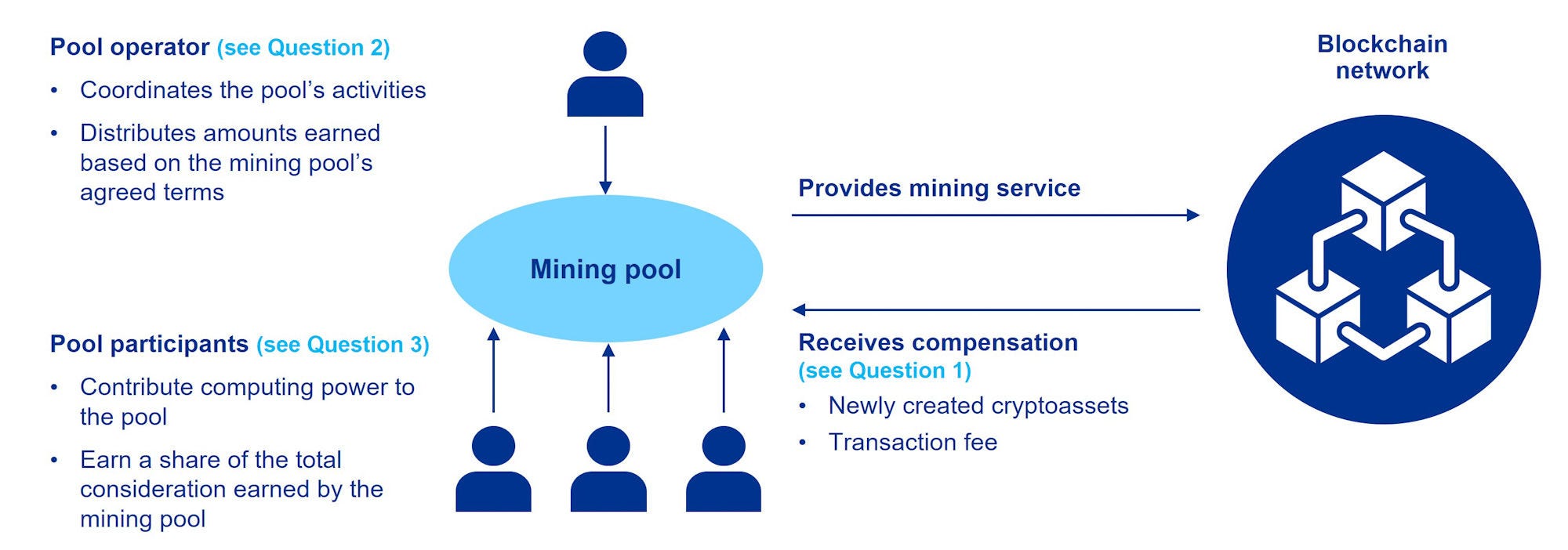
Crypto miners can work together (i.e. in a mining pool) to increase their chances of earning the right to validate the next block and ensure more consistent earnings. In a mining pool, there are two main parties – i.e. the pool operator and pool participants.
For validating and adding the next block to the blockchain, the winning crypto miner receives non-cash consideration in the form of newly created cryptoassets and a transaction fee. The question then arises about how a crypto miner accounts for that non-cash consideration; in particular, whether part or all of the arrangement is in the scope of IFRS 15 Revenue from Contracts with Customers.
To determine the appropriate accounting for a mining pool arrangement, a pool participant needs to evaluate its relationship with both the pool operator and the blockchain network.
Your questions answered
It depends.
Newly created cryptoassets and transaction fees received by a crypto miner are generally considered to meet the definition of revenue when crypto mining is part of a company’s ordinary activities. However, a question arises on whether newly created cryptoassets and/or transaction fees received are in the scope of IFRS 15 when these amounts are received based on the blockchain network’s protocols.
This raises questions on whether the contract existence criteria in IFRS 15 are met; in particular, whether:
- there is an identifiable counterparty (i.e. a customer); and
- the rights and obligations arising from the protocols are legally enforceable.
Judgement is required to determine whether the protocols set out in the blockchain operating arrangements give rise to a contract with a customer.
If a company concludes that the newly created cryptoassets and/or transaction fees are not in the scope of IFRS 15, then it develops an accounting policy considering the requirements in IAS 8 Accounting Policies, Changes in Accounting Estimates and Errors. In doing so, it considers whether the requirements in IFRS 15 are relevant.
Generally, yes.
This is because the pool operator typically controls:
- the protocols for determining how pool participants use their computing power;
- the formula for calculating the consideration pool participants receive; and
- the node that the pool operator uses to participate in the blockchain network.
The pool operator is also the party that generally is entitled to the compensation from the network, bears the obligation to compensate participants under the pool terms and obtains the residual benefit or margin from operating the mining pool.
However, rights and obligations can vary between pooling arrangements. Companies need to assess these rights and obligations thoroughly before reaching a conclusion.
When the pool operator acts as principal, it records the entire amount of compensation earned as revenue and the portion remitted to the pool participants as a cost related to that revenue.
Generally, yes.
The arrangement between a pool participant and the pool operator generally meets the contract existence criteria in IFRS 15. However, rights and obligations can vary between pooling arrangements. Companies need to assess these rights and obligations thoroughly before reaching a conclusion.
When the arrangement is in the scope of IFRS 15, a pool participant recognises its allocation of consideration earned by the mining pool as its revenue.
If crypto mining is not part of the pool participant’s ordinary activities, or the arrangement is not in the scope of IFRS 15, then the pool participant develops an accounting policy for these transactions, considering the requirements in IAS 8. In doing so, it considers whether the requirements in IFRS 15 are relevant. The pool participant also needs to consider the appropriate classification of income in the statement of profit or loss, applying the requirements in the presentation accounting standard.


© 2026 KPMG IFRG Limited, a UK company, limited by guarantee. All rights reserved.