

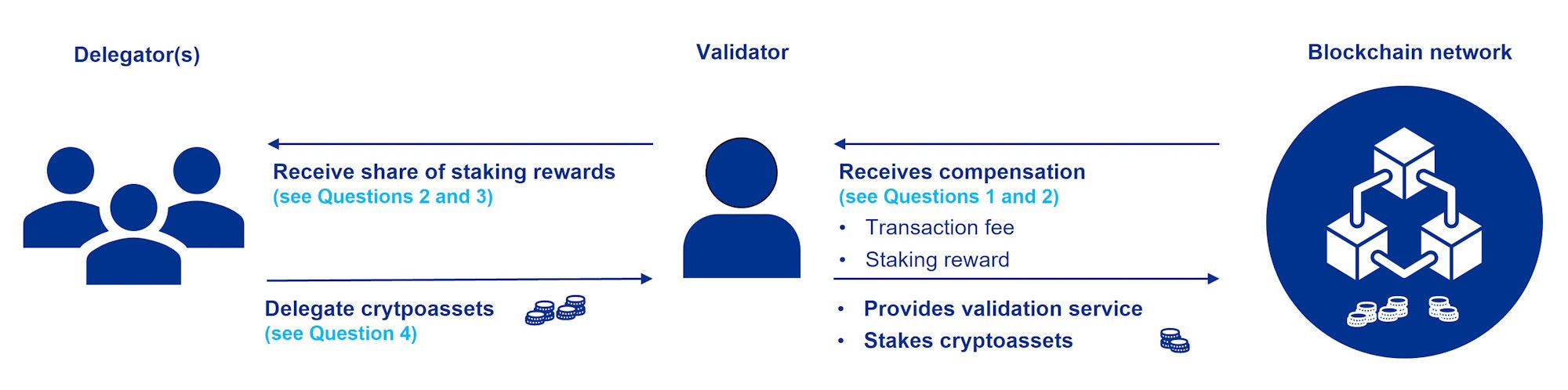
Staking activities refer to the process used in a proof-of-stake blockchain (e.g. Ethereum) to validate transactions and secure the blockchain. A company can earn rewards for staking activities by acting as either a validator or a delegator.
Only holders of the blockchain’s cryptoassets are permitted to validate transactions (i.e. act as validator). Validators are required to post cryptoassets as collateral with the blockchain (referred to as a stake) to be eligible for selection to validate blocks.
The process to select the validator of the next block uses probability and is based on the size of the stake relative to the total amount staked. Therefore, the larger a validator’s stake, the higher the chance of being selected. However, the exact protocols can vary by blockchain.
For validating and adding the next block to the blockchain, the selected validator receives non-cash consideration in the form of a staking reward and transaction fee. When considering how to account for that non-cash consideration, a validator needs to assess whether part or all of the arrangement is in the scope of IFRS 15 Revenue from Contracts with Customers.
If a company aims to earn staking rewards but does not intend to act as a validator, then it can delegate cryptoassets to a validator for inclusion in the validator’s stake. Companies applying this approach are referred to as delegators.
To determine the appropriate accounting for a delegation arrangement, a delegator needs to evaluate its relationship with both the validator and the blockchain network.
Your questions answered
It depends.
Staking rewards and transaction fees are generally considered to meet the definition of revenue when staking activities are part of a company’s ordinary activities. However, a question arises on whether staking rewards and transaction fees are in the scope of IFRS 15 when these amounts are received based on the blockchain network’s protocols.
It is unclear whether these arrangements meet the contract existence criteria in IFRS 15; in particular, whether:
- there is an identifiable counterparty (i.e. a customer); and
- the rights and obligations created by the protocols are considered legally enforceable.
Judgement is required to determine whether the protocols set out in the blockchain operating arrangements give rise to a contract with a customer.
If a company concludes that part or all of the arrangement is not in the scope of IFRS 15, then it develops an accounting policy, considering the requirements in IAS 8 Accounting Policies, Changes in Accounting Estimates and Errors. In doing so, it considers whether the requirements in IFRS 15 are relevant.
Generally, yes.
This is because the validator often:
- operates the node;
- uses its own equipment and software to perform the validation; and
- is the party selected by the blockchain protocol to validate the transactions.
The validator may also indemnify delegators against any penalties it incurs for not performing validation services in line with the blockchain protocol.
However, rights and obligations can vary between staking arrangements. Companies need to assess these rights and obligations thoroughly before reaching a conclusion.
When the validator acts as principal, it records:
- the entire staking reward earned as revenue in the same manner as staking rewards earned on its owned cryptoassets; and
- the portion remitted to the delegator as a cost related to that revenue.
It depends.
In this case, the delegator effectively lends its staked cryptoassets to the validator – i.e. the validator can use the cryptoassets to increase the number of validation activities it is selected to complete.
Judgement is required to determine whether the arrangement between a delegator and validator is in the scope of IFRS 15. For example, if the arrangement is in the form of a smart contract, then a question may arise on the legal enforceability of the rights and obligations arising from the contract, and therefore whether the contract existence criteria in IFRS 15 are met. Companies need to assess these rights and obligations thoroughly before reaching a conclusion, because the structure, number of parties involved and the rights and obligations arising from delegation arrangements vary widely between arrangements.
When the arrangement is in the scope of IFRS 15, a delegator recognises its allocation of staking rewards as its revenue.
If staking is not part of the delegator’s ordinary activities, or the arrangement is outside the scope of IFRS 15, then the delegator develops an accounting policy for these transactions, considering the requirements in IAS 8. In doing so, it considers whether the requirements in IFRS 15 are relevant. The delegator also needs to consider the appropriate classification of income in the statement of profit or loss, applying the requirements in the presentation accounting standard.
Generally, no.
A delegator only derecognises its staked assets if it loses control of those assets under the staking arrangement. The guidance on control in IFRS 15 is typically used as the basis for this assessment.
Generally, the validator does not obtain the right or ability to direct the use of these cryptoassets, so the delegator retains control. This is because, under the terms of the arrangement, the validator often does not obtain the right or ability to sell or lend the cryptoassets, and therefore realise the remaining economic benefits. However, rights and obligations can vary between arrangements. Companies need to assess these rights and obligations thoroughly before reaching a conclusion.
Similar considerations also apply to staked assets of the validator.


© 2026 KPMG IFRG Limited, a UK company, limited by guarantee. All rights reserved.