

From a historical lens, the world’s embrace of AI is one of the most consequential transformations since the Industrial Revolution. Then, mechanization reconfigured how goods were produced, drove urbanization, and reshaped labor markets. Today, intelligent systems are reconfiguring how we think about work, knowledge and responsibility. The parallel is not perfect, however it offers key lessons for organizations today.
From steam to silicon: Society evolves in waves
Societies have reinvented themselves many times. Eli Whitney’s invention of the cotton gin accelerated textile production and reshaped labor; industrialization concentrated workers in cities and elevated management, clerical, and engineering roles as new white‑collar strata; the internet rewired retail, media, and daily routines. Economists refer to such breakthroughs as general‑purpose technologies (GPTs): pervasive platforms that improve over time and need complementary investments (skills, processes, infrastructure) to unlock their full productivity. Steam and electricity were classic GPTs — AI is often seen as the next one. 1
A caution from history: electrification delivered economy‑wide gains only when firms redesigned factories around unit motors; simply substituting a dynamo with a steam engine produced no meaningful gains. Productivity follows re‑architecture, not just adoption — an S‑curve of gradual to rapid gains, followed by stabilization. 2
Wealth, work — and the “Engels’ Pause” lens (then and possibly now)
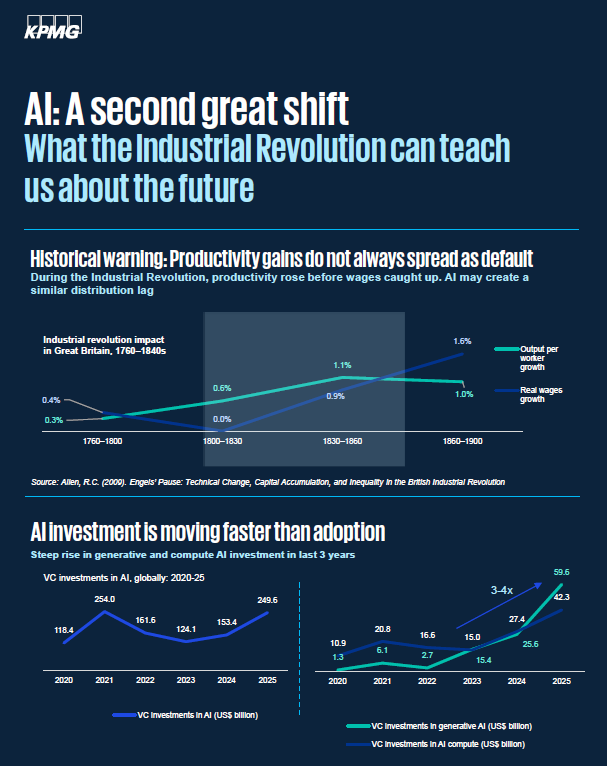
The Industrial Revolution generated significant wealth and, in time, higher living standards —though not immediately. In Britain’s early industrial decades, output per worker rose markedly while typical wages remained largely unchanged — a pattern the Economics professor Robert C. Allen labelled “Engels’ pause.” Reconstructing national accounts, Allen’s analysis indicates that between ~1780–1840, output per worker rose ~46% while real wages rose ~12%; profits and capital’s share increased, with wages beginning to track productivity only after the 1840s, as capital deepening, diffusion, and institutional change gained momentum. In short, a temporary lag separated technical progress from broad‑based wage gains. 3
In today’s context, the modern macro reappraisal by Nicholas Crafts and Knick Harley reinforces a drawn‑out transition — early output growth was real but modest, and the social dividend lagged the technical advance — providing a useful context for expectations about AI. 4
What we may be seeing now. Several contemporary patterns echo the conditions that can produce an Engels‑style lag — though outcomes are not pre‑ordained: labor’s income share has declined across many economies since the 1980s, partly because cheaper investment/IT capital encouraged capital‑for‑labor substitution; careful accounting attributes about half of the global decline to this effect. Across most Organization for Economic Co-operation and Development (OECD) countries, real median wages have decoupled from labor‑productivity growth over the last two decades, reflecting lower labor shares and superstar‑firm dynamics (leading firms in tech adoption). Early AI evidence is mixed: studies show both automation (displacement) and augmentation (productivity) effects; pre‑gen‑AI cross‑country data (2014–2018) show no clear effect on between‑occupation wage inequality and some reduction of within‑occupation inequality where AI lifts lower performers. Forward‑looking International Monetary Fund (IMF) analysis cautions on uneven adoption which could raise this inequality unless skills, diffusion and competition policies spread gains. 5, 6, 7
What makes this time different: From mechanization to cognition
Industrialization mechanized muscle; AI augments and in some cases substitutes cognition. This distinction matters. The opportunity is not to simply layer AI onto existing workflow, but to rethink the entire workflow itself, where human bottlenecks — memory limits, linear search, fatigue —no longer apply. Winners typically go beyond “adding a model” to a step; they’ll redesign the end‑to‑end system. Electrification’s lesson applies directly: productivity follows re‑architecture, not tool insertion. 2
Jobs at risk — and jobs reimagined
Roles intensive in routine synthesis — entry‑level analysis, basic coding, standard reporting, customer support — are likely to face the most substitution pressure. However, history suggests job loss is only part of the story; new complimentary roles proliferate (model auditors, AI safety specialists, data product managers, workflow architects). The distributional risk is real: without diffusion, productivity gains concentrate in frontier firms, reinforcing the decoupling described above — hence the need for skills, diffusion, and competition to shorten any modern “pause.” 6
Education: Build the base, then accelerate
AI recombines and extrapolates from existing knowledge; human judgment remains central. Paradoxically, as AI capabilities advance, investment in foundational skills such as numeracy, literacy, logic, and domain depth, becomes critical. Teach with AI — while assessing core skills without it — to help avoid cognitive atrophy and preserve the uniquely human capabilities that complement machines. The 20th‑century education system is instructive: mass secondary education compressed adjustment costs and helped translate technological change into widely shared wage gains. 8
AI: A second great shift
What the Industrial Revolution can teach us about the future
Related insights


1 Bresnahan, T.F., & Trajtenberg, M. (1995). General Purpose Technologies: Engines of Growth? Journal of Econometrics, 65(1), 83–108.
2 David, P.A. (1990). The Dynamo and the Computer: An Historical Perspective on the Modern Productivity Paradox. American Economic Review (Papers & Proceedings), 80(2), 355–361.
3 Allen, R.C. (2009). Engels’ Pause: Technical Change, Capital Accumulation, and Inequality in the British Industrial Revolution. Explorations in Economic History, 46(4), 418–435.
4 Crafts, N.F.R., & Harley, C.K. (1992). Output Growth and the British Industrial Revolution: A Restatement of the Crafts–Harley View. Economic History Review, 45(4), 703–730.
5 Karabarbounis, L., & Neiman, B. (2014). The Global Decline of the Labor Share. Quarterly Journal of Economics, 129(1), 61–103; OECD (2017). Decoupling of wages from productivity: Macro‑level facts. OECD Economics Department Working Paper No. 1373.
6 OECD (2017/2018). Decoupling of wages from productivity; Labor share developments; IMF (2017). Why Is Labor Receiving a Smaller Share of Global Income? Working Paper 17/169.
7 OECD (2024/2025). Artificial intelligence and wage inequality; The impact of AI on productivity, distribution and growth (AI Papers No. 15, 2024); IMF (2024/2025). Gen‑AI: Artificial Intelligence and the Future of Work; The Global Impact of AI – Mind the Gap.
8 Goldin, C., & Katz, L.F. (2008). The Race Between Education and Technology. Harvard University Press.

