The Washington Consensus era of ever-expanding trade liberalization is over. Persistent trade shocks — policy-driven tariffs, export controls, pandemic aftershocks — continue to reshape global supply chains. The strategic use of tariffs, whether implemented or merely signaled, is driving a reintegration of economic and geopolitical strategy at a pace that most corporate planning cycles cannot match. 

      Corporate resilience in this environment depends on clarity. This piece uses trade flow data, sector exposure analysis, and 25 years of corporate financial history to cut through the geopolitical noise and identify actionable signals for strategic direction. 
      Changing trade flows

      Over the past two decades, global trade flows have changed significantly, largely driven by divergent approaches adopted by largest trade blocs. 


      The US has increasingly retreated from open globalization. What began with steel and aluminum tariffs evolved into technology export controls, semiconductor restrictions, and industrial policy aimed at reshoring. The objective: reduce a structural trade deficit that had persisted for decades. 

      China pursued the opposite strategy — trade diversification. In 2000, Greater China'sᵃ top five trading partners by export value accounted for 60% of its exports. By 2024, that figure had fallen to 35%. China systematically built trade relationships across Southeast Asia, Africa, and Latin America while its total export value grew from $443bn to $4.5tn.¹

      Europe adopted a middle path — maintaining trade relationships with both powers while selectively protecting strategic industries. The result: tariffs on Chinese electric vehicles, continued energy dependence, and a semiconductor industry that accounts for only 8% of global production despite consuming 20% of global output.²

      Redrawing trade maps

      The shift is visible at the country level. In 2000, the EU and the US dominated as top trading partners across the globe. By 2025, China had displaced both across large parts of Asia, Africa, and Latin America. 


      The reality of decoupling

      The prevailing narrative centers on widespread decoupling and aggressive reshoring. The data tells a different story. 

      While Europe maintained a consistent trade balance as overall flows expanded, Greater China's export growth stood in sharp contrast to the US, where imports eclipsed exports by a widening margin.


      These divergent trade imbalances have fueled geopolitical friction and served as the primary justification for punitive tariffs. Yet despite years of tariffs, the US-China trade imbalance has shifted geography rather than shrinking. What once arrived directly from Shenzhen now passes through Hanoi, Monterrey, or Jakarta. Decoupling has now become recoupling through intermediaries. 


      The rise of intermediary hubs

      Ten countries — designated here as "emerging manufacturing hubs" (EMH)ᵇ — have benefited most from policy-driven trade frictions. They serve as an industrial buffer zone, absorbing production that tariffs displaced from direct US-China trade. These countries share four characteristics: export scale exceeding $100bn (or rapid growth), labor-intensive or mid-tech manufacturing, strategic geographic positioning within global trade routes, and membership of free trade agreements that confer tariff advantages.³


      Some of these hubs have translated trade growth into sustainable economic growth. Others risk becoming assembly zones with minimal domestic value capture. The distinction lies in whether a country establishes genuine industrial capability or merely reroutes goods with a new customs stamp. 


      Sector dynamics

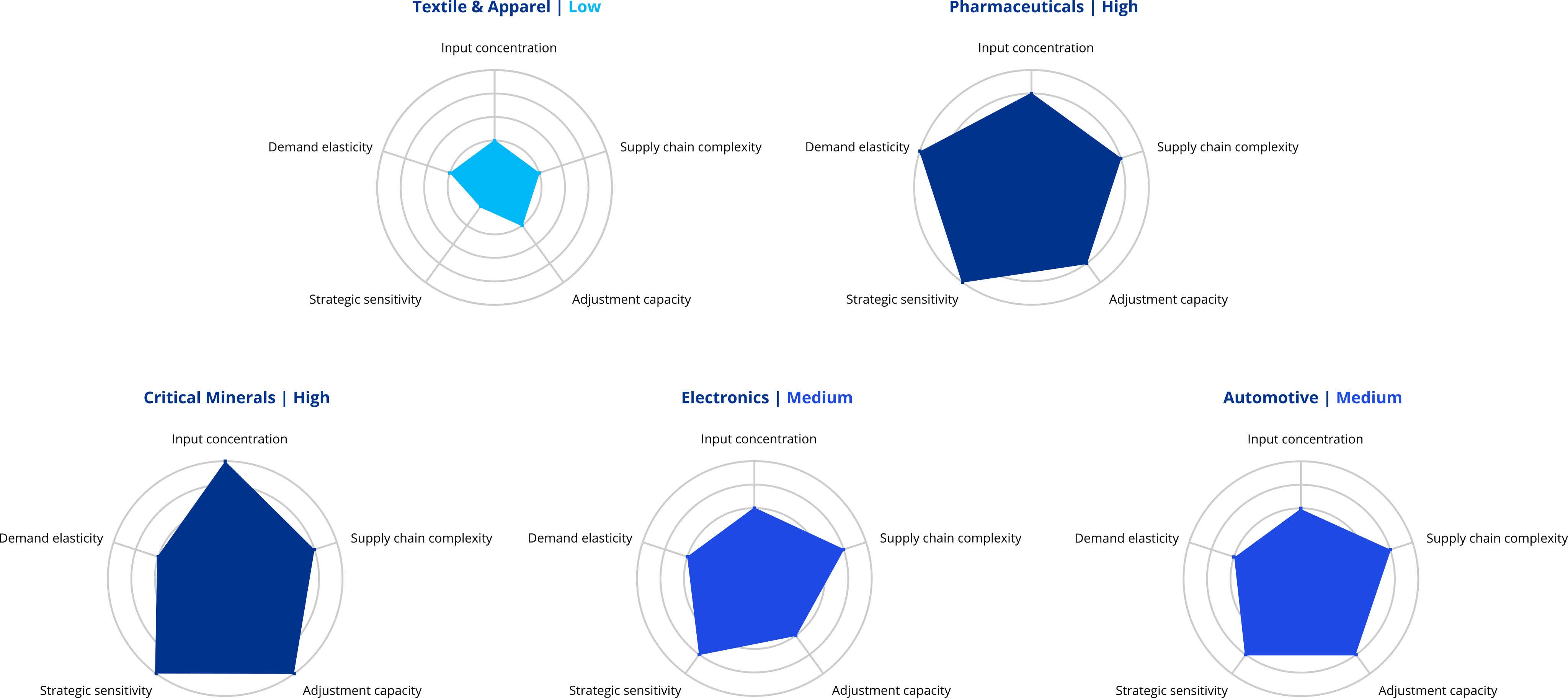
      Not all sectors face equal exposure to trade shocks. The impact depends on five structural factors: input and market concentration, supply chain complexity, adjustment capacity, strategic sensitivity, and demand elasticity.

      Shocks can be policy-driven — tariff adjustments, sanctions, export controls — or structural, arising from natural disasters, pandemics, or armed conflicts. The combination of these five dimensions determines where a sector sits on the exposure spectrum and, critically, which strategic responses are available.


      Ratings on a 1-5 scale across five dimensions of trade shock vulnerability. Higher ratings indicate greater exposure. Input-concentration assessments draw on apparel-production,⁴ pharmaceutical-API,⁵ rare-earth,⁶ and cobalt⁷ sourcing analysis.

      Strategic responses by exposure level

      Companies can employ a range of strategies depending on their sector's structural position. The optimal choice reflects the interaction between sector exposure and the firm's competitive positioning. 

      Financial architecture of trade shock resilience

      Anticipation of — or reaction to — trade shocks reshapes firms' capital and operating models. These shifts can be mapped through a Capital Intensity (CI) versus Operational Flexibility (OF) matrix, which plots capital and operating expenditure as a share of revenue across time.

      Capital intensity (capex/revenue) measures long-term strategic investment — reinvestment in plant, equipment, and capacity. High ratios signal scale ambitions but also lock capital into fixed assets that become liabilities if trade routes shift beneath them.

      Operational flexibility (opex/revenue) measures day-to-day cost structure and the capacity to adjust costs when demand, supply, or regulation changes. Finding the balance between these two dimensions defines a company's resilience archetype.

      Electronics: Capital intensity as the winning strategy

      Capital-intensive sectors face constraints that limit rapid pivoting. Electronics firms have responded by moving toward asset-heavy resilience models — regionalizing production, vertically integrating, and investing in proprietary infrastructure.


      Despite stable company counts across quadrants, market capitalization has concentrated dramatically in Q1 — asset-heavy operators — after major shocks. This shift was driven by firms combining high intangible investment with strategic capex when capital was cheap, and by investors rewarding control over intellectual property.ᶜ⁸

      Textile and apparel: Brand ownership as the moat

      Operationally flexible sectors possess inherent reconfigurability. Textile and apparel firms can shift sourcing across countries because factories and labor can be redeployed with limited capital cost. The winning strategy here is brand control and vertical integration of the customer relationship. 


      Market cap concentration in Q2 — integrated brand owners — confirms that investors reward companies with full control of their value chain: from raw material through design, production, and distribution to the end consumer. 


      The pattern across both sectors is consistent: in inflexible sectors, firms compensate through strategic asset ownership. In flexible sectors, firms build capabilities and brand power. Markets reward both approaches. 

      Case study: Dell vs Lenovo

      While firms with high intangible assets have surged in value, legacy electronics manufacturers must chart a path through a complicated set of geopolitical and logistical constraints. 

      Dell's post-2019 shift toward higher capital intensity signals a strategic pivot to AI infrastructure and supply chain resilience. After years of operating a "build-to-order" model with negative cash conversion cycles driven almost entirely by payment terms, Dell began investing in regional manufacturing capacity — a "China+1" strategy diversifying to Mexico and Vietnam.

      Lenovo's tight clustering reflects a scale-driven, China-centric supply chain. The consistency delivers lower unit costs through density, but concentrates geographic risk. Lenovo's cost-led model gives it market share; Dell's margin-led model gives it a profit cushion against rising input costs.ᵈ

      The great recoupling

      The trade shocks of the past decade were a prelude. To chart a course through what comes next, companies should take four actions: 

      • Forensically map their supply chains

        Identify geographic concentrations, pinpoint single points of failure, quantify exposure to specific choke points, and deploy adaptive strategies before the next disruption arrives.

      • Move early

        Defensive strategies — diversification, inventory buffering, nearshoring — are cheaper and faster when competitors are not scrambling for the same limited capacity.

      • Accept the trade-off

        Whether through capital investments to own and control critical assets, or higher operational costs for greater agility, resilience costs efficiency. The question is whether to pay that cost now, on your terms, or later, on someone else's.

      • Stay true to core positioning

        Dell built supply chain resilience through regional manufacturing diversification, while Lenovo pursued scale through density. Both succeeded because they reinforced, rather than abandoned, their competitive identity.


      Complete decoupling is neither possible nor desirable. Supply chains exist because they create value. The objective is to make interdependence strategic — accepting some risks while eliminating others. The winners will be those who make hard choices now rather than when the next crisis forces their hand. 


      fy26-kpmg-strategy-splintering-supply-chains

      Spintering supply chains

      Deal Advisory Supply Chain

      a. Greater China comprises mainland China, Hong Kong SAR, and Macao SAR.
      b. EMH classification follows the UNIDO Country Classification (2025 edition): middle-income industrial or industrialising economies.
      c. Intangible assets account for 92% of S&P 500 market capitalization.
      d. Dell now employs a "supply-first" approach for select AI infrastructure components, hedging against rising costs for GPUs and high-bandwidth memory.

      1. United Nations. (n.d.). TradeFlow. UN Comtrade Plus. comtradeplus.un.org 
      2. ING. (n.d.). Is Europe still in the semiconductor race? ING Wholesale Banking. ingwb.com 
      3. Cantú Bazaldúa, F. (2025). UNIDO Country Classification: Edition 2025. United Nations Industrial Development Organization. 
      4. TUE Garment. (n.d.). Analysis: Apparel production in China, India, Vietnam and Bangladesh. tuergarment.com 
      5. Eglovitch, J. S. (2024, November 8). USP: India and China continue their API manufacturing reign. Regulatory Affairs Professionals Society. raps.org 
      6. Rare Earth Exchanges. (2025, June 18). Analyst report: China to maintain rare-earth dominance through 2035. rareearthexchanges.com 
      7. Yu, A., & Camposano, J. (2025, October 16). DRC cobalt export quotas to support cobalt prices, though challenges loom. S&P Global Market Intelligence. 
      8. Ocean Tomo. (2025). Intangible Asset Market Value Study. oceantomo.com 

      Additional data sources. S&P Global Market Intelligence (2001–2025), data for the top 100 companies by revenue. United Nations Conference on Trade and Development. (2025). Global Trade Update, December 2025. United Nations Industrial Development Organization. UNIDO Statistics Portal. Worldometer. Dell Technologies and Lenovo Group Annual Reports, 2010–2025.

      Our insights

      From PPAs to power ownership: How data centers are driving a power generation land grab

      The year of the carve-out

      Designing, executing and winning Consumer and Industrials carve-outs

      Our people

      Javier Rodriguez

      Head of KPMG Strategy

      KPMG International

      Barnaby Robson

      Partner, Head of Value Creation, China, Head of Deal Strategy, Hong Kong, Head of Financial Services Deals, Hong Kong

      KPMG in China

      Audrey Menard

      Partner, Deal Strategy and Value Creation

      KPMG China