We believe sustainable growth is the only way to build a successful business and have a lasting impact on the world. Our commitment to good governance of ESG spans all the way to Board level.
To us, good governance of ESG is much broader than the oversight of data or reporting, it requires a fundamental transformation of all processes involved in running a business, and a significant mindset shift towards sustainability-focused thinking.
That’s demonstrated by the activities of our Board and Board Committees in 2025.
Example of Board and Board Committee ESG activities during FY25
* The UK Audit and Risk Committee (ARC) has been dissolved – and its former responsibilities are now split between the UK Oversight Board and the Group ARC.
Our governance structure
KPMG UK and KPMG Switzerland merged on 1 October 2024 (the Group).

Melissa Geiger
Melissa Geiger, as Group Board Chair, oversees the stewardship, accountability and leadership of the Group. Melissa is responsible for ensuring the Group Board fulfils its responsibilities to set the tone from the top, including approval and oversight of Group strategy and holding senior leadership to account.

Jon Holt
Jon Holt, Group Chief Executive and UK Senior Partner, is responsible for leading the whole business of the multi-disciplinary firm and is accountable for the executive leadership’s execution of the Group Board’s approved strategy. The Chief Executive is accountable to the Board and the partners in fulfilling these responsibilities.
Independent oversight
Independent oversight of KPMG UK is sought from the Independent Non-Executives (INEs) and Audit Non-Executives (ANEs).
The UK Board is now referred to as the UK Oversight Board.
Risk management
We manage risk responsibly and in the interest of our stakeholders and the public.
Our Board is responsible for identifying, evaluating, managing and monitoring the most significant risks that face our firm. The principal risks and uncertainties that our UK firm faces are set out in, and managed under, the firm’s Enterprise-Wide Risk Management (ERM) framework.
The ERM framework is subject to a comprehensive review and refresh on an annual basis. This involves robust challenge of the firm’s risk taxonomy, reflecting developments in the firm’s risk landscape (current and longer term) and changes made to KPMG Global’s enterprise risk management framework during the year.
For the year ending 30 September 2025, KPMG UK identified 11 principal risks that fall within four key risk ‘families’.
Principal risks
Reputational
- Conduct
- Regulation
- Legal
Strategic
- Growth strategy
- Client and audited entities
Operational
- Delivery – quality
- Delivery – execution
- People
- Technology
- Business operations
Financial
- Financial
Reputational
- Conduct
- Regulation
- Legal
Strategic
- Growth strategy
- Client and audited entities
Operational
- Delivery – quality
- Delivery – execution
- People
- Technology
- Business operations
Financial
- Financial
We view ESG risk as a cross-cutting risk within our Enterprise Risk Management (ERM) framework, which must be considered alongside other risk types and be integrated into the fabric of how we operate as a business. To address this, our risk owners are expected to consider potential ESG opportunities and risks under their purview at each level of our risk taxonomy.
Tax strategy and contribution
Tax strategy
KPMG in the UK is committed to full compliance with all statutory obligations and full disclosure to tax authorities. The firm’s tax affairs are managed in a way which takes into account the firm’s wider corporate reputation in line with KPMG in the UK’s overall high standards of governance.
Tax contribution
KPMG in the UK manages all of its tax affairs in a way which seeks to ensure compliance with legal requirements in a manner which ensures payment of the right amount of tax.
KPMG in the UK makes a significant contribution each year to the public finances through the taxes paid by our partners on our profit, the taxes we bear as an organisation such as employers’ national insurance, corporation tax (which is paid on the small proportion of profit earned in subsidiary companies), business rates and property and environmental taxes, and those we collect on behalf of the exchequer, such as employees’ national insurance, employment tax and VAT.
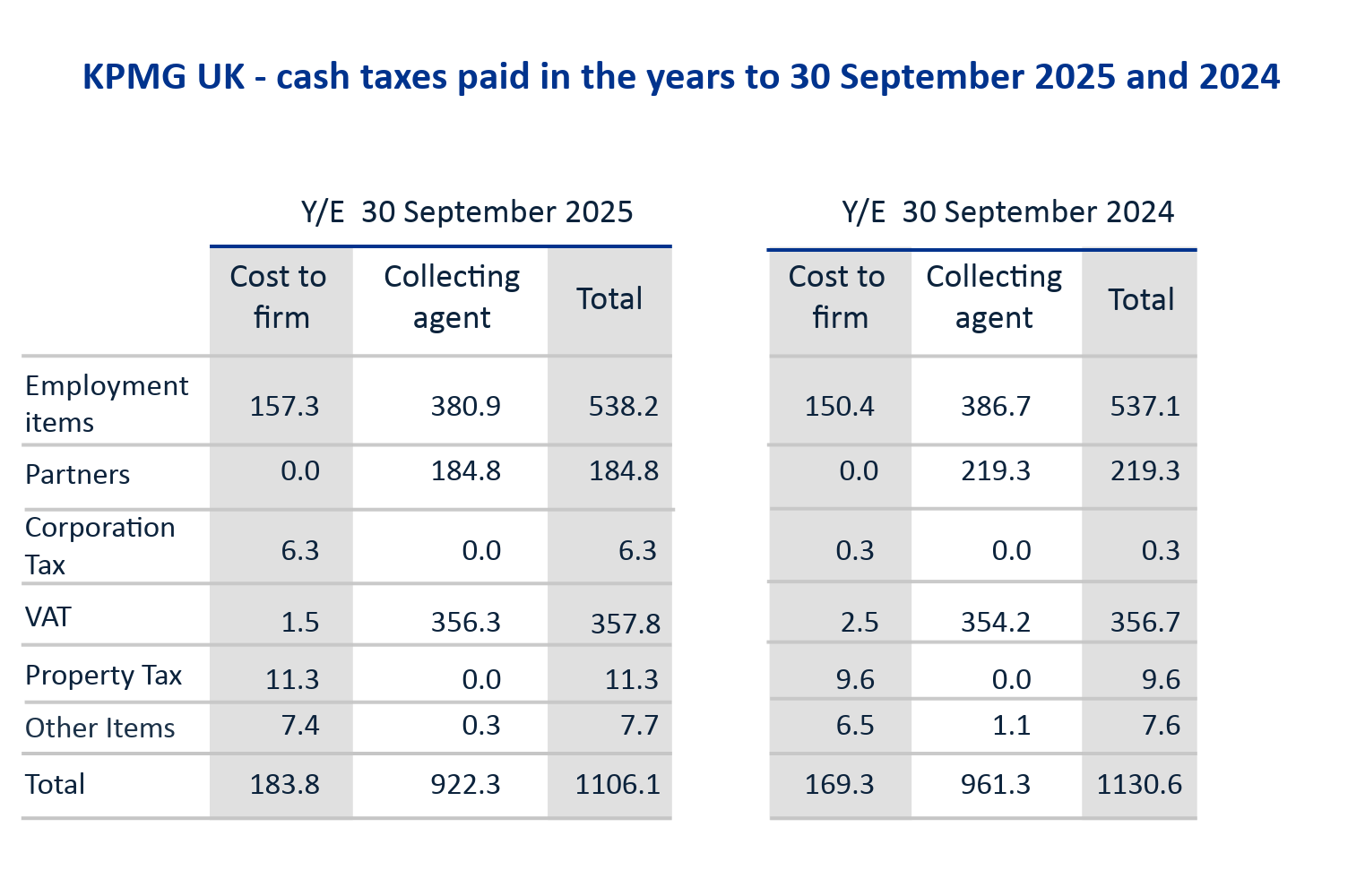
Taken together the total paid and collected by us in 2025 was £1,106.1 million (2024: £1,130.6 million). The information presented below shows the split between taxes borne by us directly (2025: £183.8 million (2024: £169.3 million), and those we collect for the public purse in the course of our day-to-day business (2025: £922.3 million (2024: £961.3 million).
It shows that our largest contribution comes through the tax paid in respect of and on behalf of our employees. We are proud of the contribution this level of employment makes to the overall economy.
Taken together, the tax borne by us and collected on behalf of the Government gives a clear picture of our economic activity, the contribution we make to the UK economy and the value we add to society at large.
Partners
KPMG in the UK manages all of its tax affairs in a way which seeks to ensure compliance with legal requirements in a manner which ensures payment of the right amount of tax. KPMG in the UK expects its members to adopt a corresponding approach in relation to their individual tax obligations and liabilities. It is a condition of membership of the firm that UK members provide KPMG in the UK with full visibility of their personal tax affairs. By requiring this transparency KPMG in the UK seeks to ensure that members comply fully with their obligations in respect of UK taxation.
Total partner income tax and national insurance paid during the year totalled £184.8 million compared with £219.3 million in the preceding year. In accordance with tax legislation, the tax we pay on behalf of the partners in the year is payable on 31 January and 31 July. The tax is payable by reference to the statutory rates of 20% and 40% on the first £150,000 of profit, and then at 45% thereafter (these rates also applied in 2024) together with national insurance contributions. Tax rates for Scottish partners are 2-3% higher. Capital Gains Tax is paid in a year on gains realised in the previous year. Tax paid in respect of partners during 2025 was lower than that paid in 2024; this is because of higher payments on account being made in the prior year leaving a smaller balance due in the year. Tax relating to the basis period reforms has started to become payable in the year ended 30 September 2025 and will be spread over a five year period as permitted by tax legislation.
Corporation tax
As a limited liability partnership, KPMG in the UK does not pay corporation tax on the majority of its profits. Those profits are instead subject to income tax in the hands of the individual partners.
Tax paid in 2025 is higher than in 2024 because the latter was largely settled by an overpayment in 2023.