The report presents a strategic perspective on the emergence of Sustainable Aviation Fuel (SAF) as a critical enabler of India’s aviation growth, energy security, and decarbonisation ambitions. India’s aviation sector is witnessing rapid expansion, with passenger traffic expected to grow steadily and position the country among the largest aviation markets globally.

      However, this growth is accompanied by increasing dependence on imported crude oil for aviation turbine fuel (ATF), exposing the sector to global price volatility, geopolitical risks, and supply chain disruptions. At the same time, evolving international carbon regulations and SAF mandates are reshaping the economics of global aviation, creating urgency for India to develop a domestic, scalable aviation fuel alternative.

      It highlights the convergence of two structural forces, that is, energy security and decarbonisation, which is elevating SAF from a sustainability initiative to a strategic fuel pathway for the aviation sector. Globally, SAF is gaining prominence due to its ability to reduce lifecycle emissions by up to 60–90 per cent while functioning as a drop-in fuel compatible with existing aircraft and infrastructure. For India, this transition presents a unique opportunity to leverage its agricultural base, biofuel ecosystem, refining capacity, and growing aviation demand to build a domestically anchored SAF ecosystem.

      A key theme of the report is the need to move beyond a blending-focused approach and develop a fully integrated SAF ecosystem. It outlines that the future of aviation fuel will be shaped by four structural pillars: feedstock resilience, multi-pathway production capability, integrated industrial clusters, and robust logistics and storage infrastructure. The report identifies viable SAF production pathways, such as Hydroprocessed Esters and Fatty Acids (HEFA) and Alcohol-to-Jet (ATJ), as critical enablers for early deployment, while also emphasising the importance of advanced pathways like Fischer–Tropsch (FT) and Power-to-Liquids (PtL) for long-term scalability.

      The report further presents a phased roadmap for India’s SAF transition, structured across three stages: foundation (creating policy certainty and investment confidence), scale-up (building industrial capacity and integrated infrastructure), and export play (positioning India within global SAF supply chains). It underscores that early blending mandates, while important for compliance and market development, are only the starting point. Achieving meaningful energy security and reducing crude oil dependence will require large-scale deployment and ecosystem-wide alignment across airlines, refiners, fuel producers, airports, logistics providers, and policymakers.

      Key highlights of the report

      • India’s aviation sector is experiencing rapid growth, thus increasing demand for aviation fuel and exposing dependence on imported crude oil
      • Highlights the dual challenge of energy security and decarbonisation, driving the need for alternative aviation fuels
      • Positions Sustainable Aviation Fuel (SAF) as a strategic solution for both emissions reduction and fuel resilience
      • Identifies SAF as a drop-in fuel capable of reducing lifecycle emissions by 60–90 per cent
      • Outlines four pillars of a SAF ecosystem: feedstock resilience, multi-pathway production, industrial clusters, and logistics infrastructure
      • Highlights key production pathways including HEFA and ATJ for near-term scale-up, with FT and PtL for long-term transition
      • Emphasises need for integrated SAF ecosystems rather than isolated projects or pilot initiatives
      • Presents a three-phase roadmap: Foundation, Scale-Up, and Export Play for India’s SAF transition
      • Identifies challenges across the value chain including feedstock aggregation, financing, logistics, certification, and demand visibility
      • Positions SAF as a strategic industrial opportunity to enhance energy security, enable decarbonisation, and build global competitiveness

      Overall, the report provides a comprehensive framework for developing a resilient aviation fuel ecosystem in India. It brings together insights on SAF production pathways, feedstock strategy, policy mechanisms, industrial integration, and global market positioning. By outlining both the opportunities and structural challenges, the report positions SAF not just as a decarbonisation tool, but as a strategic industrial opportunity that can strengthen energy resilience, enable bioeconomy development, and establish India as a key player in the emerging global sustainable aviation fuel market.


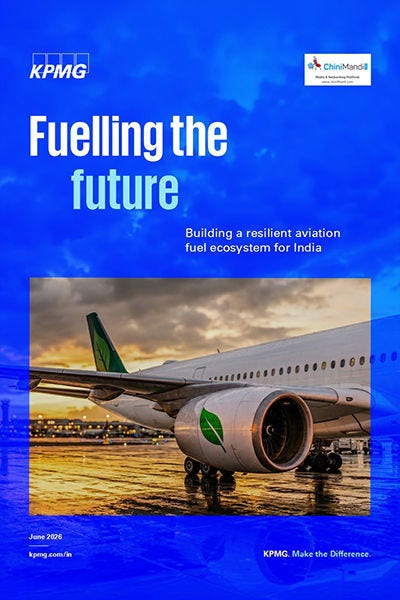
      Fuelling the future: Building a resilient aviation fuel ecosystem for India


      A strategic roadmap to scale sustainable aviation fuel (SAF) and strengthen India’s aviation energy security and resilience


      Key Contacts

      Anish De

      Global Head for Energy Natural Resources & Chemicals (ENRC)

      KPMG International

      Vivek Rahi

      Partner and National Head - Oil & Gas

      KPMG in India

      Jodhbir Sachdeva
      Jodhbir Sachdeva

      Associate Partner, Aviation

      KPMG in India

      How can KPMG in India help

      Energy has been universally recognised as one of the most important inputs for economic growth and human development

      We have a well-defined and robust approach to support our clients effectively across a spectrum of projects in business performance services, transaction services and tax and regulatory services including offset advisory

      For a more productive and sustainable business future

      Access our latest insights on Apple or Android devices