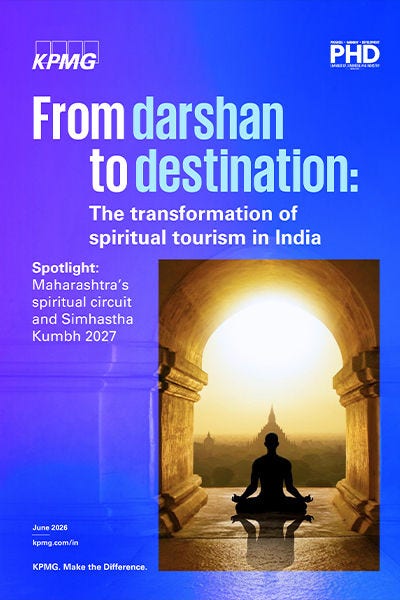
‘From darshan to destination: The transformation of spiritual tourism in India’ is a comprehensive thought leadership report by KPMG in India, developed in collaboration with the PHD Chamber of Commerce and Industry (PHDCCI). This study explores India’s spiritual tourism sector which is currently undergoing a major transformation from a traditional pilgrimage-driven model to an integrated, experience-led ecosystem. Historically focused on short visits for ritual fulfilment, the sector is now evolving to cater to diverse traveller expectations, including cultural exploration, wellness, and personal transformation.

      This shift is expanding the visitor base beyond traditional pilgrims to include experience seekers, lifestyle travellers, youth audiences, and international visitors. The industry is witnessing strong growth, supported by increasing domestic travel, increased disposable incomes, improved connectivity, and government initiatives such as Swadesh Darshan and PRASHAD.


      India’s spiritual tourism sector is at an inflection point, where scale and diversity of demand are converging with the need for more structured and experience-led development. The opportunity lies in moving beyond managing footfall to designing holistic destination ecosystems that integrate infrastructure, storytelling, and technology. If executed effectively, spiritual tourism can become a key pillar of India’s broader tourism and economic growth strategy, while preserving the authenticity and sanctity of its cultural heritage.
      Vivek Agarwal

      Partner and Head - Public Infrastucture, Lead - Industrial and Infrastructure Development Advisory, Government and Public Services

      KPMG in India


      Key highlights of the report

      • Experience economy

        The emergence of the ‘experience economy’, where travellers value immersive and participatory experiences over simple visitation. Spiritual destinations are increasingly integrating storytelling, festivals, guided tours, wellness activities, and community engagement, transforming into holistic ecosystems. Circuit based travel is also gaining importance, allowing visitors to explore multiple destinations within a unified journey

      • Multi-dimensional spiritual traveller

        Another defining shift is the rise of the ‘multi-dimensional spiritual traveller’, whose motivations blend spirituality with lifestyle, leisure, and self-development. Younger demographics, influenced by digital platforms and social media, are engaging with spirituality in new ways, including hybrid formats and experiential events. International demand remains strong, particularly for yoga, meditation, Ayurveda, and Buddhist heritage circuits

      • Technology

        Technology is playing a critical enabling role in this transformation. Digital platforms, AI-driven personalisation, virtual reality experiences, and live-streaming services are enhancing accessibility, improving visitor planning, and enabling real-time destination management. At the same time, private-sector innovation and the rise of ‘faith-tech’ are further expanding digital engagement


      The next phase of growth in spiritual tourism will be driven by how effectively destinations create integrated, experience-led journeys. Maharashtra presents a compelling opportunity in this context, with its well-established spiritual circuits and anchor destinations such as Shirdi and Nashik. The upcoming Simhastha Kumbh Mela further reinforces the state’s potential to emerge as a global spiritual tourism hub. By leveraging circuit-based planning, digital enablement, and public–private collaboration, Maharashtra can lead the way in creating scalable, immersive and globally competitive spiritual tourism experiences.
      Aalap Bansal

      Partner and Chief Sales Officer – G&PS and Lead – Tourism, Sports and Leisure Practice

      KPMG in India

      However, this evolution also introduces challenges. High visitor volumes are creating pressure on infrastructure, crowd management, environmental sustainability, safety incidents, and heritage preservation. Balancing modern amenities with the authenticity of spiritual sites remains a key concern.

      To address these challenges and unlock future potential, the sector requires strategic interventions. These include experience-led policy frameworks, stronger governance through multi-stakeholder coordination, development of integrated infrastructure, and positioning India as a global hub for experiential spirituality. Emphasis on sustainability, inclusivity, and cultural preservation will be critical.

      The case of Maharashtra highlights how circuit-based planning can enhance spiritual tourism by connecting multiple destinations into cohesive travel experiences. Large-scale events such as the Kumbh Mela further demonstrate the sector’s potential to drive economic activity and infrastructure development. The upcoming edition, Simhastha Kumbh Mela in Nashik and Trimbakeshwar, scheduled between late 2026 and mid-2028,1 is expected to witness unprecedented participation, with estimates suggesting over 12 crore devotees,2 a significant increase from approximately 2.5 crore in 2015 and 0.75 crore in 2003.3 With the expected influx of millions of devotees, the Mela is projected to generate up to INR 27,000 crore in total economic activity.4 This presents an opportunity to position Maharashtra, India, within the global context of the spiritual tourism sector.

      Overall, India’s spiritual tourism is at an inflection point, where success will depend on its ability to combine tradition with innovation, scale with sustainability, and deliver meaningful, immersive experiences while preserving its cultural and spiritual essence.

      From darshan to destination: The transformation of spiritual tourism in India

      India’s spiritual tourism is shifting from pilgrimage to immersive experience-led travel, driving growth, innovation, and regional development

      [1] Nashik Kumbh Mela | accessed on 03 June 2026
      [2] Nashik authorities face challenge as 2027 Kumbh mela footfall projected at 12 crore | The times of India | accessed on 03 June 2026
      [3] In the limelight | The Hindu | accessed on 03 June 2026
      [4] Simhastha Kumbh 2027 in Nashik to generate up to 27,000 crore economic activity: study | Punekar News | accessed on 04 June 2026

      Key Contact

      Aalap Bansal

      Partner and Chief Sales Officer – G&PS and Lead – Tourism, Sports and Leisure Practice

      KPMG in India

      How can KPMG in India help

      Smart manufacturing transforms traditional processes with technology

      The economic, social and political environment globally and in India seems to be evolving.

      Collaborating for progress, development, citizen empowerment and upliftment

      Access our latest insights on Apple or Android devices