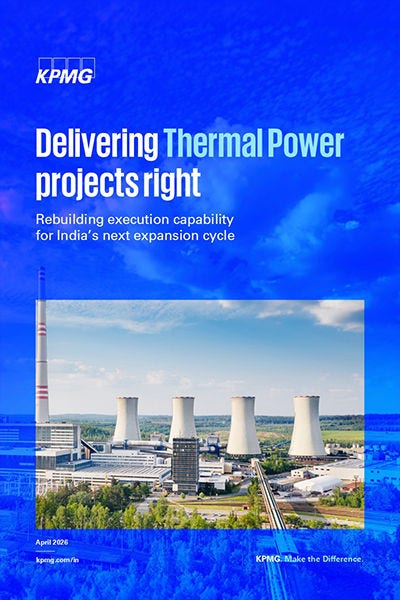
Delivering thermal power projects right explores why execution capability-not capital, ambition, or policy intent-has become the binding constraint for India's next phase of thermal power expansion. As India's peak electricity demand crosses 250 GW and total installed capacity reaches over 520 GW, energy security, grid stability, and affordability remain critically dependent on firm, dispatchable thermal power, even as renewable capacity accelerates. This thought leadership (TL) examines how India is re entering a major thermal expansion cycle under fundamentally different conditions from previous build outs-characterised by ecosystem scarcity, constrained manufacturing capacity, talent depletion, and fragmented delivery models.
Despite more than 50 per cent of India's installed capacity now coming from non fossil sources, thermal power continues to anchor system reliability during peak demand periods, renewable intermittency, and extreme weather events. With per capita electricity consumption projected to rise from approximately 1,400 kwh today to nearly 4,800 kwh by 2050, India's energy system must expand not only in scale, but also in resilience. In this context, thermal capacity expansion is not a reversal of the energy transition, but a stabilising force enabling renewables to scale sustainably.
The report highlights how a prolonged slowdown in thermal capacity addition over the last decade has eroded execution readiness across the value chain-engineering depth, EPC and OEM capacity, contractor availability, manufacturing slots, supply chains, and experienced project leadership. As a result, India is entering its next expansion cycle under conditions of scarcity rather than surplus. Planned thermal additions of more than 97 GW over the next decade are already facing bottlenecks, with recent years showing significant shortfalls between planned and actual capacity addition due to constraints in BTG manufacturing, EPC capacity, and skilled manpower.
Drawing on KPMG in India's experience across 38.5 GW of thermal power projects overseen since 2009, the report explains why execution challenges-such as design changes, interface mismatches, delayed clearances, resource idling, and manual progress tracking-are not isolated project issues but systemic outcomes of outdated delivery models. While other infrastructure sectors have achieved productivity gains through standardisation, modularisation, and digital execution, thermal power has lost momentum due to discontinuity and fragmented practices.
The report proposes a modern thermal project delivery Target Operating Model (TOM) anchored around five critical execution decisions:
These decisions are enabled through KPMG's DRIVE model, which serves as the execution imperative for India's thermal ecosystem-Digital execution platforms, Resilient and visible supply chains, Institutionalised governance, Value based performance linked delivery models, and Enabled workforce capability and development. The report argues that India's thermal power challenge is no longer about whether capacity is required, but whether the ecosystem can deliver projects predictably, at scale, and under scarcity.
Ultimately, Delivering thermal power projects right positions execution excellence as the decisive factor that will determine whether India's thermal expansion strengthens energy security, supports the clean energy transition, and delivers long term value for developers, utilities, EPC players, and policymakers.
Delivering thermal power projects right
Rebuilding execution capability for India’s next expansion cycle
Key Contacts

Anish De
National Leader - Energy Natural Resources & Chemicals (ENRC) and Infrastructure
KPMG in India

Suneel Vora (PMP®)
Partner and Head - Major Projects Advisory Services, Business Consulting
KPMG in India
How can KPMG in India help


Access our latest insights on Apple or Android devices