This report was launched at the AIMA Foundation Day.
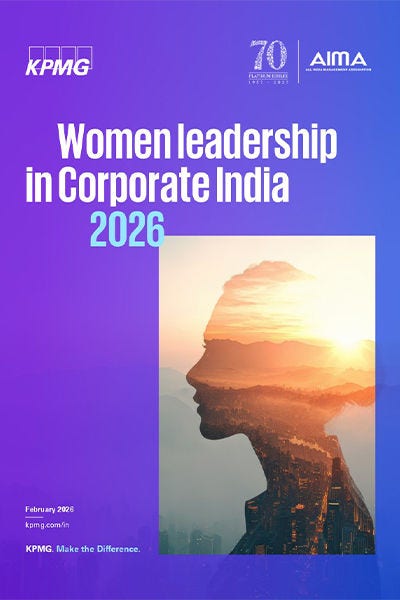
Women’s leadership continues to evolve as a defining priority for corporate India. The Women Leadership Survey 2026, jointly conducted by the All India Management Association (AIMA) and KPMG in India, marks the second edition of this flagship study, offering a deeper and more data‑driven view of how women advance into leadership roles, the barriers that shape their journeys, and the organisational systems that influence equitable progression.
Building on the foundation of the previous report, this edition deepens the focus from representation to leadership experience, progression, and systemic effectiveness.
The study captures perspectives from professionals across industries, organisation sizes and management levels to examine how women progress into leadership roles, the barriers they encounter, and the extent to which organisational systems enable or constrain their growth amid evolving leadership expectations.
Key highlights:
Across the five dimensions assessed-leadership representation, aspirations and barriers, access to skill development, leadership opportunities, and organisational culture-the report presents an in‑depth view of the state of women in corporate leadership today.
The findings indicate that while senior level representation has increased, perceptions of fairness and consistency in advancement have weakened.
One of the most significant pressure points highlighted in the 2026 survey is the mid‑career stage, where attrition risk is highest and leadership momentum is most likely to stall. Competing demands related to work–life balance, caregiving responsibilities and burnout continue to intersect with organisational expectations, often slowing progression or prompting exits despite sustained ambition.
Importantly, the findings suggest that women’s exits are rarely driven by declining aspiration; instead, they reflect accumulated organisational frictions, role design constraints and uneven support during critical transitions.
Evaluation processes and leadership advancement
The report also surfaces growing concern around fairness and transparency in leadership evaluations and promotions. While many organisations report having defined leadership assessment processes in place, perceptions of fairness have weakened, signalling a gap between formal systems and lived experience.
This trust gap has implications for leadership confidence, engagement and long‑term retention, particularly for women navigating senior and high‑visibility roles.
Leadership development and opportunity
Access to leadership development emerges as another critical theme. Although leadership development programmes for women are increasingly available, participation gaps persist, and a significant proportion of women report not engaging in any formal leadership development initiative over the past year.
The report reinforces that leadership readiness is shaped not only by training interventions, but also by access to stretch assignments, visibility, sponsorship and decision‑making authority. Without these enablers, development efforts risk remaining episodic rather than transformational.
Organisational culture and inclusion
Organisational culture plays a decisive role in determining whether intent translates into impact. While DEI commitments and inclusive leadership messaging have gained prominence, cultural reinforcement remains inconsistent across teams and levels.
Many women continue to experience neutrality rather than active support in day‑to‑day leadership interactions, authority and recognition. The report underscores that inclusive cultures are built through consistent behaviours, transparent systems and leadership accountability, not policy statements alone.
Evaluation processes and leadership advancement
The report also surfaces growing concern around fairness and transparency in leadership evaluations and promotions. While many organisations report having defined leadership assessment processes in place, perceptions of fairness have weakened, signalling a gap between formal systems and lived experience.
This trust gap has implications for leadership confidence, engagement and long‑term retention, particularly for women navigating senior and high‑visibility roles.
Leadership development and opportunity
Access to leadership development emerges as another critical theme. Although leadership development programmes for women are increasingly available, participation gaps persist, and a significant proportion of women report not engaging in any formal leadership development initiative over the past year.
The report reinforces that leadership readiness is shaped not only by training interventions, but also by access to stretch assignments, visibility, sponsorship and decision‑making authority. Without these enablers, development efforts risk remaining episodic rather than transformational.
Organisational culture and inclusion
Organisational culture plays a decisive role in determining whether intent translates into impact. While DEI commitments and inclusive leadership messaging have gained prominence, cultural reinforcement remains inconsistent across teams and levels.
Many women continue to experience neutrality rather than active support in day‑to‑day leadership interactions, authority and recognition. The report underscores that inclusive cultures are built through consistent behaviours, transparent systems and leadership accountability, not policy statements alone.
Why this report matters
The second edition of the survey provides actionable direction for organisations seeking to build robust, future‑ready leadership pipelines. It emphasises the need for intentional organisational design, strengthened advancement pathways, equitable and bias‑resilient evaluation systems, structured sponsorship, and sustained cultural reinforcement.
As leadership expectations continue to evolve, the insights from the Women leadership in Corporate India 2026 report offer an opportunity for organisations to reflect on progress, recalibrate priorities and reaffirm the long‑term value of gender‑balanced leadership to organisational performance, resilience and growth.
Women leadership in Corporate India 2026
Explore how changes in leadership pathways, evaluation processes, and organisational culture are reshaping women’s leadership journeys
Key Contacts


How can KPMG in India help


Access our latest insights on Apple or Android devices