India’s ambition to become a developed economy by 2047 places real estate at the centre of the country’s economic, social and infrastructure agenda. This report sets - out how the sector converts national intent into on-ground capacity through housing, productive workplaces, modern urban infrastructure and stronger market trust, with execution, not projections, as the central theme. 

      It provides a structured view of the forces reshaping the ecosystem, inclusive housing and housing finance, the next wave of commercial demand led by GCCs and flexible workspaces, the technology stack transforming approvals, construction and operations, the acceleration of green building and the regulatory backbone that is improving transparency and investor confidence. 
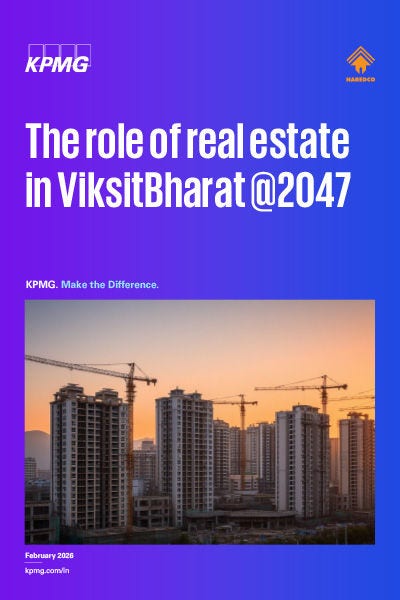

      Key highlights of the report:

      • ViksitBharat 2047 lens, real estate as a national execution lever

        Real estate is positioned as a direct enabler of productivity, competitiveness and quality of life by building the physical capacity. India needs at scale - homes, jobs, workplaces and urban systems

      • Scale-up trajectory and rising economic footprint

        The report highlights a steep expansion in market size from INR26.4 trillion in 2025 to INR88 trillion by 2030 and further to an estimated INR440.5-616.7 trillion by 2047, alongside a rising share of gross domestic product (GDP), reinforcing real estate’s role as a core growth engine rather than a peripheral sector

      • Housing as the foundation of inclusive growth

        The housing challenge is framed as primarily an affordability and low-income access challenge, with the largest gap concentrated in economically weaker sections (EWS) and lower income groups (LIG) segments and constrained by formal credit access. Pradhan Mantri Awas Yojana-Urban (PMAY-U) and PMAY-U 2.0 are positioned as key scale mechanisms, while the next phase needs stronger delivery capacity, better targeting and financing pathways that expand formal participation including ownership and rental solutions

      • Commercial real estate, where productivity happens

        The report explains how office demand is shifting toward grade-A, future-ready assets, with global capability centres as a structural demand engine and flexible workspaces becoming mainstream. It also highlights the growing role of institutional capital and listed structures such as real estate investment trust (REIT) in deepening long-duration investment participation in quality commercial assets

      • Technology and innovation, moving from add-on to operating system

        Artificial intelligence (AI), digital governance and construction technology are shown as practical execution accelerators, improving speed, transparency, safety and lifecycle performance. The report covers the digitisation of approvals and land systems, property technology (PropTech) and internet of things (IoT)-enabled operations and modern construction methods such as prefabrication as levers to reduce delays and improve quality

      • Green building, from choice to necessity

        Sustainability is framed as a cost, resilience and competitiveness imperative. The report points to the mainstreaming of green standards and the policy stack supporting them and it notes the green building market trajectory to about INR6.2-7.0 trillion by FY30

      • Regulation and trust, enabling investable confidence

        The report highlights how Real Estate Regulatory Authority (RERA) has improved disclosure discipline, accountability and buyer protection, helping convert trust into capital confidence. It also links the broader regulatory and market architecture, including REIT and digitised systems, to improve transparency and deeper participation by long-term investors

      • Demographic shifts reshaping demand patterns

        The report captures how next-generation buyers are changing preferences toward ready-to-move, amenity-led and well-connected locations, how women’s participation in homeownership is rising and how formats such as senior living and co-living are emerging alongside traditional housing demand

      • Execution agenda, what must happen next?

        The report closes with a clear execution thesis. Achieving the 2047 opportunity depends on strengthening institutions and predictable rules, accelerating infrastructure delivery, institutionalising technology and green adoption, keeping inclusion central through affordability-led supply and rental ecosystems and raising skilling and professional standards to improve productivity and delivery reliability


      The role of real estate in ViksitBharat @2047

      A comprehensive perspective on how real estate can help deliver the Viksit Bharat 2047 vision at national scale

      Related content

      National Urban and Real Estate Development Conclave – 2026


      An overview of India’s evolving real estate landscape driven by sustainable urbanisation, strengthened governance and future‑ready development pathways

      Key Contact

      Neeraj Bansal

      Partner and Head India Global

      KPMG in India

      How can KPMG in India help

      The world is witnessing urbanisation at an unprecedented pace, which is expected to further accelerate, and India is anticipated to lead this growth.

      Providing fillip to Infrastructure and Industrial ecosystem in India

      KPMG’s Business Consulting professionals we may help you identify and solve the challenges that stand in the way of your growth and progress

      Access our latest insights on Apple or Android devices