

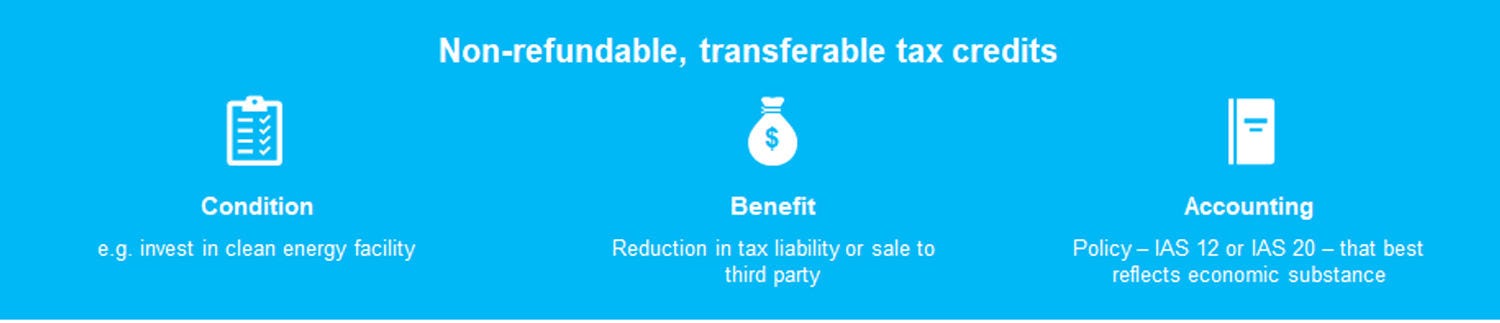
Typically, companies benefit from non-refundable, transferable tax credits in the form of:
- a reduction in the tax liability; or
- a cash payment from the transfer (sale) to an unrelated third party.
Your questions answered
There is no specific guidance in IFRS® Accounting Standards for non-refundable, transferable tax credits. Therefore, a company needs to develop an accounting policy that best reflects the economic substance of those credits. This requires judgement in light of all relevant facts and circumstances.
In our view, in determining the economic substance of these tax credits, a company may consider, among other factors, whether it generally expects to realise the benefits of the credits:
- through reducing its taxable income; or
- by transferring the credits to a third party.
The accounting standard a company applies by analogy to these tax credits will depend on whether it determines their economic substance to be similar to:
- a tax allowance: we believe that it is appropriate to account for these tax credits applying IAS 12 Income Taxes by analogy; or
- a government grant: we believe that it is appropriate to account for these tax credits applying IAS 20 Accounting for Government Grants and Disclosure of Government Assistance by analogy.
Once a company develops its accounting policy, we believe that it should apply it consistently to all non-refundable, transferable credits, regardless of how it realises the benefits of the credits at subsequent reporting dates – i.e. whether they reduce taxable income or are transferred to a third party.
This depends on the accounting policy applied (see Question 1).
Tax credit similar to… | Applicable accounting standard | Follow recognition and presentation guidance for… |
Tax allowance | IAS 12 | Non-refundable, non-transferable tax credits (see Question 2) |
Government grant | IAS 20 | Refundable tax credits (see Questions 2 to 5) |
Answering your questions


© 2026 KPMG IFRG Limited, a UK company, limited by guarantee. All rights reserved.