

This article relates to the proposed amendments to the Technical Screening Criteria (TSC). For information on the latest amendments proposed by the ESAs, read our article.
Highlights
Companies in scope of the Corporate Sustainability Reporting Directive (CSRD) may need to apply proposed new amendments to the EU Taxonomy from 2026 reporting periods. The proposals contain changes to activity descriptions and Technical Screening Criteria (TSC) for most economic activities.

What's the issue?
On 17 March 2026, the European Commission published proposed amendments to the EU Taxonomy’s Climate and Environmental Delegated Acts (CDA and EDA). The proposals include widespread revisions of the activity descriptions and the TSC used to determine whether economic activities are environmentally sustainable.
The TSC include both substantial contribution criteria and Do No Significant Harm (DNSH) criteria. The revisions aim to harmonise the TSC more closely with other EU legislation, thereby reducing complexity for reporting companies, and were open for public consultation until 14 April 2026.
Following the latest amendments to the Disclosure Delegated Act as part of the Omnibus initiative, this proposal is part of the regular cycle to update the TSC.
What's the impact?
Most companies applying the EU Taxonomy would be affected by the proposed changes. Companies would need to reassess if their activities are eligible under the revised activity descriptions. Furthermore, they would need to prepare for updating the alignment assessment of their eligible activities in line with the revised criteria.
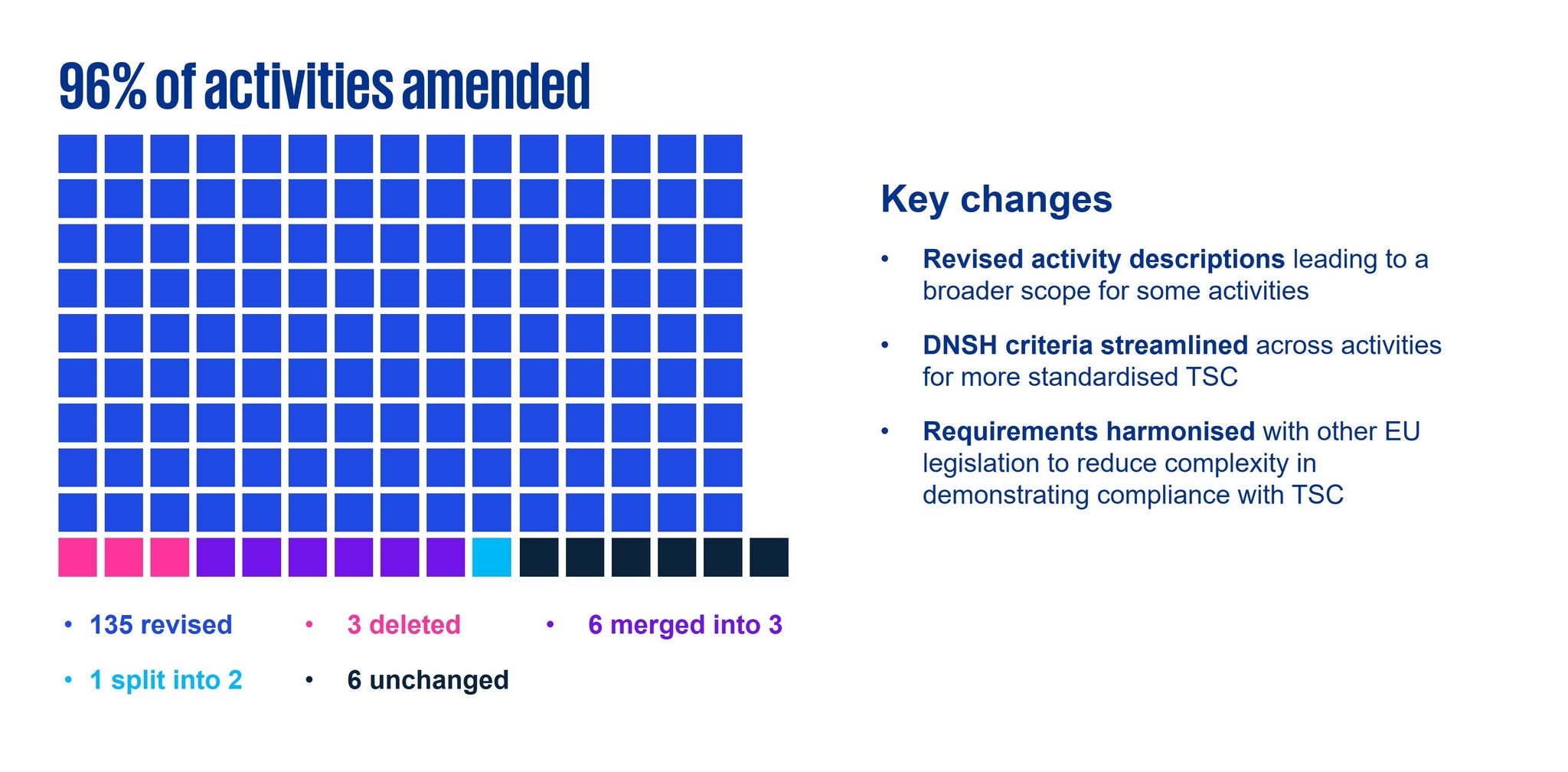
Although the proposed revisions to individual economic activities vary in significance, the proposed revisions to the general DNSH criteria would affect most economic activities. The below table summarises the key changes proposed.
| Amendments proposed to the general DNSH criteria | |
| Climate change adaptation (Appendix A) | The criteria would be clarified and structured under a four-phase approach:
The initial screening of potential climate-related hazards would be to assess the need for a CRA. If a CRA is not needed, then phases 2 to 4 would not be required. However, for economic activities that substantially contribute to the objective of climate change adaptation (Annex II of the CDA), there would be five phases. The substantial contribution criteria would include the four phases above plus an additional monitoring phase. Additional rules would apply for enabling activities. |
| Sustainable use and protection of water and marine resources (Appendix B) | The taxonomy assessment would only require an Environmental Impact Assessment (EIA) if mandated by the Environmental Impact Assessment Directive (2011/92/EU). Otherwise, compliance could be demonstrated through an ‘environmental permit’ (or an ‘alternative available evidence of compliance’ when a permit is not available). |
| Pollution prevention and control (Appendix C) | Exceptions would be explicit and clarified for all categories of chemicals. Specific substances of very high concern would no longer require proof that ‘no other suitable alternative substances or technologies are available’. This would be replaced by a requirement to implement measures to ‘minimise exposures and emissions as far as practically possible’. A new clause would clarify that releasing/mobilising naturally occurring substances is not considered to be pollution. |
| Protection and restoration of biodiversity and ecosystems (Appendix D) | The requirement would be explicitly limited to cases in which Directive 2011/92/EU requires an EIA or a ‘screening’ to determine if such an assessment is necessary. ‘Critical habitats’ and ‘nationally protected areas in third countries (non‑EU)’ would be added to the list of biodiversity-sensitive areas. Offsetting would be explicitly indicated as not aligned with this DNSH criterion. |
| Water appliances (Appendix E) | This would no longer be a ‘generic DNSH’ requirement. Instead, the economic activities previously referencing Appendix E would now include simplified criteria regarding water usage for water appliances as activity-specific DNSH criteria. |
What's next?
The public consultation ended on 14 April*. The Commission will now consider the feedback received and aims to adopt the amendments in Q4 2026. After a scrutiny period of up to six months, the amendments could then enter into force during Q1 2027 and apply from 2027 reporting periods onwards.
Additionally, the Commission has called on the European supervisory authorities1 (ESAs) to develop technical advice aimed at improving the usability of the EU Taxonomy through targeted revisions to the Disclosures Delegated Act. Following this request, the ESAs conducted three public consultations on proposed further amendments to the EU Taxonomy reporting requirements in July-August 2026 (now closed).
Speak to your usual KPMG contact to find out more about the proposals and visit kpmg.com/ifrs to keep up to date with the latest news.
* Read our comment letter.
1 The European Securities and Markets Authority, the European Banking Authority and the European Insurance and Occupational Pensions Authority.
© 2026 KPMG IFRG Limited, a UK company, limited by guarantee. All rights reserved.