This thought leadership demonstrates a comprehensive framework for building cognitive business assurance using agentic AI in the telecom industry, addressing the growing gap between AI investments and actual value realisation. While organisations are allocating significant budgets to AI, most struggle to scale impact due to limitations in data readiness, governance structures, and execution capabilities. The framework highlights that successful AI transformation is not just about adopting advanced technologies, but about aligning strategy, data, processes, and people to enable a cohesive and enterprise-wide assurance ecosystem. At its core, the framework proposes a six-step transformation approach that integrates AI into the business assurance function in a structured and scalable way. It emphasises the importance of grounding AI initiatives in clear business objectives, building strong data governance and infrastructure foundations, and adopting agile deployment models. By introducing concepts like a unified “one-agent” architecture and layering AI over existing systems, the approach enables organisations to transition from isolated use cases to a holistic, intelligence-driven assurance model that delivers sustainable value and stronger risk control.
The framework begins by stressing the need to align AI initiatives with business assurance priorities, recommending a phased approach where organisations start with lightweight experimentation and gradually scale successful use cases. It then highlights that data is the backbone of any AI system, requiring robust governance, continuous quality management, and modern architectures such as lakehouses to support agentic workflows. The deck further underscores the need to modernise data infrastructure to handle real-time processing demands and evolving workloads, ensuring scalability and resilience.
A key innovation presented is the “one-AI agent” model, which enables consistent reasoning across different business functions while delivering context-specific insights to teams like billing, finance, and IT. The framework also emphasises leveraging existing technology investments by building an AI layer on top of current systems, rather than replacing them entirely. Finally, it advocates for agile deployment models supported by MLOps, CI/CD pipelines, and continuous testing to ensure that AI agents remain accurate, adaptable, and aligned with business objectives.
Key highlights of the report
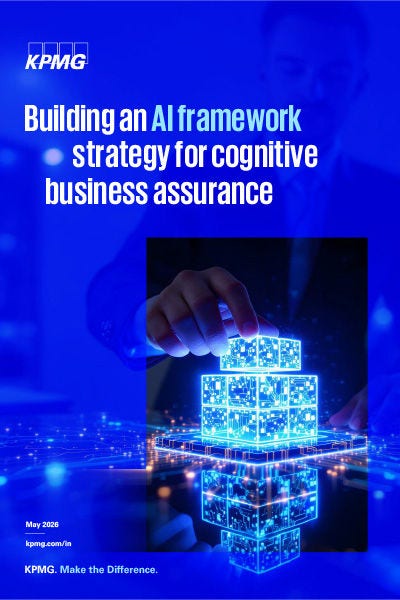
Building an AI framework strategy for cognitive business assurance
A comprehensive framework for building cognitive business assurance using agentic AI in the telecom industry
Key Contacts


How can KPMG in India help


Access our latest insights on Apple or Android devices