

(This article was published on 6 February 2026 and updated on 22 July 2026)
Highlights
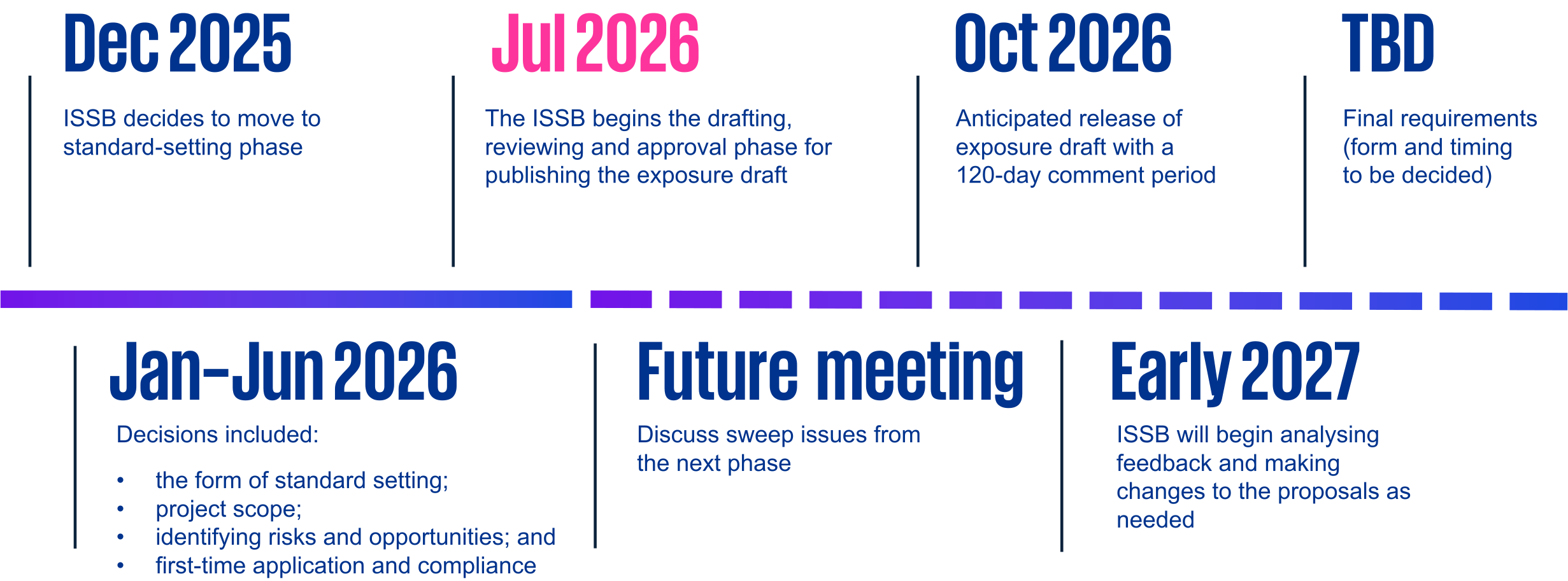
With the deliberation phase now complete, the International Sustainability Standards Board (ISSB) will work towards issuing a draft practice statement in October 2026 for public comment.
At its July 2026 meeting, the ISSB also published its assessment of the proposals’ expected costs and benefits.

What's the latest?
In July, the ISSB concluded its discussions on the proposed practice statement on nature-related reporting. It will begin the formal drafting, review and approval phase before releasing the proposals in October.
Companies can access the ISSBTM assessment of the proposals. This can help them understand the ISSB’s perspective on the impacts and benefits of, as well as how to prepare for, reporting on nature.
The table below summarises the ISSB’s decisions during the deliberations phase.
Focus area | Decision date | ISSB decisions |
Defined terms | June 2026 |
|
Identifying risks and opportunities | June 2026 |
|
First-time application and compliance | June 2026 |
|
Metrics | June 2026 |
|
Identifying risks and opportunities | May 2026 |
|
Scenario analysis | May 2026 |
|
Location-specific information | April 2026 |
|
Indigenous peoples, local communities and affected stakeholders | April 2026 |
|
Transition plans | March 2026 |
|
Metrics | March 2026 |
|
Targets and regulatory alignment | March 2026 |
|
Project scope
| February 2026
|
|
Defined terms | February 2026 |
|
Climate-nature nexus | February 2026 |
|
What’s the impact?
Companies already need to report material nature-related information under IFRS S1 (after their first year of reporting). This project aims to help them do so more effectively by providing additional direction on what nature-related information can be disclosed that could be relevant for investors’ decision-making.
The draft practice statement is intended to provide more comprehensive support in applying IFRS S1, IFRS S2 and related SASB Standards to a broad range of nature-related topics, such as land use, pollution, resource extraction, water and biodiversity. The proposals also seek to align with European Sustainability Reporting Standards (ESRS) and the Global Reporting Initiative (GRI) Standards.
By issuing the materials as an IFRS® practice statement, the ISSB aims to provide flexibility for preparers, while also minimising disruption as jurisdictions adopt IFRS S1 and IFRS S2. Jurisdictions could choose to mandate the guidance, which would have a similar effect to introducing a new sustainability disclosure standard.
What’s next?
The ISSB will discuss any sweep issues in future meetings, before finalising the draft practice statement. The draft is expected in October 2026 for a 120-day period of public consultation. The final practice statement will take time to develop and, once finalised, will need to be adopted locally to become mandatory.
Actions for management
- Bookmark and revisit this page to stay informed about the project, including the proposals expected in October 2026.
- Respond to the consultation once the proposals are released. This will be an opportunity to provide feedback and suggest improvements before the practice statement is finalised.
- Understand how your company is exposed to nature-related risks and opportunities, including by familiarising yourself with the TNFD’s LEAP approach. If you are exposed, then consider how TNFD materials can help you to report, given that the ISSB is building its practice statement on them.
- Companies planning to adopt the practice statement that report under ESRS and GRI Standards need to monitor the ISSB’s proposals closely. Although the ISSB aims to align with these standards, differences may emerge in the final proposals.
1 Locate, evaluate, assess, prepare (LEAP) is a four-phase assessment framework designed to help companies identify, manage and report on nature-related dependencies, impacts, risks and opportunities.
© 2026 KPMG IFRG Limited, a UK company, limited by guarantee. All rights reserved.