On 4 February AMLA published its first Single Programming Document (SPD). First announced in AMLA’s 2025 work programme, the SPD sets out the authority’s strategic priorities and work plans for 2026-2028, presenting how AMLA will deliver its three core missions of completing the single AML rulebook, advancing supervisory convergence and strengthening cooperation among Financial Intelligence Units (FIUs).

      The SPD lays out AMLA’s five strategic objectives:

      • Convergence, Consistency and Proportionality
      • Cooperation and Inclusiveness
      • Technology and Innovation
      • Credibility and Accountability
      • Global Leadership

      It then presents AMLA’s activity over the coming years in five interlinked areas:

      1. delivering on core regulatory mandates
      2. advancing direct supervision
      3. operationalizing the FIU framework
      4. laying the foundations for indirect supervision and oversight, and
      5. building AMLA’s risk frameworks

      Rulemaking

      Under the AML reform package legislation (AML Regulation, 6th AML Directive and AMLA Regulation), AMLA is mandated to produce around 40 different regulatory or implementing technical standards (RTS / ITS) and guidelines to complete the EU single AML rulebook.1

      In December 2025, AMLA reviewed two RTS proposals from EBA — on assessing the risk of obliged entities, and on the methodology for selecting entities for direct AMLA supervision — following consultation by the European Banking Authority earlier in the year and agreed on the proposals without opening a new consultation. It also consulted on one ITS, on cooperation among AML supervisors.

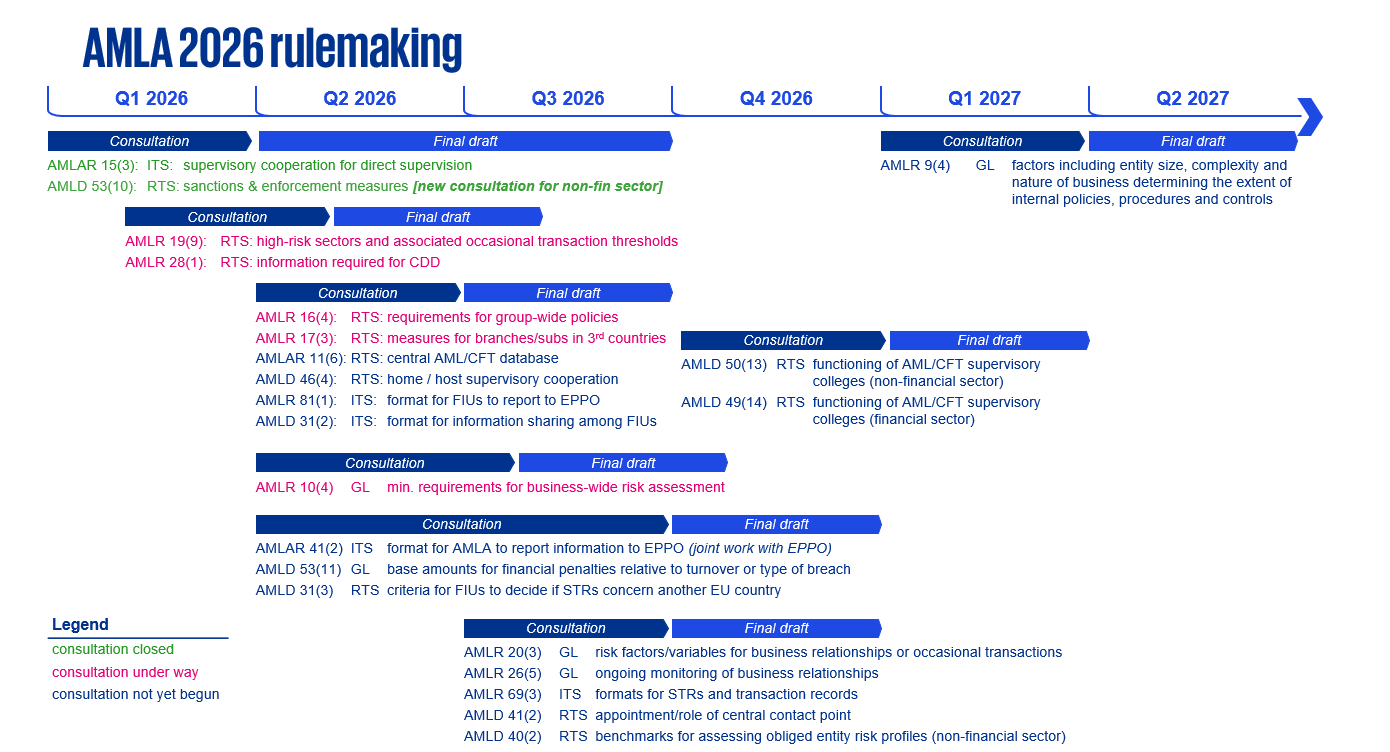
      Rulemaking will be a major area of focus for 2026. The SPD includes plans for consultation on multiple regulatory instruments during the course of the year:


      This timetable is clearly highly ambitious, requiring AMLA to produce multiple texts simultaneously and leaving only short periods for AMLA to take account of stakeholder feedback on consultation drafts. This timetable is likely intended to give industry the maximum time to implement the final rules before the single AML rulebook takes effect in July 2027. Nonetheless, it is notable that the SPD timetable implies that at least 13 rules will not be finalised until after their statutory deadlines.2 AMLA has not disclosed if it (or national authorities) will offer any supervisory forbearance to firms that are not yet compliant by July 2027. If delays in rulemaking make timely compliance impossible, however, supervisors may conclude they have little option but to show some flexibility.

      As of April 2026, two AMLA public consultation procedures have already been completed, i.e. the consultation on the draft ITS under Article 15(3) of Directive (EU) 2024/1620, which ended in January 2026, and the consultation on the draft RTS on pecuniary sanctions, administrative measures and periodic penalty payments under Article 53(10) of Directive (EU) 2024/1640, closed at the beginning of March 2026. AMLA is currently reviewing industry comments and final drafts are expected to be published later on in the course of 2026.

      Supervision

      • Direct supervision

        From 2028 AMLA will directly supervise the 40 highest-impact cross-border financial firms in Europe. The SPD lays out a roadmap for direct supervision. Key steps will include developing a supervisory strategy; setting up supervisory methodologies, tools and structures, including joint supervisory teams; and finalising AMLA’s risk assessment and selection model. Following the announcement published in January, on 16 March 2026 AMLA launched a data collection exercise to gather information to calibrate its risk models. Having fine-tuned its models AMLA will select the first cohort of 40 firms for direct supervision in 2027, based on data collected in 2027 Q1. Direct supervision will then begin in 2028.

      • Indirect supervision

        The great majority of obliged entities will remain supervised by national authorities under AMLA oversight. AMLA will develop a common supervisory methodology and toolkit for national authorities to apply. As a first step, the SPD states that AMLA will assess how national authorities currently supervise firms in their countries and how well obliged entities comply with regulatory requirements. Once the new rulebook takes effect in 2027 AMLA will conduct a series of supervisory convergence reviews. The first review cycle is expected to take seven years: AMLA will prepare this review timetable over the course of 2026-2028. Alongside, AMLA will also map out supervisory practices across Europe for the non-financial sector and plan peer reviews of non-financial supervisors to encourage greater harmonisation of supervisory approaches.

      FIU coordination

      On the FIU side, AMLA will fully operationalise its support and coordination framework. This will involve developing a robust framework for information sharing, including an enhanced FIU.net platform; finalising common standards for reporting suspicions; and enabling joint analyses. One priority area for analysis will be crypto-assets and other novel payment channels, which AMLA previously highlighted as posing particularly high money laundering and terrorist financing risks. Underpinning this collective effort, AMLA will set up mechanisms for joint training and sharing of expertise as well as mediation between FIUs.

      Risk framework

      Risk analysis is central to effectively tackling illicit finance. The last major area of activity identified in the SPD is therefore the development of AMLA’s risk framework. This will be built on AMLA’s data analysis systems and will allow for continuous monitoring and evaluation of money laundering and terrorism financing risks to the EU. In line with AMLA Chair Bruna Szego’s previous comments about bringing together the insights from both supervisors and FIUs, the risk framework aggregate risk data across areas of AMLA’s work. The goal is to reach a common understanding among EU authorities and obliged entities of the key risks.

      Conclusion: Building the future

      2026 will be a decisive year for how the new EU AML regime will operate in practice. AMLA’s activities this year will both determine much of the detail of the new AML rulebook and shape how firms will be supervised, whether directly or indirectly by AMLA. Firms should closely monitor the evolution of AMLA policy and engage with the authority to shar their practical experience of what rules and controls are most practical and effective. In particular, firms should prepare for the multiple consultations on draft rules that AMLA will initiate this year and be ready to make their voices heard. The KPMG AMLA Office will continue to monitor and provide insights on the development of AMLA policy and practice, to help firms get ‘AMLA ready’.


      1 The legislation includes 39 rulemaking mandates (19 under AMLR, 16 under AMLD, 4 under AMLA-R). In some instances, however, AMLA is expected to produce separate rules for the financial and non-financial sectors.

      The remaining 8 rules all have statutory deadlines of 10 July 2026. The SPD plans for these 8 rules to be completed in Q3 2026 (of which the first 9 days fall before the deadline).


      KPMG AMLA Office

      Navigating AMLA Supervision with KPMG’s Dedicated Office

      Our people

      Timo Purkott

      Partner, Global Fraud & Financial Crime Transformation Lead

      KPMG International

      Maureen Finglass

      Partner, Financial Services

      KPMG in Germany

      Benedict Wagner-Rundell

      Senior Manager

      KPMG in Germany