January 2026

      The FCA has published CP26/5 on aligning listed issuers’ sustainability disclosures with international standards.

      Existing FCA policy anchors sustainability reporting for UK listed companies to the recommendations of the Task Force on Climate-related Financial Disclosures (TCFD). Under the proposals in CP26/5, this will be replaced with alignment to the new UK Sustainability Reporting Standards (UK SRS), based on the International Sustainability Standards Board’s IFRS S1 and S2.


      CP26/5 at a glance:
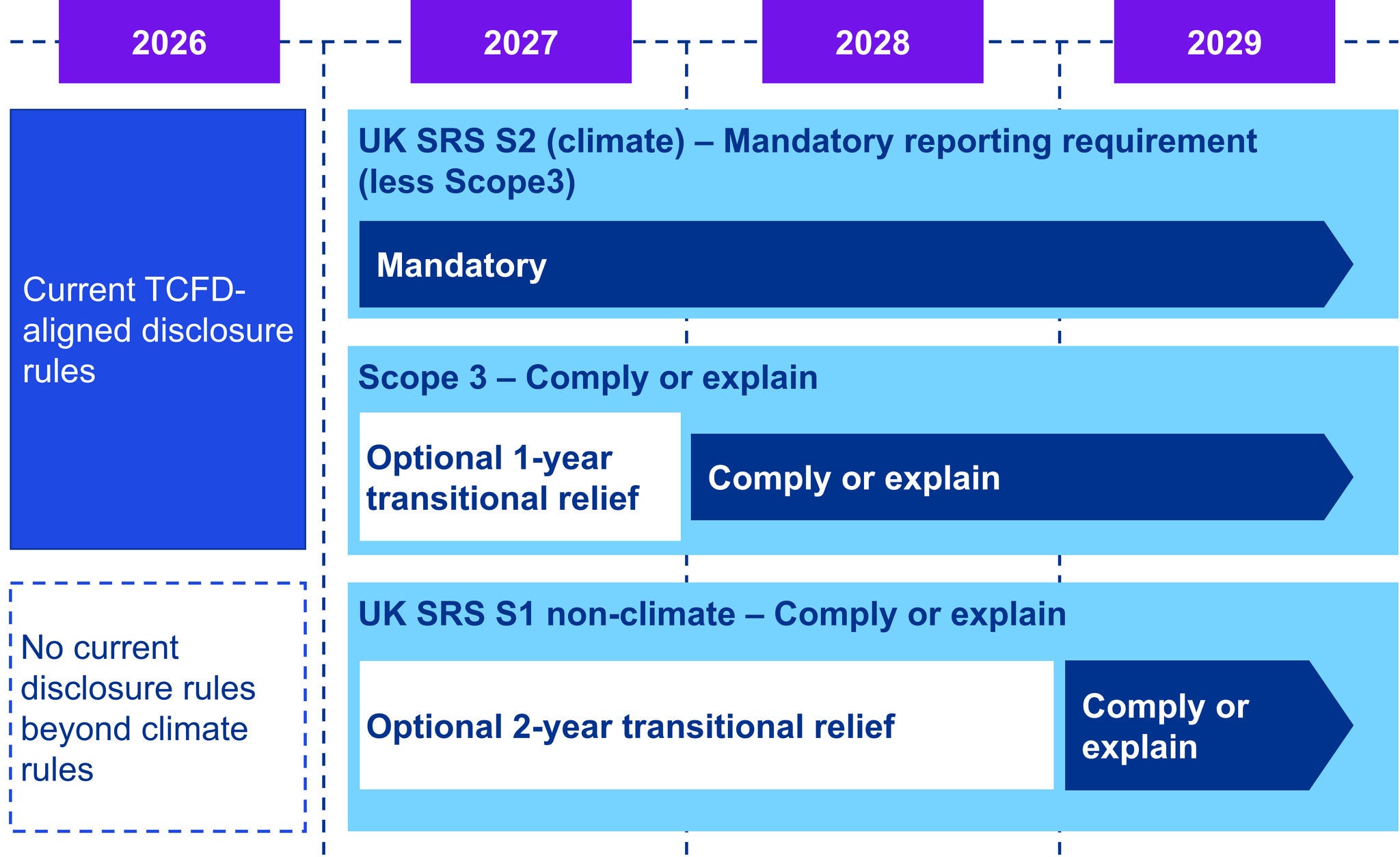
      • Mandatory UK SRS S2 climate disclosures with Scope 3 emissions on ‘comply or explain’ basis – optional 1 year deferral for Scope 3
      • Wider sustainability (non-climate) reporting against UK SRS S1 on ‘comply or explain’ basis – optional 2 year deferral
      • No mandate for transition plan disclosures but statement required on whether and where a transition plan has been published
      • No mandatory assurance but requirements to report on voluntary assurance
      • Consultation closes 20 March 2026
      • Final policy expected autumn 2026
      • Implementation for accounting periods from 1 January 2027
      Actions for firms:
      • Respond to the FCA consultation by 20 March 2026
      • Review existing reporting and disclosure processes for TCFD-aligned reporting and consider any gaps in preparation for UK SRS / ISSB-aligned reporting
      • Devise a remediation plan to address any gaps, ready for application of UK SRS from the FCA’s proposed date of 1 January 2027
      • Seek to integrate sustainability reporting across the business to align it with financial reporting

      Current requirements

      At present, in-scope listed companies must include a statement in their annual financial report setting out:

      • Whether they have made disclosures consistent with the recommendations of the TCFD.
      • Where they have included some, or all, of their disclosures in a document other than the annual financial report, an explanation of why, and a reference to where the disclosures can be found.
      • Where they have not made disclosures, an explanation of why and a description of any steps they are taking or plan to take to be able to make consistent disclosures in the future – including relevant timeframes.

      Under the proposals in CP26/5

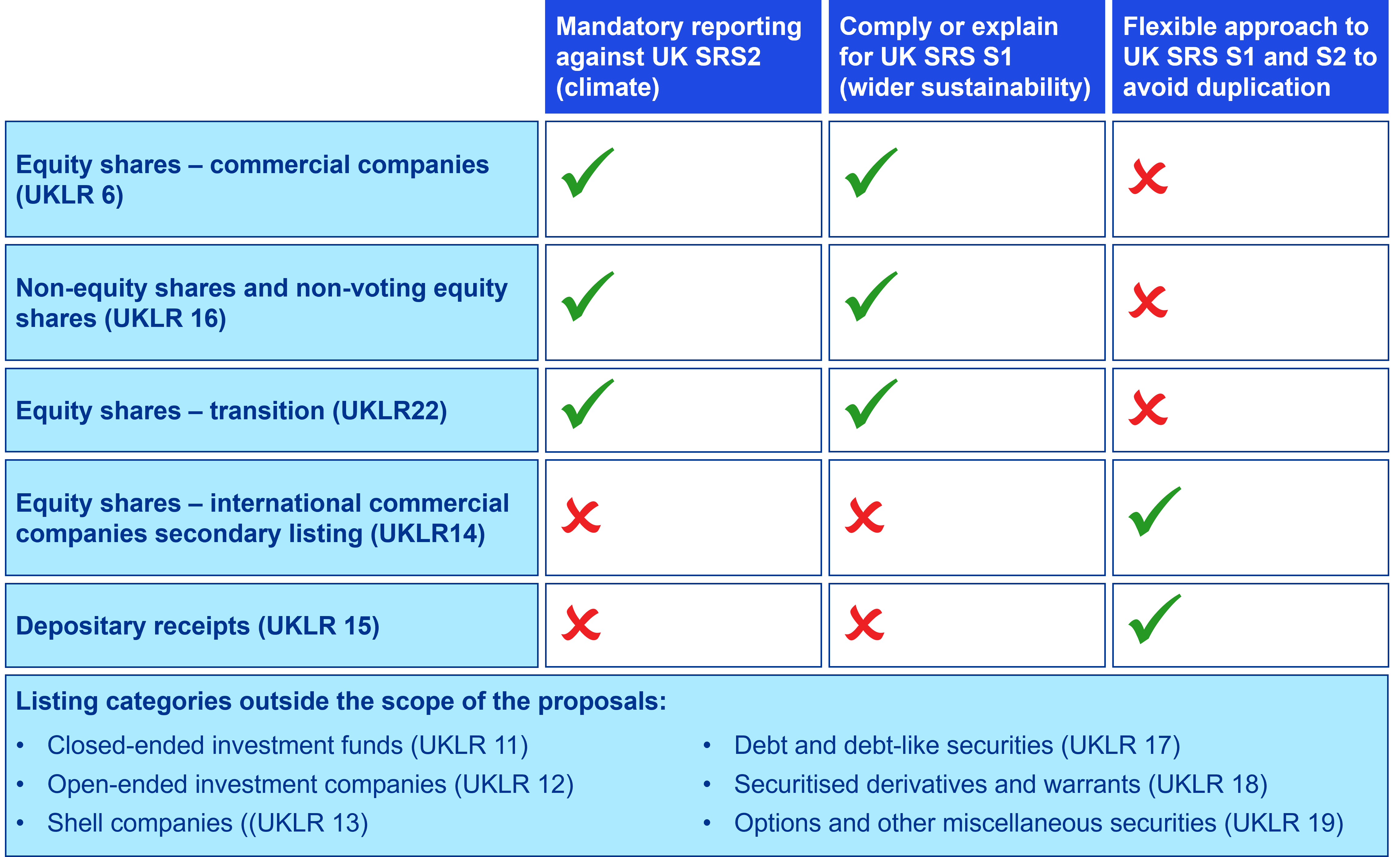
      Firms categorised as commercial companies (UKLR6), non-equity shares and non-voting equity shares (UKLR 16), and transition category (UKLR22) will be required to move to mandatory reporting against UK SRS 2 (climate disclosures). There will be an exception for Scope 3 emissions data, which can be reported on a ‘comply or explain’ basis due to the difficulties in obtaining this data across the value chain.

      The FCA recognises that wider sustainability reporting will be new to many listed companies and may present challenges. Therefore, disclosures against UK SRS S1 will be on a ‘comply or explain’ basis.

      Where firms choose to ‘explain’ rather than ‘comply’ for UK SRS S1 and UK SRS S2 Scope 3, they should provide the reasons for not including those disclosures, and any steps currently being taken, or planned, to make future disclosures, including expected timeframes.

      For firms categorised as secondary listing (UKLR 14) and depositary receipts (UKLR 15), the FCA has proposed a flexible approach to avoid duplicating requirements that international issuers face in the markets where they have their primary listing. Instead of applying UK SRS S1 and S2, these firms will need to include a statement in the annual financial report setting out any climate or wider sustainability disclosures made in their primary overseas listing location, including a statement if they are not subject to such requirements and do not make voluntary disclosures.

      Disclosures should be made in the annual financial report and state whether they have obtained third-party sustainability assurance.

      The FCA does not propose to set mandatory requirements for the assurance of sustainability reporting, though it may revisit this in the future, once the outcome of the government consultation is published. However, it does propose to require in-scope companies to specify in their annual financial report whether or not they have obtained third-party assurance over UK SRS S1 and S2 disclosures – this includes any assurance over “explain” disclosures. Companies should state:

      • The name of the assurance provider
      • Which of the disclosures or explanations have been assured and to what level
      • Which assurance standards were used and
      • Where the assurance report can be found and how it can be accessed 

      No explanation will be expected for a decision not to obtain assurance. 

      The FCA notes that mandating transition plans is a matter for the government. However, given that investors find the plans useful, the FCA proposes that companies in scope for CP26/5 disclose whether and where they have published a transition plan, or the reason why not. To avoid duplication by adding its own standalone rules or guidance on transition plans, and to encourage international comparability, the FCA proposes to introduce FCA Handbook Guidance stating that listed companies which produce a climate-related transition plan may wish to refer to the IFRS Educational Material.


      Scope

      The proposals in CP26/5 relate only to certain categories of listed companies. Economically significant non-listed companies can expect a separate consultation from the government on how to report against the UK SRS via the Companies Act:


      Timeline and next steps

      The FCA consultation runs until 20 March 2026, with final policy expected in autumn this year.

      The final rules would come into force from 1 January 2027, with reporting against the UK SRS for accounting periods beginning on or after 1 January 2027.

      In-scope issuers will be able to take advantage of transitional reliefs for UK SRS S2 Scope 3 emissions and UK SRS S1 non-climate disclosures as shown below:


      What does CP25/6 mean for firms?

      Companies would be wise to seize the opportunity for earlier engagement given that the proposed 1 January 2027 implementation date is less than one year away.

      Uplift in requirements

      Although this is essentially a ‘lift and drop’ update, compliance with the UK SRS will inevitably require more work than existing TCFD-aligned reporting, given that IFRS S1 and S2 build and expand on the TCFD recommendations and include additional requirements such as quantification of sustainability-related risks and opportunities, and connectivity with the financial statements. In-scope listed firms can therefore expect an uplift in their sustainability disclosure requirements.

      Decision-useful disclosures

      The UK SRS will turn sustainability disclosures into a structured, decision-useful, investor-grade reporting regime that integrates climate and other sustainability risks and opportunities into core business reporting, governance and strategy.

      This translates to:

      • Heightened responsibility for boards
      • Increased scrutiny by investors, regulators and auditors
      • Disclosures increasingly linked to access to sustainable finance

      A more holistic approach

      Once the UK SRS final standards are published, together with further government guidance on transition planning and assurance, companies should have a clearer idea of what the UK sustainability reporting landscape looks like and how far it aligns with other requirements around the world.

      The new UK requirements come at the same time as the EU Corporate Sustainability Reporting Directive (CSRD), ISSB standards and country-specific requirements are being adopted in other jurisdictions. Even where other jurisdictions are basing their requirements on the same ISSB standards as the UK, there may be different timelines and local specificities. This naturally presents challenges for companies, but also an opportunity to take a step back and develop a thoughtful strategic approach to sustainability reporting across their business.

      With careful planning the right decisions can be made to support compliance at a global level.


      How KPMG in the UK can help

      KPMG sustainability reporting professionals can support you to:

      • Interpret and implement sustainability reporting and disclosure requirements – including scoping, gap analysis and the preparation of accurate, transparent sustainability disclosures that meet regulatory and stakeholder expectations.
      • Embed robust governance, data and controls around sustainability reporting – helping to design governance frameworks, data models and internal controls that improve the quality, consistency and comparability of sustainability information across the organisation, including GHG emissions inventories, quantification of sustainability related risks and opportunities, and the integration of risk into risk management frameworks.
      • Align sustainability reporting with financial reporting – helping to link sustainability performance to financial outcomes, risk management and long-term strategy, to make sustainability reporting an integrated part of corporate reporting rather than a standalone exercise.
      • Move to wider sustainability reporting – we have the experience to support you as you move from just climate-only to wider sustainability reporting, whether you choose to take a ‘comply’ or ‘explain’ approach.
      • Develop a robust reporting strategy many companies are also working to report against the ISSB standards in other jurisdictions or the ESRS under CSRD in the EU. We can assist you in creating reporting processes and frameworks that will enable you to respond effectively and efficiently across all these requirements. 

      Related content

      Driven in no small part by political considerations and the escalating growth and competitiveness agenda, the rapid pace at which sustainability-related rules were developed and implemented has slowed.

      Our people