

March 2026
Key proposals at a glance
- Crypto asset firms will be in scope of the Consumer Duty, including activities carried out in relation to UK-issued qualifying stablecoins and activities relating to public offers and admissions.
- Associated guidance will provide greater clarity for cryptoasset firms applying the Duty.
- Trading between participants of a UK-authorised cryptoasset trading platform (QCATP) will be exempt from the Duty.
- The Duty will continue to apply to QCATP operators that interact with the retail customer more broadly, for example where communications and services are provided to customers.
Context
Currently, cryptoassets in the UK are primarily unregulated except for financial promotion requirements. However, this will change in October 2027, when a regulatory regime for cryptoassets will take effect, in response to the increasing integration of digital assets within mainstream financial services.
In the past year the FCA has begun consulting on the rules for the UK’s cryptoassets regulatory regime including the best approach to adequately protect consumers. Unsurprisingly, the application of the Consumer Duty to the sector is the FCA’s favoured approach rather than new bespoke rules.
The consumer duty
The Duty requires financial services firms in the UK to “act to deliver good outcomes for retail customers”. This principle is underpinned by three cross-cutting rules and four key outcomes where firms should demonstrate positive results – products and services, price and value, consumer understanding, and consumer support.
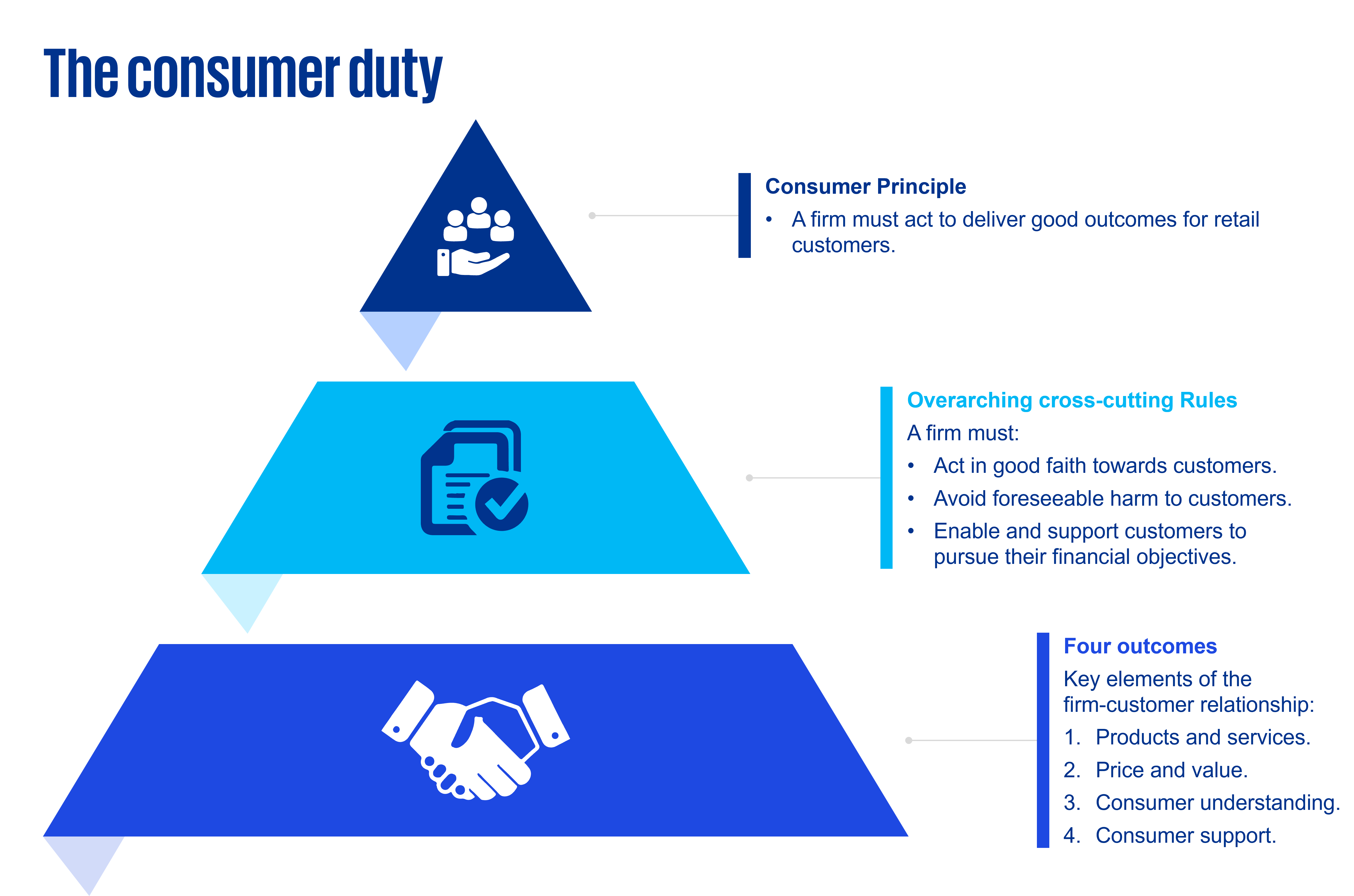
In simple terms, the Duty means that consumers should receive communications they can understand, products and services that meet their needs and offer fair value, with appropriate customer support when they need it.
Overview of the proposals
As the FCA’s flagship standard of consumer protection, it’s unsurprising that the FCA is applying the Duty to regulated cryptoasset activities with retail customers. However, the FCA acknowledges that applying the Duty to the cryptoasset market, without adjustment presents challenges that could undermine its effectiveness. The FCA explored two approaches: introducing bespoke rules or applying the Duty with supplementary guidance.
Consistent with its objectives of simplification, competitiveness and alignment with traditional finance (TradFi), the FCA has opted to apply the Duty. This approach received broad support from respondents to CP25/25 and is now being consulted on further through CP26/4 and GC26/2.
The FCA intends to apply the Duty (Principle 12 and PRIN 2A) to regulated cryptoasset activities, including all activities relating to UK issued qualifying stablecoins. Targeted nonHandbook guidance will clarify how the Duty applies in practice, particularly where requirements may be challenging for cryptoasset products (see challenges below).
Trading between participants on a UK-authorised cryptoasset trading platform (QCATP) will be out of scope, aligning with the treatment of multilateral trading facilities in traditional finance. However, the Duty will continue to apply where QCATP operators interact directly with retail customers.
Admissions and disclosure activities will generally fall outside the scope of the Duty, except for qualifying stablecoins, with similar consumer outcomes pursued through bespoke admissions and disclosure rules.
Applying the Duty: Key challenges
It’s clear that cryptoasset firms will need to carefully consider various challenges when implementing the Duty.
No clear issuer: Many cryptoassets are created and distributed without a clear issuer or manufacturer, making it difficult for distributors to fulfil product governance obligations.
Target market: Under the Duty’s products and services outcome a manufacturer should identify a target market and develop a distribution strategy. There are features of the cryptoasset market that make this challenging to comply with:
- No clear oversight or controls: Many cryptoassets are released without a central authority to oversee distribution.
- No identifiable manufacturer: Most lack a clear manufacturer, making it difficult to enforce accountability for their distribution.
- Fungibility and lack of control: Cryptoassets can be freely traded, so distributors have no control over future ownership or use after transfer.
Assessing fair value may be challenging to navigate as the high volatility and lack of inherent value of most cryptoassets make an assessment of value difficult. The price of the asset and the firm’s charges (where based on the asset price) can vary significantly from one day to the next and bear an unclear relationship to an identifiable benefit to the consumer.
The Duty focuses on activities which have a material impact on retail customer outcomes and therefore wholesale market activity is largely outside its scope. However, wholesale firms have raised examples of business-to-business activities with a retail nexus where they are unclear about the application of the Duty. For example, where they create products and services that are intended for onward sale to retail consumers. The FCA is planning various activities to help clarify application. Wholesale cryptoasset firms are therefore not automatically exempt from the Duty and should engage with the proposals and consider best practices as the regime develops.
The FCA’s draft guidance provides more context and examples of how compliance with these elements can be achieved
Key actions
Implementing the Duty will require significant review and changes to firms’ business models, customer journeys, policies and controls. Cryptoasset firms should not underestimate the work required to implement and embed the Duty. The process has been substantial even for TradFi firms experienced with FCA regulation and presents ongoing challenges.
Learning lessons from TradFi
Beyond the identified challenges, the large body of FCA-issued best practice and areas for improvement on applying the Duty highlight other considerations for cryptoasset firms. All material may be relevant but given the high-risk nature of crypto assets and digital platforms the following findings will be particularly pertinent:
- Contracts for Difference (CFDs): concerns raised about fair value, and the detection and ongoing monitoring of vulnerable customers. Given the complexity of cryptoassets distribution chains, how to capture and react to customer vulnerability to ensure the delivery of good customer outcomes will require careful consideration.
- Complex exchange traded products: good practices hinged on having good processes in place for defining target markets, assessing customer knowledge and monitoring outcomes. Conversely, bad practice resulted from weak controls, limited assessments of customers’ investment experience and knowledge and unclear disclosure making it harder for consumers to understand risks.
- Digital design in online journeys: inadequate design resulting in rushed or uninformed decisions, designs not accommodating the variety of needs and characteristics of a product’s target market. Understanding how users interact with crypto exchange platforms from the initial point of awareness to the final transaction and beyond will be important to enable effective customer outcomes monitoring –- a fundamental component of the Duty. The FCA’s research into digital engagement practices identified a number of design features that could impact customer outcomes.
Implementation
Cryptoasset firms, particularly those new to FCA regulation, should take immediate steps to familiarise themselves with the Duty and consider how their business model may need to be aligned. Duty implementation has been a large undertaking for many firms, starting work as early as possible is unlikely to be wasted. Firms may want to commence the following activities:
- Establish the appropriate governance structure for the required change programme.
- Map proposed requirements against existing practices, identify any gaps or changes required, and consider how existing systems and controls may need to adapt.
- Begin implementation planning that brings together key stakeholders and identifies the resources required to deliver compliance.
- Give high priority to understanding the FCA’s expectations and reviewing relevant good practice and areas for improvement to inform any regulatory change programme.
Concluding thoughts
The FCA’s acknowledgement of the challenges applying the Duty to this sector, and the supplementary guidance should not be seen as an indication as a softening of the main principles of the Duty; rather, the FCA has taken steps to clarify how these principles can be applied successfully.
How can KPMG in the UK help
KPMG professionals have extensive experience helping firms understand and apply FCA regulatory requirements and can help with:
Consumer Duty implementation support
- Price and fair value: support in designing, reviewing and implementing fair value assessment frameworks, including cost benefit evaluations, benchmarking and governance to support robust, repeatable analysis.
- Customer outcomes and board reporting: support defining outcomes and designing and deploying outcomes testing frameworks, bringing together relevant MI points to evidence customer outcomes in a meaningful manner.
Customer journey design:
- Support reviewing and redesigning customer journeys to support consumer understanding and effective decision making, including designing testing frameworks, reducing unnecessary friction and embedding duty consideration into digital and non-digital journeys.
Implementation and authorisation support
- Delivery professionals help translate the FCA’s conduct requirements into workable operating models across technology, data and process. We assist with alignment with regulatory expectations and authorisation processes.
- Delivery of education and training programmes for stakeholders (line managers, business unit heads, senior managers and board members.
Our insights


Our people

