

Highlights
Companies now have clarity on the requirements of the revised European Sustainability Reporting Standards (ESRS). After a period of uncertainty, change and recalibration, the European Commission’s adoption of the revised standards draws the Omnibus simplification process to a close.
The final revised standards are largely aligned with the text that the Commission consulted on earlier this year based on the technical advice prepared by EFRAG1.

What's happened?
The Commission’s adoption marks the latest stage of the Omnibus initiative – launched in February 2025 to simplify sustainability reporting under the Corporate Sustainability Reporting Directive (CSRD). After a short public feedback period that ended on 3 June 2026, the Commission has reviewed the feedback and adopted the revised ESRS, which will apply to companies above the new threshold of 1,000 employees and net turnover of EUR 450m.
The Commission has also adopted the Voluntary Standard for companies below this threshold. It is based on the VSME and sets a limit on the information that can be requested from small companies in the value chain of larger companies applying ESRS.
The table below summarises the main changes introduced in the revised ESRS compared with the first set of ESRS.
| Proposals in EFRAG technical advice | Shorten and clarify the text of the standards. Introduce flexibility to reduce administrative burden. Reduce mandatory datapoints. Enhance interoperability with international standards and EU legislation. Simplify the double materiality assessment (DMA) through a more proportionate, top down approach. |
| Limit excessive reporting | Require application of fair presentation to the sustainability statement as a whole, not individual datapoints. Limit reporting to information that is material for stakeholder groups rather than individual users. Allow reporting of non material information only when it meets specific conditions. Permit omissions in defined circumstances, including commercially sensitive information (Omnibus I Directive). |
| Other key simplifications on climate reporting | Allow a choice between equity share, operational control and financial control for determining the greenhouse gas (GHG) boundary. Require disclosure of whether climate targets are compatible with a 1.5°C pathway, not alignment of targets with the pathway. Allow but do not require companies to report on impacts relating to assets managed on behalf of clients. |
| Transitional relief | Leave the relief provisions introduced under the quick-fix amendments substantially unchanged. Extend these reliefs to companies starting to report in 2027. |
| Structure | Allow but do not require structure in four parts, as long as a reasoned justification for a different structure can be provided. |
What's next?
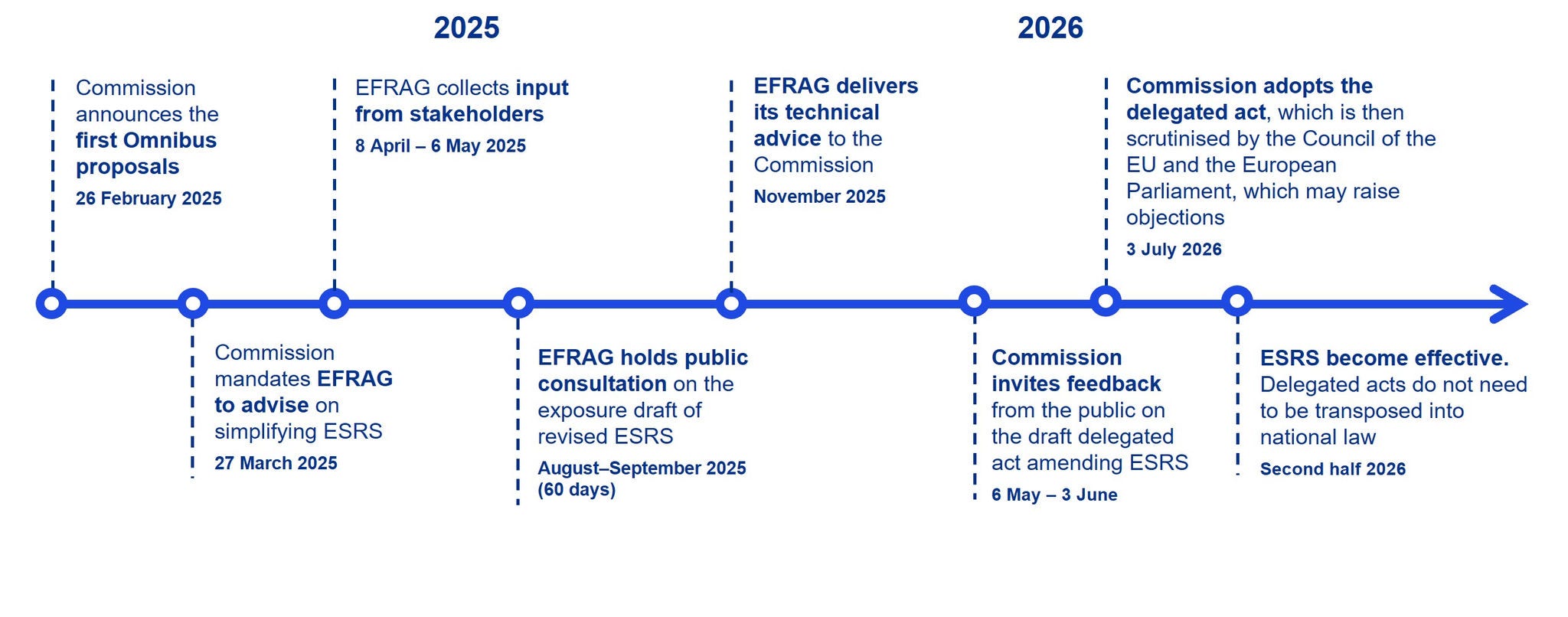
The standards are now subject to scrutiny by the European Parliament and European Council for up to four months before they can be published in the Official Journal of the European Union and enter into force on 10 November 2026. As a delegated act, the standards will apply directly and will not require transposition into national law.
The revised standards will become mandatory for reporting periods starting in 2027. Companies already applying the first set of ESRS may also adopt the revised standards in full in 2026, or may apply some reliefs, including the top-down approach in the DMA, relief for undue cost and effort, acquisitions and disposals, and partial reporting boundary for metrics.
The timeline below outlines the key milestones in the simplification process.
Actions for management
- Understand the extent of the changes if your company is already reporting under the CSRD and consider whether to adopt the revised standards from 2026.
- Assess the revised standards and consider how they would affect your reporting strategy if your company does not currently report under the CSRD.
- Speak to your KPMG contact for further information on the revised ESRS and visit Sustainability reporting in the EU to keep up to date with the latest news and discussion.

1 The EU’s advisory body on corporate reporting.
© 2026 KPMG IFRG Limited, a UK company, limited by guarantee. All rights reserved.