Regulation and competitiveness

      In the current discussions on European regulation and competitiveness, the European Central Bank (ECB) has reiterated its position against relaxing regulatory standards. In a November speech, ECB Supervisory Board Chair Claudia Buch reaffirmed the regulatory reforms enacted since the global financial crisis. According to the ECB’s analysis, better capitalised institutions are more capable of sustaining lending across the economic cycle, and there is no empirical evidence that stricter prudential standards have materially reduced banks’ lending capacity, profitability, or international competitiveness.

      Similar positions have been expressed by other members of the ECB Supervisory Board, including Patrick Montagner and Pedro Machado, as well as by EU Commissioner Maria Albuquerque. These statements point to a shared concern among European policymakers that a significant easing of regulatory requirements, particularly in response to deregulatory developments in other jurisdictions, could undermine financial stability and reintroduce vulnerabilities addressed by post-crisis reforms.

      Regulatory Simplification

      Against this backdrop, on 11 December, the ECB Governing Council’s High Level Task Force on Simplification published its much-anticipated recommendations. As we wrote earlier this year, this task force was set up to make proposals on simplifying both supervisory practice and the European regulatory framework. The task force’s main recommendations included:

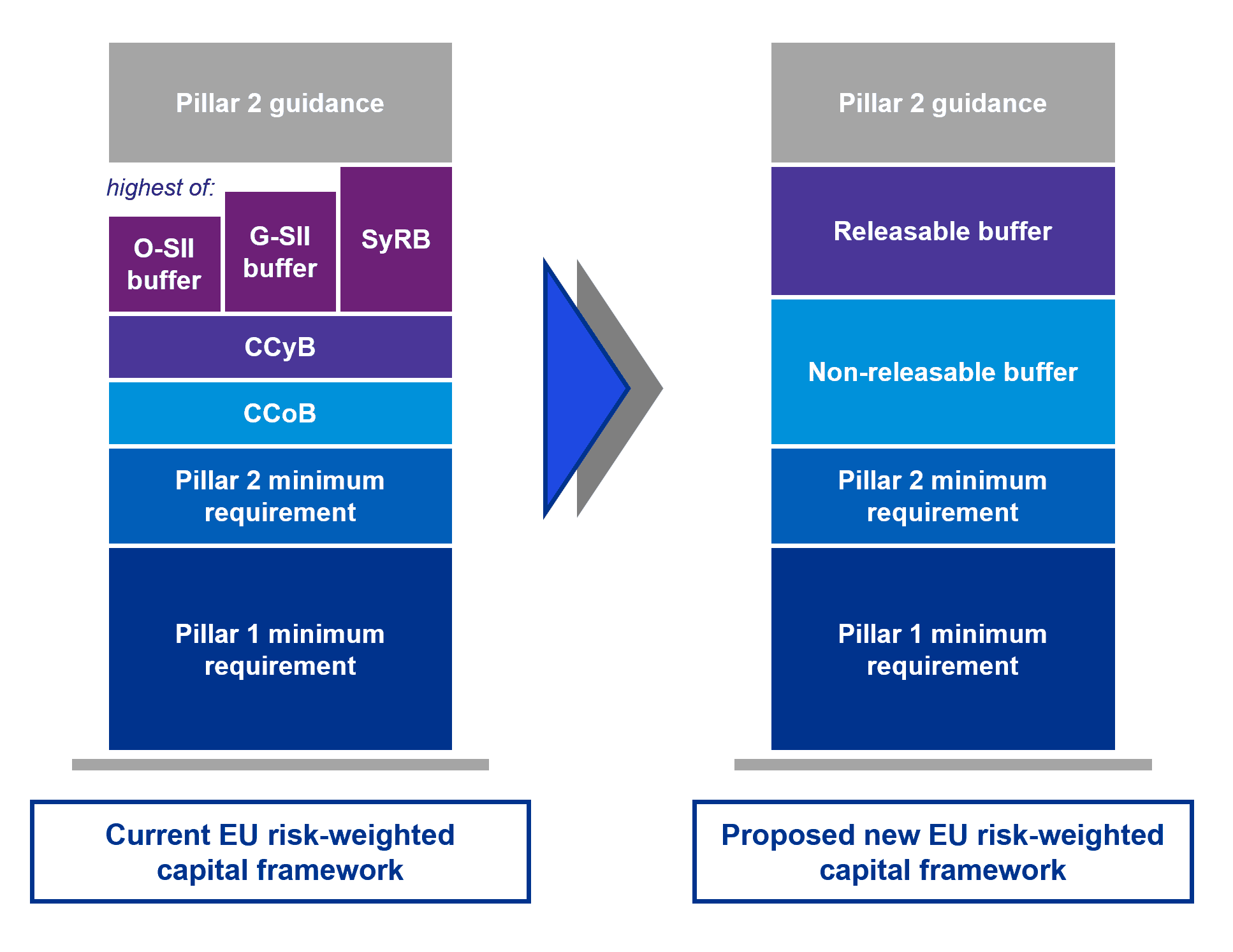
      • Simplifying bank capital requirements by merging multiple existing capital buffers into one fixed and one releasable buffer (plus pillar 2 guidance) for each bank – building on elements of the capital reform proposals by the German authorities over the summer (see figure 1);
      • Reforming Alternative Tier 1 (AT1) and Tier 2 capital instruments to make them more ‘equity like’ – or alternatively excluding them altogether from regulatory capital;
      • Expanding the simpler prudential regime for small banks by raising the eligibility threshold for small and non-complex institutions (SNCIs) and harmonizing supervisory requirements for SNCIs;
      • Aligning EU requirements for bail-in debt (minimum requirements for own funds and eligible liabilities, MREL) with global standards (total loss-absorbing capacity, TLAC)
      • Simplifying EU stress testing, including potentially shifting to a more ‘top-down’ approach akin to that used in the US;
      • Giving the ECB Governing Council holistic oversight of bank capital, to monitor the overall level of capital required of the European banking system as a whole;
      • Strengthening the single rulebook by further harmonizing rules on licensing, fit and proper assessments, and governance;
      • Reducing prescriptive requirements to allow more risk-based supervision, such as legal requirements for compulsory three-yearly review of internal models;
      • Rationalising reporting requirements by increasing coordination among authorities to reduce duplicative data requests by prudential, resolution and statistical agencies;
      • Regularly reviewing reporting rules to weed out redundant requirements on an ongoing basis.

      Several of the task force’s recommendations – in particular those on reforming the capital stack and on AT1 and Tier 2 capital — will likely be highly controversial. In most cases, implementation would involve amending current legislation, including the Capital Requirements Directive and Regulation (CRD and CRR) and the Bank Recovery and Resolution Directive (BRRD).

      So all eyes will now be on the European Commission (EC). The ECB is conducting its own review of EU banking rules, due to conclude in 2026. A key question is how far the ECB will endorse the ECB task force’s recommendations when it brings forward its legislative proposal. Changes to the law will then need to be negotiated with the European Parliament and EU governments. That means the debate on competitiveness and regulatory reform still has a long way to run.
      Improving Supervision

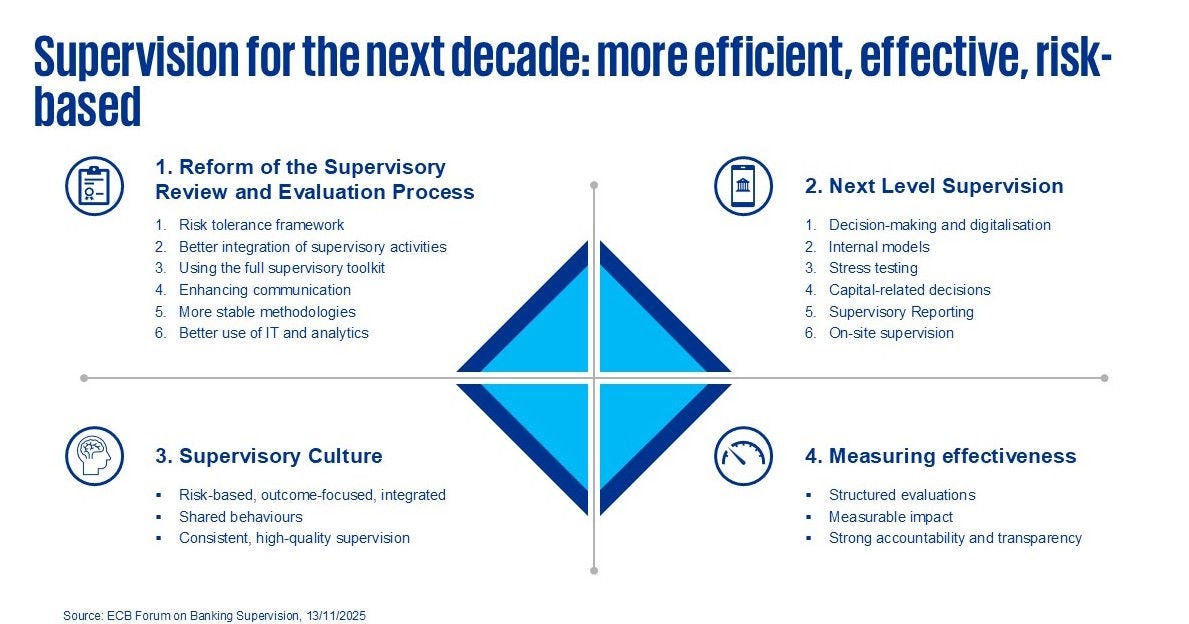
      Meanwhile the ECB continues its work to reform and modernize its supervisory practice. Alongside the simplification task force’s proposals, ECB banking supervision released a report on Streamlining Supervision. This sets out its agenda to make supervision more efficient, effective and risk-based in the years ahead. This comprises four main elements:

      • Reform of the Supervisory Review and Evaluation Process (SREP)

        First announced in 2024, the reforms aim to make the SREP more responsive to the different risk profiles of each bank, and to deliver clearer, more timely decisions focused on the most important problems identified by supervisors. The reforms will be fully implemented in 2026 with the introduction of the ECB’s new methodology for setting Pillar 2 capital requirements (P2R). The new methodology aims to be simpler, and to link P2Rs more directly to each bank’s main risk drivers, while leaving scope for ‘constrained supervisory judgement’.

      • Next Level Supervision

        The ECB will make supervisory processes more efficient and speed up supervisory decision-making, including by using new digital tools. This will particularly focus on fit and proper, internal model, and capital-related decisions. In addition the ECB will improve stress testing to remove unnecessarily complex processes, and enhance the efficiency of on-site inspections (OSIs). The ECB is also mapping bank reporting requirements to identify where overlaps and outdated requirements can be removed or streamlined.

      • Supervisory Culture

        The ECB has launched a dedicated supervisory culture initiative to ensure that reforms are implemented in a consistent way, and to cement a risk-based, outcome-focused approach across European banking supervision.

      • Measuring Effectiveness

        The ECB has incorporated regular assessments of supervisory effectiveness into its annual planning process. This aims to ensure accountability by focusing on measurable outcomes to understand how well supervisory interventions achieve their desired objectives.


      In addition, the ECB will in the coming months launch a stocktake of supervisory guides, to identify where these need updating. ECB Supervisory Board Vice-Chair Frank Elderson discussed supervisory guides in a recent speech, emphasizing that the ‘expectations’ and ‘good practices’ they set out are not legally binding, but represent supervisors’ understanding of the best way for banks to meet their regulatory obligations. One aim of the stocktake will be to ensure guides accurately distinguish between legal requirements that are binding on banks, and statements of supervisory policy, which arguably serve more to bind supervisors in their exercise of discretion.

      Related content

      KPMG ECB Office offers you information and solutions for dealing with the ECB supervisory approach under the Single Supervisory Mechanism (SSM).

      The ECB joins the wider European effort to simplify regulation and promote growth and competitiveness

      Our people

      Benedict Wagner-Rundell

      Senior Manager

      KPMG in Germany