Reforming add-ons

      The European Central Bank (ECB) will fully implement its new P2R methodology this year - largely completing its reforms of the Supervisory Review and Evaluation Process (SREP), announced in May 2024. The new methodology, which was piloted last year, will be used to calculate P2Rs for all banks under ECB direct supervision for 2027 and beyond.

      The new methodology takes a more ‘bottom up’ approach to determining P2Rs than the current system. Joint Supervisory Teams (JSTs) will assign separate capital add-ons for each risk, drawing from pre-defined ranges for each SREP element score (for example, where a bank scores 2 for a given SREP element, JSTs will be able to set a P2R add-on of between 10 and 25 basis points). These individual add-ons will then be aggregated into an overall P2R value, which will then be adjusted according to ‘constrained supervisory judgement’. This contrasts with the current approach of first setting an overall P2R then testing that risk-by-risk.
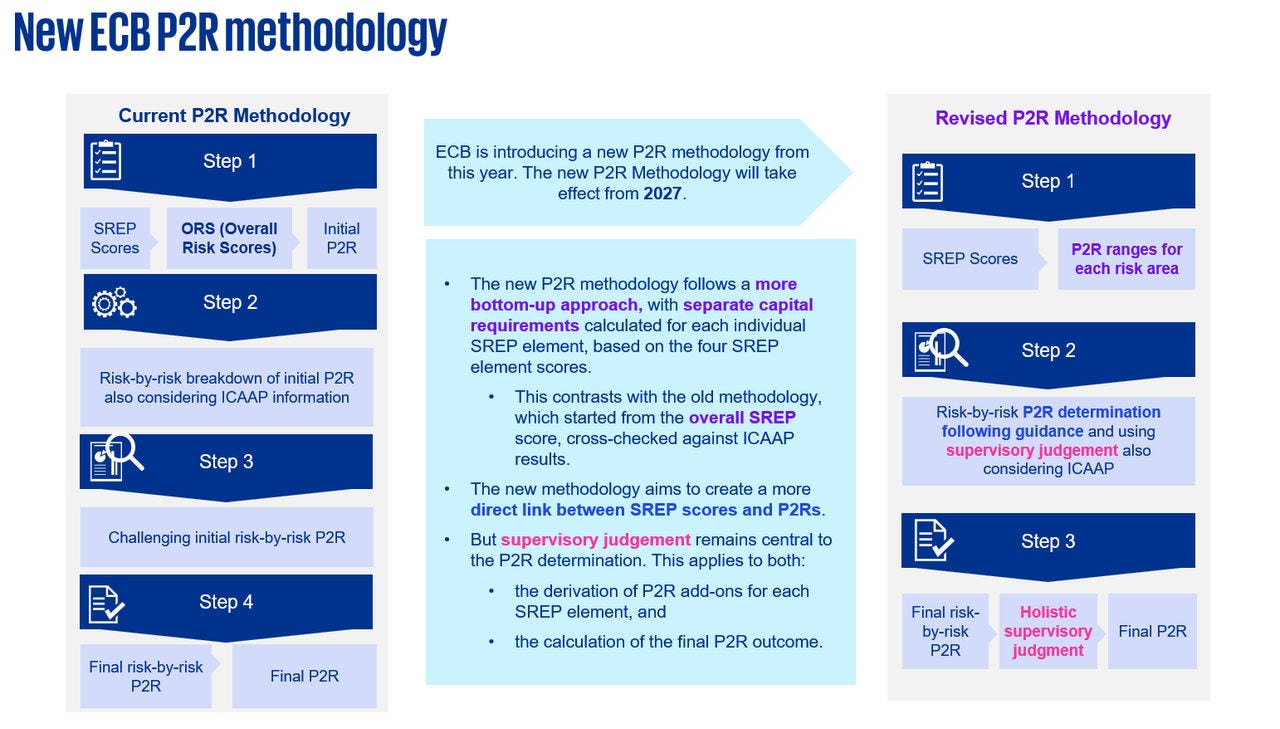

      Objectives of reform

      Describing the new methodology in a March 2025 blog post ECB Supervisory Board Chair Claudia Buch said she did “not expect the introduction of the new methodology to lead to abrupt changes in capital requirements.” Rather the goal is to make the P2R methodology more simple, stable and transparent and strengthen the link between individual risk drivers and P2R outcomes.

      Under the current methodology, P2Rs have typically been rather stable. This year, 52 banks (around half of ECB-supervised banks) saw no change in their P2Rs from 2025. Across all banks, the average P2R was also broadly stable from 2025, at 2.1%. Since 2020, the average year-on-year change in P2R has been less than 5 basis points (bps). In only 12 cases since 2020 has a bank’s P2R changed by 50bps or more from one year to the next (and in only 3 cases by 75bps or more). This reflects the broad stability in SREP scores from year to year: 75% of banks received the same SREP score in 2025 as 2024.

      The new ‘bottom up’ approach should, however, make it clearer to banks how their P2Rs are determined. Assuming they are communicated to banks, the individual P2R components should also signal to banks which risks supervisors consider most serious. This would support the ECB’s work to focus SREP decision letters on the most pressing issues for each bank. It should also help banks to prioritise their remediation efforts.

      Qualitative and quantitative factors

      The prominent role of supervisory judgement will ensure that the new methodology is not simply a mechanical process of translating SREP scores into P2R outcomes. Qualitative factors will continue to play an important role – just as they do in determining SREP scores, alongside quantitative KPIs. Supervisors’ overall perceptions of how well a bank is run will influence individual P2R components (what value JSTs choose within the available range) and the final aggregate P2R.

      From our client discussions, we observe a number of considerations playing a key role in shaping JSTs’ judgement. First is the perceived stability of a bank’s business model: banks that are well diversified geographically and draw a larger share of revenue from more stable income streams such as retail banking tend to be rewarded over those with business models that are narrower or more dependent on more volatile revenues such as from investment banking. Second, supervisors often regard banks’ record of delivering successfully on efficiency or other change programmes as a key indicator of management quality. The third factor is a bank’s perceived attitude to supervisory feedback. JSTs typically have more sympathy for banks they see as keen to understand the underlying issues highlighted by supervisory findings, and to use findings as a tool for improvement – in contrast to banks who aggressively challenge findings or focus their remediation efforts only on surface-level ‘symptoms’.

      We also note, however, that the influence of qualitative judgements on SREP scores and P2Rs is asymmetric. Poor perceptions by JSTs are more likely to lead to worse outcomes than vice versa. This is in part because ECB supervisory manuals give JSTs greater scope to adjust SREP scores ‘against’ banks (i.e. to higher, worse values) than in their favour. It is likely also psychologically harder for supervisors to justify upgrading a bank’s SREP or P2R without strong quantitative evidence to support that decision.

      Implications for banks

      Both quantitative and qualitative factors will therefore remain important under the ECB’s new P2R approach. So banks looking to improve their P2Rs should first concentrate on managing the most significant quantitative KPIs, such as those for profitability (return on assets, cost:income ratios) and asset quality (non-performing loan ratios, provisioning levels). They would also be well advised to invest in strengthening their relationship with their JSTs to improve supervisors’ perception of their general management quality. There is no single ‘silver bullet’ solution to managing P2Rs: banks need to take a holistic view.

      Related content

      KPMG ECB Office offers you information and solutions for dealing with the ECB supervisory approach under the Single Supervisory Mechanism (SSM).

      Managing supervisory pressure on key topics will be critical

      Our people

      Benedict Wagner-Rundell

      Senior Manager

      KPMG in Germany