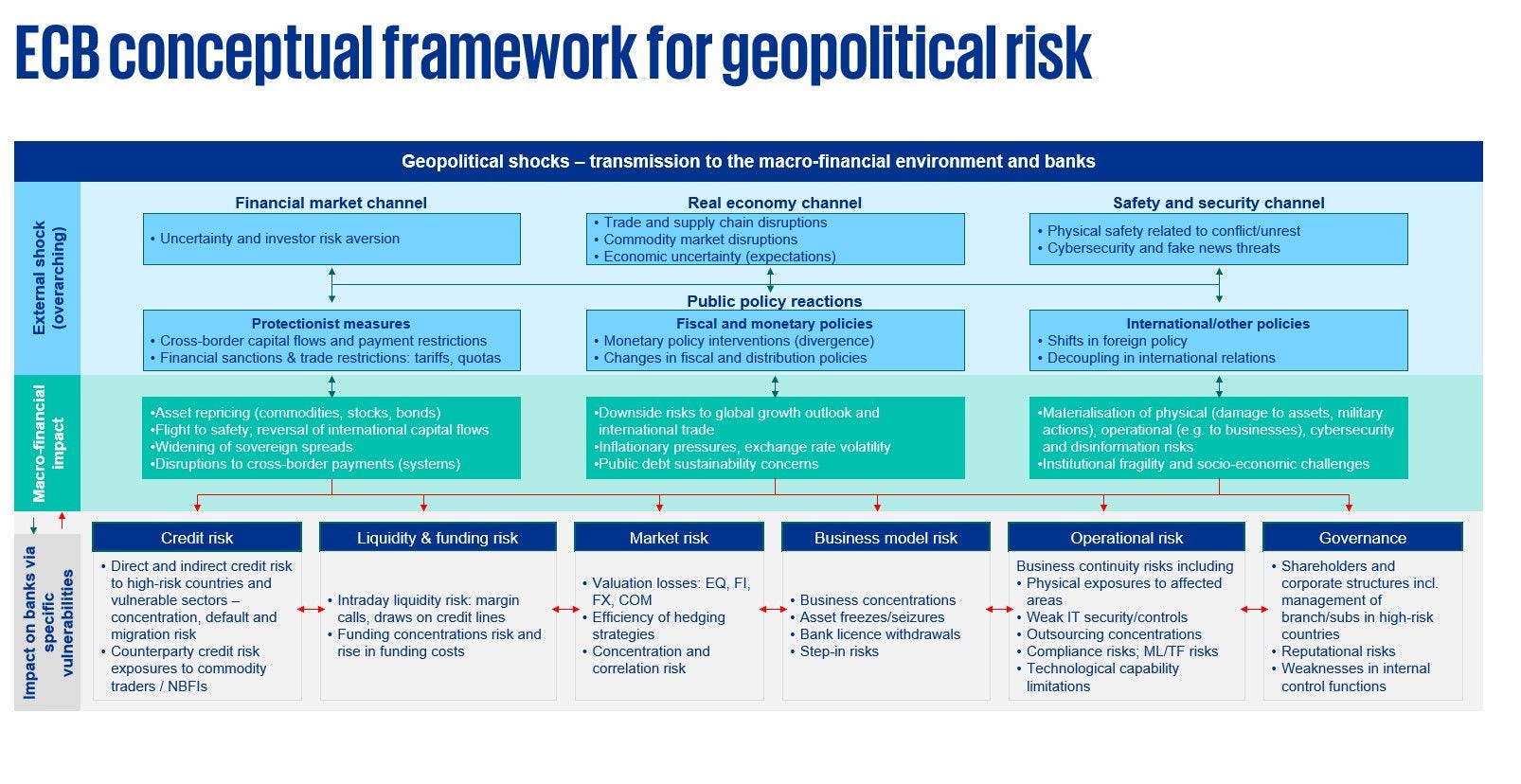
So far, the Iran conflict has impacted European banks mainly via oil and gas prices. Economists have offered a range of predictions for how these might evolve, depending on how long exports through the Straight of Hormuz are disrupted and production facilities in the Gulf are shut down. A prolonged rise in the oil price would likely result in increased credit defaults as both businesses and households are squeezed by higher energy costs. It could also push up inflation and expectations for interest rates. In parallel, oil price volatility could feed through into financial markets, potentially exposing banks’ securities portfolios to rapid price movements that could generate losses where portfolios are not fully hedged.
Meanwhile, European banks have so far seen little impact via the ‘safety and security’ channel. As ECB Supervisory Board member Pedro Machado alluded to in a recent interview, European banks have only limited operations in the Gulf region, and do not depend greatly on critical staff or facilities that could be at risk of attack. There have also been no reports of an increase in cyber attacks against European financial institutions so far in the current conflict. That could, however, change, for example if the conflict escalated or spread geographically.
Future geopolitical shocks could also affect banks mainly through the operational risk channel: for example hybrid conflict scenarios in which belligerents employ (physical or cyber) sabotage or incite domestic civil disorder to put pressure on European governments or hinder their ability to act in the international arena. ECB Supervisory Board Vice-Chair Frank Elderson highlighted how a sudden operational outage can severely damage to even a financially sound bank’s business: in a 2025 speech Elderson cited the example of a Dutch bank that, although solvent and liquid, collapsed in 2022 after losing access to its IT systems when its Russian parent company was hit by international sanctions. In a similar vein, Supervisory Board Chair Claudia Buch warned last November that “exposure to external providers can become a vulnerability in an adverse geopolitical risk scenario.”