As we move into the second quarter of 2026, the data on completed deals for 2025 shows it really was a year of two halves, with second half global deal value up nearly 40%, and large (US$ billion plus) deal volume up 30%, versus the first half.

      Tech deals held on to first place in our sector heatmap for the year as a whole, but flattening momentum meant that two other sectors overtook tech in the heatmap rankings in the second half.

      Finance sector M&A surged in H2 2025 as regulatory clarity, more manageable interest rate effects on deal economics, and the need to achieve scale and fund technology investment re-opened finance sector deal pipelines. Strategic buyers and private equity concentrated capital into fewer, larger transactions, lifting deal values sharply and carrying momentum into Q1 2026, a quarter in which finance deal growth became the dominant trend.

      Sector heat in industrials ramped up in the second half as capital flowed toward assets seen as mission critical to energy transition, defense readiness, logistics resilience, and AI driven physical infrastructure.

      The great divide: Large deals are reshaping M&A strategy

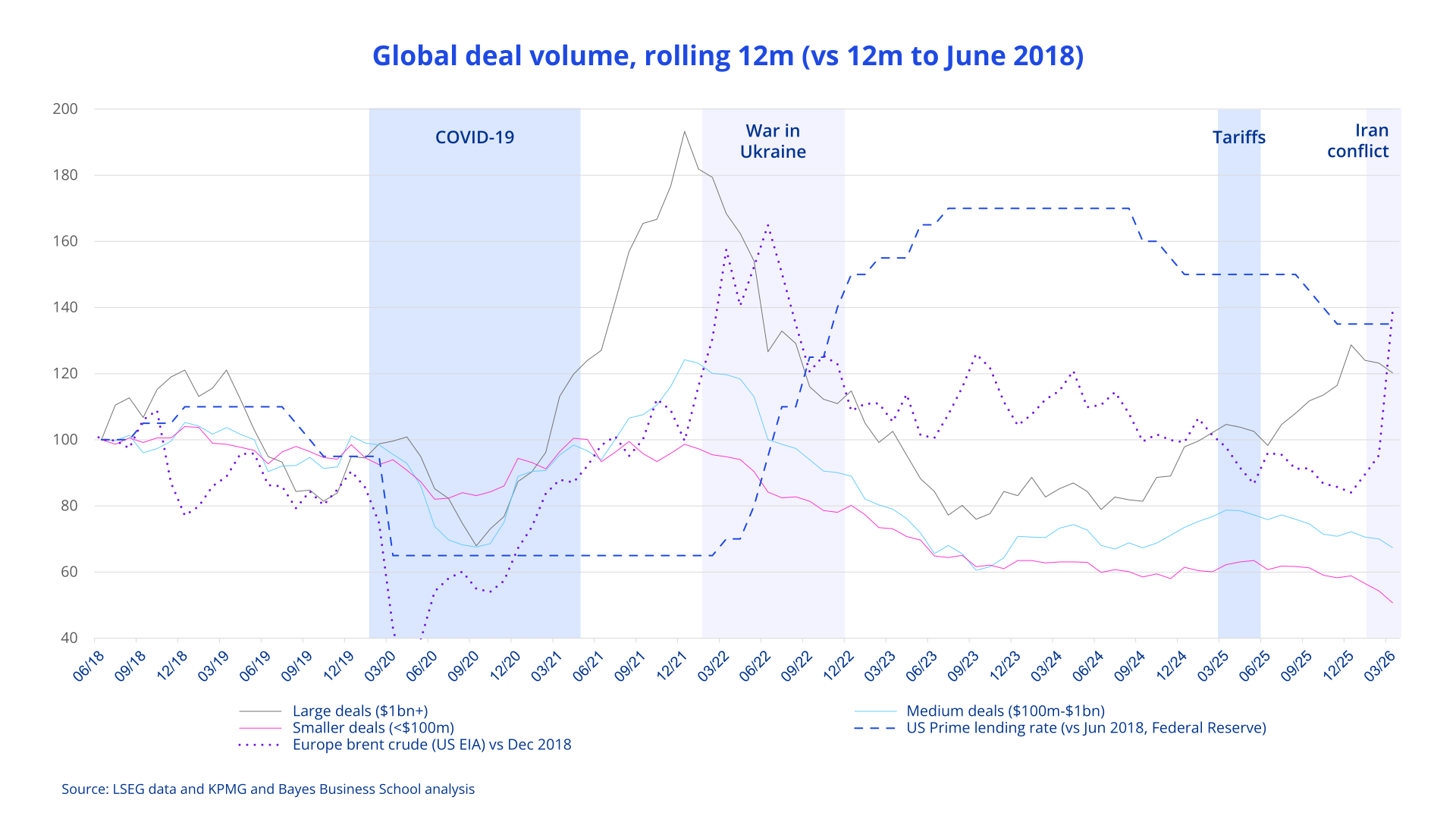
      In H1 2025, billion dollar plus deals represented nearly three quarters of total global acquisition spend, while smaller deals accounted for most volume but little value. Since 2018, there has been a step change in the weight of large deals within total global dealmaking, alongside a return of >US$1bn deal volumes to exceed pre COVID levels.


      The math is stark: fewer deals overall, but the big ones are getting bigger and capturing almost all the value:


      The data from H2 2025 shows 305 completed large deals (over US$1 billion), compared to just 233 in H1. Meanwhile, small and medium-sized deal volumes barely budged (down 2% and 4%, respectively). 

      Small deals (under US$100 million) have steadily declined since the end of 2021, to volumes which are now lower than the low point of the COVID crash. Think about that for a moment. Even when the world was literally shutting down, more small deals were getting done than today. 

      For executives, the implications are profound. The old playbook of managing risk by building through a series of bolt-on acquisitions is increasingly shifting to more aggressive, focused, and transformational moves that compress years of strategic evolution into single transactions. In our view, the new focus is more aligned to the use of M&A to address transformational capability development and sector convergence over and above simple consolidation and cost synergy mining.

      Ecosystem architects: Why tech is an increasing issue in deals

      The sector rankings tell only part of the story. Dig into the cross-sector acquisition data and a clearer picture emerges: companies have stopped just buying their neighbors and are increasingly hunting for distant cousins with complementary DNA.

      Traditional sector consolidation used to drive M&A logic. Banks bought banks. Manufacturers bought manufacturers. That playbook appears to be dead. Today's acquirers are increasingly ecosystem architects, assembling capabilities that didn't even exist in the same category five years ago.


      We're seeing a fundamental shift where our clients are becoming ecosystem builders rather than industry consolidators. They're buying capabilities that didn't even exist in their sector five years ago.
      Liz Claydon

      Global Head of Deal Advisory & Global Head of Life Sciences

      KPMG International


      Exploit: Deals with acquirer and target in same sector and country
      Explore: Cross-border deals with acquirer and target in the same sector
      Extend: Cross-sector deals - where acquirer and target are in different countries.

      One of the most telling insights comes from examining deal strategy by sector. At the top of the strategic spectrum sits the ecosystem architects: companies whose deal focus centers on acquiring capabilities in entirely different sectors. At the bottom are the core consolidators, still playing the old game of leveraging sector synergies.

      Materials, healthcare, industrials, and consumer companies have become the most international in focus. They're not just buying competitors; they're buying supply chain control, customer access, and technological capabilities wherever they find them globally. Tech companies, surprisingly, remain stubbornly domestic despite their global reach. Perhaps when you already control the digital ecosystem, physical geography matters less.

      The cross-sector investment patterns reveal two dominant themes that transcend traditional industry boundaries. First, almost everyone wants to acquire technology capabilities to enable their own transformation. Second, almost everyone wants to acquire control over physical operations, whether manufacturing, logistics, or resource extraction.


      This creates a fascinating dynamic where tech companies are buying their way into the physical world while traditional companies are buying their way into the digital world. The result is a convergence that increasingly blurs traditional sector analysis.

      Business model disruption has accelerated this trend. When every company faces digital transformation pressures, vertical and capability adjacencies can become more valuable compared to horizontal scale within existing markets. The question is no longer "how do we get bigger in our industry?" but "what broad capabilities do we need, and what critical assets or resources do we need to control, to serve our customers' future needs?"

      For dealmakers, this shift demands new evaluation frameworks. Traditional sector multiples and comparison sets become a less useful shorthand for real value potential when deals cross industry boundaries. Due diligence teams need expertise across multiple domains, and the insight to evaluate innovation as a source of potential value creation. Integration planning becomes exponentially more complex when you're not just combining similar businesses but creating entirely new hybrid entities.

      The companies that master this ecosystem approach will likely dominate the next decade. Those still thinking in traditional sector terms may find themselves acquisition targets for more strategically sophisticated buyers.

      Crisis lessons: How the M&A market reacts when the world shakes

      March 2026 taught us something unsettling about market resilience. As the Iran conflict deteriorated and economic uncertainty spiked, deal volumes across multiple sectors began showing signs of a market pause. We'd seen this movie before, twice in recent memory, and the ending was never quite the same.


      The pattern recognition comes from understanding how M&A markets respond to different types of economic shocks. COVID represented a demand-side crisis: around the world, lock-down strategies delivered an unprecedented near 20% shock to consumer demand and business activity, temporarily closing down whole industries. In contrast, the war in Ukraine created a supply-side shock: energy, grain and commodity prices spiked, triggering a medium-term inflationary spike and subsequent interest rate increases.

      Each crisis type produces a distinct M&A market signature. COVID initially paralyzed dealmaking as everyone waited to understand the economic impact. But once the policy response became clear, large deals bounced back aggressively. Historically low interest rates fueled a 2021 boom driven primarily by tech sector acquisitions and record private equity investment.

      The war in Ukraine followed a different script. Initial price volatility caused immediate deal hesitation, but the sustained impact came from central bank responses to supply-driven inflation. As interest rates climbed to combat price pressures, deal activity was suppressed much longer off the back of valuations adjusting to the much higher cost of capital. The correlation between M&A volumes and interest rates proved far stronger than any relationship with underlying commodity prices.

      But here's where it gets really interesting: large deals recovered much faster than small ones in both scenarios. When financing costs matter, it seems that scale provides protection. Really transformational deals potentially absorb higher borrowing costs and still generate acceptable returns, larger deals have the potential to access a wider range of financing options, and large acquirers are often more diversified and hence more financeable.

      Overall market activity remained bullish coming into 2026 — with Q1 ahead of the prior year, and at a run rate higher even than 2025 H2. High-tech targets saw deal values jump 35% in Q1 despite the emerging uncertainty. Finance sector targets surged 149%, suggesting continued ecosystem-building momentum even as other sectors showed hesitation.


      But March 2026 data offer early warning signals worth heeding. A characteristic pause to assess the longer-term impact of immediate volatility seems to have affected the value of completing deals for both PE acquirers, and wider acquisitions of Tech, Finance and Energy sector targets in March 2026. Overall, the typical seasonal “bounce” from February to March did not happen this year — with deal volume and value around a third lower in March 2026 than the level expected if activity had tracked previous seasonal trends.

      These patterns suggest that current economic uncertainty will likely impact different parts of the M&A market in predictable ways. Opportunistic deals are likely to pause first. Necessity-driven consolidation is likely to continue. Large, strategic combinations should prove more resilient, and come back quicker, than smaller, tactical acquisitions — but the overall impact is expected to be driven by the level and persistence of inflationary pressure.

      For corporate strategists, the lesson is clear: understanding shock resilience should inform not just timing decisions but fundamental deal strategy. Companies building mission-critical capabilities or achieving survival-level scale can operate through uncertainty. Those pursuing nice-to-have acquisitions should prepare for extended market pauses when the next crisis hits.

      The real insight isn't about predicting specific shocks but about building M&A strategies that can operate across different economic environments. As global interconnection increases, shock frequency seems unlikely to decrease. The winners will likely be those who can make strategic moves regardless of whether the world is calm or chaotic.

      Our research at the M&A Research Centre at Bayes Business School draws a sharp distinction between geopolitical threats, which make deal markets pause, and realized conflicts, that trigger a rebound with significant pricing discounts in terms of market multiples and indeed opportunistic deals. The data shows that the pause is here, and price reductions are therefore likely coming. But the recent evidence is also clear that large deal opportunities bounce back fastest – so for the prepared buyer, this a moment of significant opportunity.

      Professor Scott Moeller

      Founder, M&A Research Centre

      Bayes Business School, City St George’s, University of London

      Strategic imperatives for 2026’s disrupted new M&A reality

      • Design strategy for a concentrated deal market

        2026 is the “Year of the Carve Out” as large groups and sprawling PE platform plays refocus — with a growing number of large assets coming to market as a result. As deal value becomes increasingly concentrated in a smaller volume of these large transactions, buyers should plan for a world where fewer decisions drive a disproportionate share of strategic outcomes. This can require sharper prioritization, stronger conviction thresholds, and organizational readiness to act decisively, and speedily, to seize value when high impact opportunities emerge.

      • Treat portfolio shaping as a growth enabler, not a defensive move

        As the geopolitical position becomes more complex, portfolio simplification, including carve outs and separations, is an important and proactive tool to re-balance the strategic focus from efficiency to resilience and to release capital. In a concentrated deal market, reshaping the portfolio is often the most effective way to fund transformation, help reduce managerial complexity, and create headroom for targeted growth investments.

      • Build an execution edge that holds under rate volatility

        With interest rates exerting a material influence on deal activity and viability, execution speed and reliability become sources of competitive advantage. Companies should adapt operating models that embrace AI value opportunities, accelerate value capture, compress integration timelines, and maintain deal economics across varying financing and macro conditions.

      • Invest in integration models that protect and scale when “big buys small”

        Capability led acquisitions increasingly involve smaller, specialist businesses whose value lies in unique people, know how, and speed of innovation. Traditional integration approaches risk diluting that value. Firms should design integration models that preserve talent, protect autonomy where needed, and rapidly scale value by deploying acquired capabilities across the wider organization and beyond.

      • Build agile deal capability to master the Three Es: Exploit, Explore, Extend

        Many leading organizations align their deal capability explicitly to distinct strategic pathways — and are able to pivot between them when required: exploiting the core, exploring new geographies, and extending into new capabilities. This can require agility in governance, capital allocation, and evaluation frameworks so that very different deal types can be pursued with equal discipline and potential for success.

      • Turn crisis into competitive advantage through shock specific strategies

        Different economic shocks affect deal markets in different ways. Demand side disruptions and supply side disruptions call for distinct responses. Companies should develop tailored playbooks for each, enabling them to move early, structure deals appropriately, and act with confidence to identify and seize opportunity while competitors pause.

      • Build capability for complex deal structures and carve out opportunities

        The rise of carve outs, staged transactions, and other complex deal forms, places new demands on organizations. Success can depend on early separation planning, robust governance, and strong execution disciplines across technology, people, and operations. Firms that build this capability can be better positioned to access assets others struggle to transact.

      • Ensure your deal approach is robust to the challenges and opportunities of AI

        As AI threatens existing business models, acquirers are re-focusing on the capabilities they need to transform and survive. Assessing the AI potential, and resilience of acquisition targets is increasingly critical. And AI-enabled approaches to deal assessment are already enabling better, earlier insight into deals risks and value creation opportunities that were not previously possible. Buyers who embrace and address these issues can have a competitive advantage in the deal market.


      Methodology

      KPMG and Bayes Business School researchers have analyzed more than 40,000 transactions completing between 1 Jan 2019 and 31 March 2026, selected from LSEG data to include all recorded transactions which i) represented the acquisition of a majority stake in of the target and resulted in a change of control; and ii) for which a transaction value was disclosed. Resulting deals were re-classified by sector based on KPMG’s own definition of relevant market sectors. Cross-sector deals are those with acquirer and target in a different sector (based on this classification). Cross-border deals are those with Acquirer and Target identified by LSEG as being based in different countries. The heatmap analysis combines ranking by sector of target and acquirer deal volume and deal value, and relative sector year on year deal volume and value growth to arrive at an overall ranking of which sectors were most active in the deal market, compared to historical patterns, in each period.

      Special thanks to Dr. Naaguesh Appadu, Senior Research Fellow, Bayes Business School, and Professor Scott Moeller, Founder, M&A Research Centre, Bayes Business School, for their contributions to this analysis.

      Related services

      KPMG's Deal Advisory professionals can provide actionable, practical advice designed to help you minimize risks, and unlock, drive and preserve value for your business.

      M&A requires decisive, swift action to seize opportunities. Whether raising capital, acquiring businesses, or selling your company, you need a trusted advisor with experience in delivering successful M&A deals.

      Helping you realize desired results with a deliberate, forward-thinking approach to deal planning, execution and integration.

      KPMG Global Strategy Group combines the right blend of strategy, sector expertise and data-driven insights to deliver a bespoke approach that drives performance transformation with tangible financial impact.

      Our insights

      In the rapidly evolving global landscape of 2025, the rules of M&A have transformed. Competitive threats are no longer just the familiar rivals but also emerging players from unexpected sectors.

      The year of the carve-out

      Designing, executing and winning Consumer and Industrials carve-outs

      Our people

      Liz Claydon

      Global Head of Deal Advisory & Global Head of Life Sciences

      KPMG International

      Javier Rodriguez

      Head of KPMG Strategy

      KPMG International

      Joshua Martin

      Global Head of Transaction Services

      KPMG International

      Graham Armitage
      Graham Armitage

      Associate Partner, Global Deal Advisory

      KPMG in the UK