

Highlights
To promote the consistent application of financial and sustainability reporting requirements, the European securities regulator, ESMA1, has issued its priorities for 2025 annual reports.
Its key areas of focus include the following.

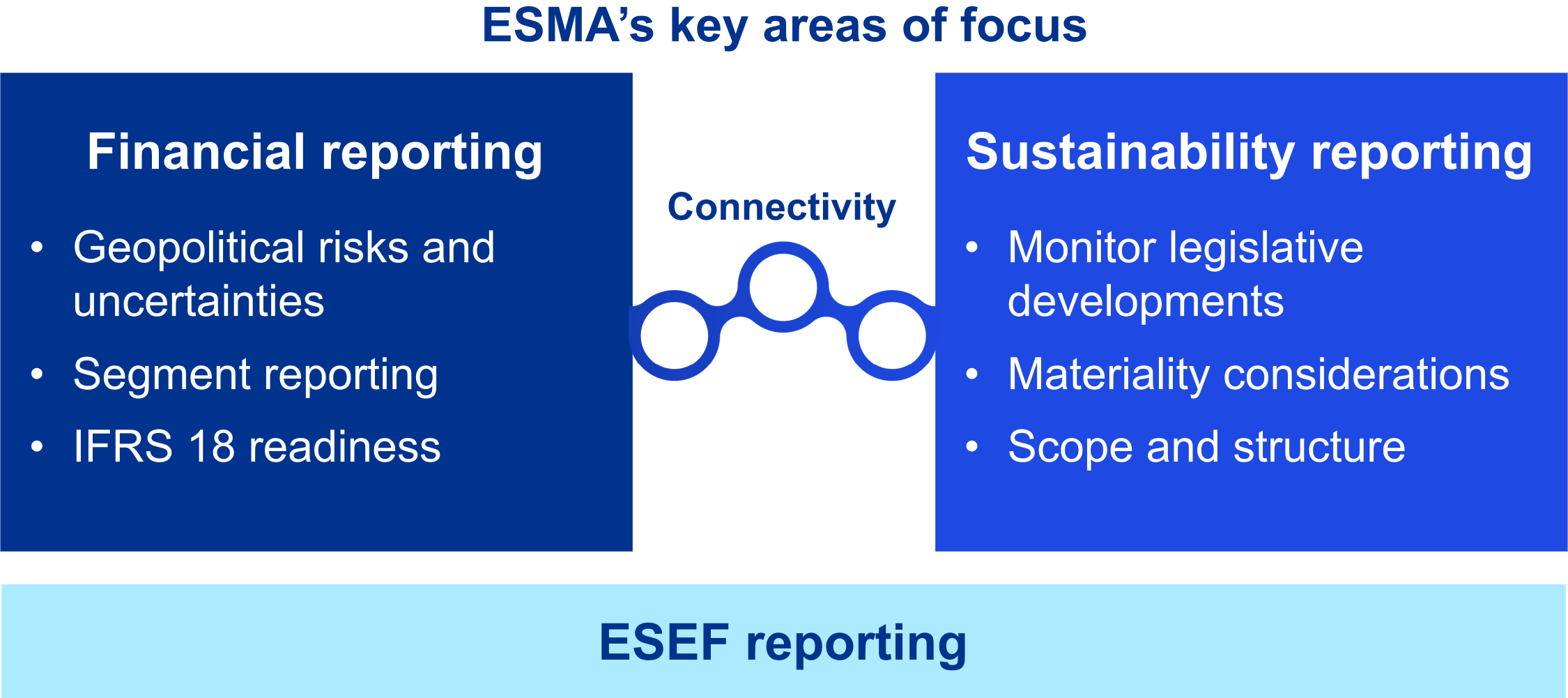
ESMA continues to call for clear and transparent disclosures throughout annual reports. It also re-emphasises the need for connectivity and consistency between financial and sustainability reporting (e.g. in relation to climate-related disclosures) and highlights the near-final illustrative examples issued by the International Accounting Standards Board (IASB).
Regulatory bodies outside Europe are also likely to focus on similar financial reporting topics.
Financial reporting
ESMA expects companies to provide relevant company-specific information on how geopolitical risks and uncertainties and the knock-on impacts of these (e.g. conflict in Ukraine, trade frictions, volatility in energy and commodity prices, supply chain disruptions) affect their financial position and performance, and the judgements and estimates they have made in preparing their financial statements.
ESMA observes that these risks and uncertainties could affect many areas of financial reporting directly. In addition to segment reporting (discussed below), ESMA highlights the following examples:
- going concern;
- asset impairment and write-downs of inventories;
- changes in revenue recognition patterns;
- recoverability of deferred tax assets;
- key assumptions used in valuation models (e.g. expected credit losses (ECL) and fair value measurement);
- provisions (e.g. onerous contracts or restructuring costs);
- non-current assets held for sale and discontinued operations; and
- disclosures on financial risks (e.g. liquidity risks) and compliance with debt covenants.
ESMA also cautions companies considering adjusting or introducing alternative performance measures (APMs) to reflect geopolitical impacts (e.g. tariffs). It reminds companies that APMs need to be consistent over time and provide a fair review of the development and performance of their business and position.
ESMA observes that geopolitical uncertainties and climate-related matters could cause changes in:
- operating segments;
- applying the aggregation criteria for reportable segments; and
- disaggregation disclosures provided under IFRS 15 Revenue from Contracts with Customers.
Therefore, companies are expected to disclose company-specific information on the judgements they have made to identify and aggregate segments.
ESMA highlights the IFRS® Interpretations Committee’s agenda decision Disclosure of Revenues and Expenses for Reportable Segments issued in July 2024 and recommends companies carefully review their disclosures under IFRS 8 Operating Segments, as well as the judgements made when determining which items of income or expense to disclose for each reportable segment. In applying these judgements, ESMA emphasises that companies need to consider both the principles of materiality in IAS 1 Presentation of Financial Statements and their specific facts and circumstances, including but not limited to those circumstances described in paragraph 98 of
IAS 1.
ESMA also reminds companies of the importance of providing clear entity-wide disclosures under IFRS 8 on geographical areas and major customers in the current geopolitical environment.
ESMA urges companies to start assessing the impact of IFRS 18 Presentation and Disclosure in Financial Statements on their financial statements, reporting systems and communications. ESMA’s focus areas include aggregation and disaggregation of information, management-defined performance measures (MPMs) and the presentation of financial performance.
ESMA also reminds companies to get ready to apply the amendments to IFRS 9 Financial Instruments and IFRS 7 Financial Instruments: Disclosures, which are effective from 1 January 2026, and disclose any material effects of these amendments in their 2025 financial statements.
Sustainability reporting
ESMA reaffirms its commitment to advancing sustainability reporting – noting the EU Omnibus proposals to simplify European Sustainability Reporting Standards (ESRS) – retaining two of its prior-year priorities: materiality assessment and scope and structure of the sustainability statement. ESMA has not carried forward its prior-year priority on EU Taxonomy due to ongoing regulatory change. Companies will need to monitor EU legislative developments closely to stay abreast of changing requirements.
ESMA also reminds companies not to rely on EFRAG’s exposure draft or its technical advice to the European Commission when preparing their disclosures for 2025 sustainability statements; revised ESRS will only apply following due process in the EU. This means that companies cannot anticipate application of the revised standards. However, they may refer to them to help inform their interpretation of the currently effective requirements.
ESMA highlights materiality as the filter for decision-useful sustainability information, requiring companies to provide tailored, transparent disclosures about their materiality assessment process. It specifically calls for clarity on input parameters (e.g. data sources, geographical scope and key assumptions), thresholds and adapting the assessment to the company’s own circumstances.
It also expects companies to explain how they engage with their stakeholders, including how they identified, prioritised and consulted them, and which groups they considered to be affected stakeholders.
ESMA promotes the use of strategy disclosures and tabular formats under ESRS 2 General disclosures to help users link impacts, risks and opportunities (IROs) to the value chain and business model. It also recommends mapping IROs to ESRS topics and subtopics, and clearly signposting company-specific disclosures to enhance clarity and traceability.
ESMA also stresses that non-material information is not to obscure material matters.
Alongside its priorities, ESMA has published its research on how first-wave companies applied the double materiality assessment process in the first year of reporting.
ESMA reminds companies that, under ESRS, they are required to confirm alignment between the scope of sustainability reports and financial statements and disclose any limitations in value chain coverage.
Compared with ESMA’s 2024 priorities, those for 2025 place greater emphasis on practical solutions for accessibility, such as referencing disclosure requirements (e.g. E2-5) to support future digital tagging and using hyperlinks.
Furthermore, ESMA highlights the need for direct connectivity with the financial statements, reminding companies to reference the corresponding paragraph in the financial report whenever material monetary or quantitative data is disclosed in the sustainability statement.
ESEF reporting
ESMA highlights common European Single Electronic Format (ESEF) filing errors in the statement of cash flows and has assessed these as a priority for its 2025 reviews. Notably, many of the issues ESMA flags – e.g. incorrect signs, unnecessary extensions, incomplete or inconsistent tagging – are not new. By addressing common ESEF filing errors, ESMA believes companies can strengthen the quality and reliability of their digital financial reporting. In addition, ESMA recommends that companies continuously follow the rules in the Regulatory Technical Standards on ESEF and the ESEF Reporting Manual.
Find out more
- Our 2025 guides to financial statements will help you ensure your financial reporting provides the information that users need through clear, meaningful and specific disclosures.
- Along with Insights into IFRS®, our table on newly effective and forthcoming requirements, and our digital hubs on Uncertain times and Clear on climate reporting form part of your essential reporting toolkit.
- Our First Impressions publication provides our detailed insights and comprehensive analysis on applying IFRS 18, together with illustrative examples.
- Our ESRS Foundations guide explains ESRS in plain English, pulling together the detailed requirements in one place.
1 European Securities and Markets Authority
© 2026 KPMG IFRG Limited, a UK company, limited by guarantee. All rights reserved.