What the ETS Is and Why It Exists
Pensions are organised nationally, but careers increasingly are not. Around 10 million EU citizens live in another member state and roughly 2 million are cross-border workers.5
The result is that people who move for work end up with pension rights scattered across several countries, systems, and languages, and often lose track of them. The ETS exists to solve exactly that: to help mobile workers find, understand, and act on the pensions they have built up anywhere in Europe, working to its motto "find, inform, activate."6
It delivers this through FindyourPension.eu, using two tools: a Pension Compass to locate providers and a Pension Tracker to view the pension a person has built up, via secure personal digital login.
Where It Is Going
The ETS is now firmly in its rollout phase, backed by a €4.7m EU grant to connect as many national tracking systems as possible over five years.7
Belgium was connected first as proof of concept, France went live in February 2025, and the Netherlands is next in line, with Germany, Sweden, and Denmark among those set to follow.
The direction of travel, reinforced by the November 2025 EU recommendation urging every member state to plug in, is a genuinely pan-European overview, expanding country by country.
Country Connection Status
Country | Tracking body | Status on Find Your Pension | Pillars covered |
Belgium | Sigedis / Federal Pensions Service | Live — first connected (proof of concept) | Statutory + occupational (P1 + P2) |
France | Union Retraite | Live — connected Feb 2025 | Statutory + supplementary (P1 + P2) |
Netherlands | Stichting Pensioenregister | Connection underway | P1–P2–P3 (once live) |
Germany | DRV – Digitale Rentenübersicht | Member; targeted info available, connection pending | Statutory led |
Sweden | Minpension.se | Member; targeted info available, connection pending | Multi-pillar |
Croatia | Regos | Member | Statutory |
The portal currently carries targeted pension information for five countries, with more to follow; “member” reflects ETS Association membership, which precedes full data connection. Pillar coverage varies and is indicative. The completeness caveat (“absence of data ≠ absence of entitlement”) applies.
Divergent and Rising Retirement Ages
The ETS is designed to help mobile workers find, inform, and activate. The first two functions are largely addressed: the tools locate providers and display the pension a person has built up. Acting on that information is a separate matter. The tracker is built around accrued entitlements, not eligibility. Where projections are shown, they follow each national system's own assumptions; there is no consolidated view of when rights become payable in each country.
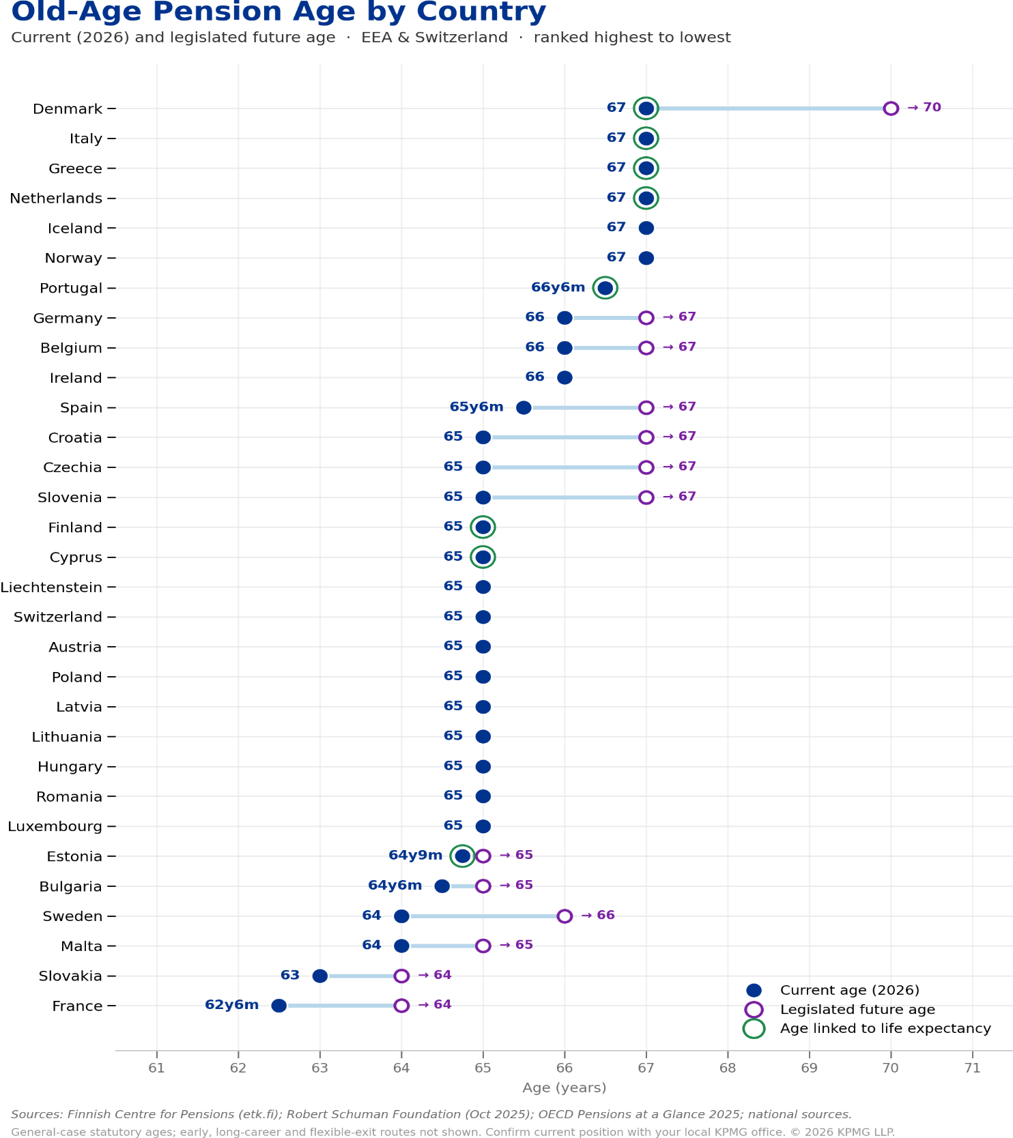
Statutory retirement age remains a national competence. Each member state sets its own pension age, its own conditions for early and deferred retirement, and, in a growing number of countries, its own mechanism linking the pension age to life expectancy.
A worker with rights in several countries may therefore reach eligibility at different ages in each of them, in some cases several years apart. Improved transparency addresses the difficulty of locating pension rights; it does not remove the divergence in eligibility ages, nor the upward trend in those ages across the EEA and Switzerland.