error
Subscriptions are not available for this site while you are logged into your current account.
close
Skip to main content

Loading

The page is loading.

Please wait...

      How AI is changing the meaning of performance in Finance

      As organisations invest heavily in AI across the finance function, much of the discussion has focused on automation, analytics, and faster insight. Less attention has been paid to a more fundamental question: how should finance now be measured, and how does it link to an organisation’s strategy?

      Finance has been moving beyond purely operational KPIs for some time, shifting toward strategic, value-add measures that link performance to business outcomes. AI doesn’t replace that journey; it accelerates it by making insight generation faster, more scalable, and increasingly proactive.

      This shift is forcing finance leaders to rethink KPIs, moving further away from measuring internal efficiency alone and toward measuring business value, decision impact, and forward-looking performance. The critical next step is that Management Information (MI) & Reporting must also help leaders understand what drives performance: which levers matter, how sensitive outcomes are to key assumptions, and where to intervene early.


      Geert Peeters

      Director - CS&P - EPM

      KPMG in the UK


      Why traditional KPIs are no longer sufficient

      Historically, MI & Reporting KPIs have been designed for a world of periodic, manual reporting. Common measures include:

      • Days to close / close readiness
      • Report timeliness and accuracy
      • Cost of finance (function cost and run-rate efficiency)
      • Forecast accuracy (and variance explanation cycle time)
      • Revenue growth
      • FTE distribution

      These KPIs made sense when MI & Reporting was largely backward-looking and labour-intensive. They focused on value protection: ensuring control, compliance, and accuracy.

      The problem is not that these KPIs are wrong, it’s that they are incomplete. In practice, many traditional KPIs optimise for a reporting model that AI is actively dismantling now. When close processes are increasingly automated and variance commentary can be machine-generated, measures such as ‘days to close’ or ‘reports delivered on time’ become hygiene factors. They confirm that Finance is operational, but not whether it is impactful.

      A deeper issue is that many KPI sets were never designed from strategy. They accumulate over time, shaped by reporting conventions and system constraints. As a result, they often lack driver logic, rarely cascade coherently, and rely on untrusted data. KPI sets become bloated, creating noise rather than clarity.

      This matters because AI amplifies whatever measurement system exists. If KPI design implementation is weak, AI will industrialise confusion: faster insight, but not more meaningful insight.


      How AI is reshaping MI & reporting and Finance KPIs

      AI is fundamentally altering the MI & Reporting operating model. Automation reduces manual effort, analytics improves insight quality, and models enable earlier intervention. As a result, KPIs can no longer focus solely on output and efficiency; they must reflect outcomes and decision impact.

      KPMG’s Banking Strategic Benchmarking Insights suggests the shift is already underway: 54% of banks are using automation for internal and management reporting, 59% are prioritising investment in insight and decision analytics, and 53% are focusing on data model integration to support consistent, reusable MI.

      In an AI-enabled MI & Reporting model, KPIs are evolving in three ways:


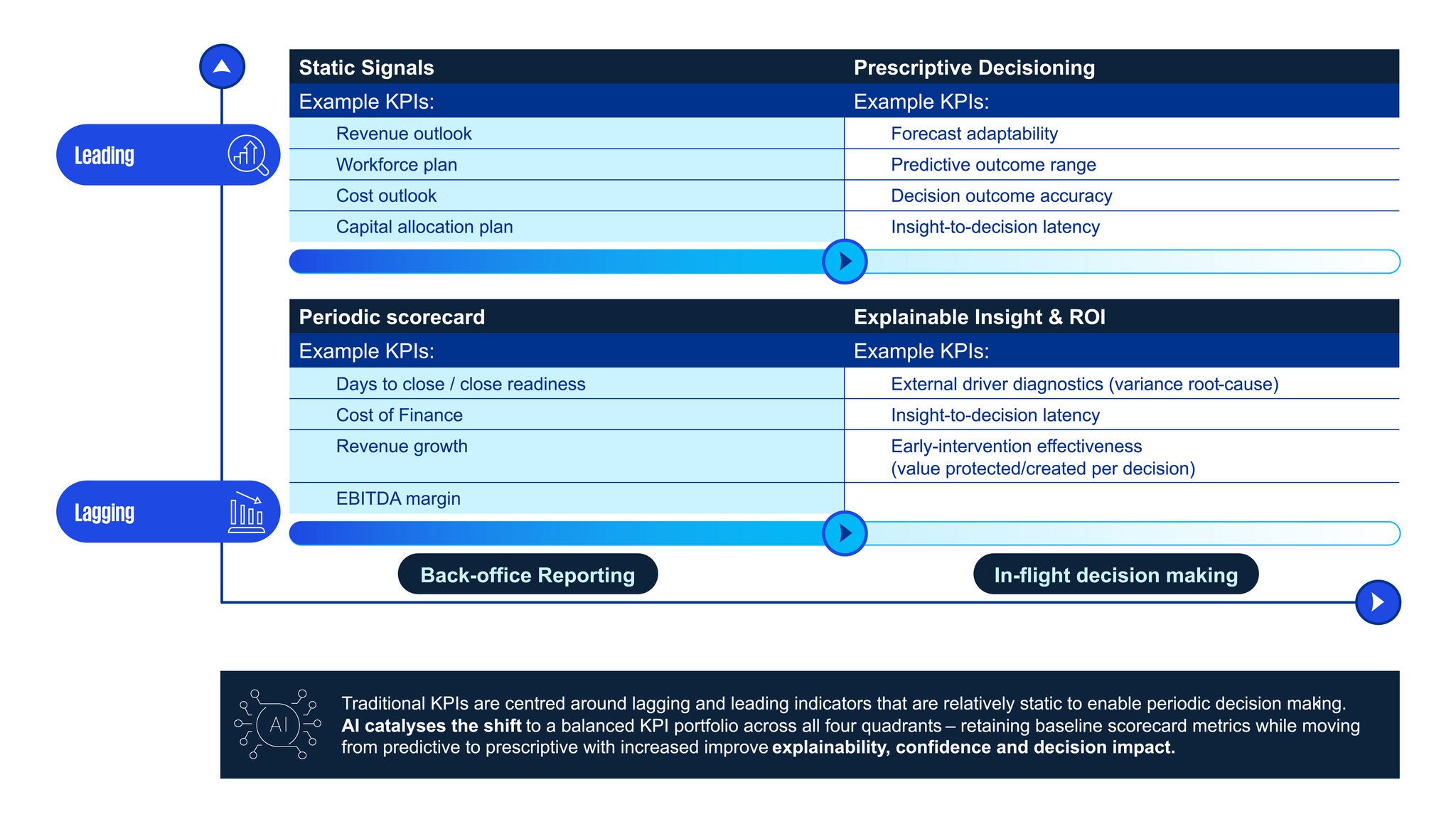
      1) From reporting results to explaining drivers

      AI should not eliminate lagging indicators, organisations will still rely on backward-looking KPIs such as close performance, cost, and variance. What changes is that AI makes those measures more useful by answering the ‘why’.

      • Automated anomaly detection in close, reconciliations, and reporting pipelines (early warning before defects propagate).

      • Driver attribution for variances (what moved, what mattered most, and what is controllable).

      • Confidence scoring and explainability (how reliable the insight is, and what assumptions underpin it).

      The disruptive shift is that MI becomes increasingly exception-led: finance spends less time producing packs, and more time validating the drivers that explain what changed and what to do about it.

      2) Proactive MI that brings the insight to the business

      AI should allow Finance to complement lagging measures with leading indicators that surface issues and opportunities before they hit the P&L. The key enabler is a larger data universe: operational telemetry, customer and channel signals, and external drivers, including unstructured text.

      With that breadth, MI becomes proactive: AI pushes signals that matter and links interventions to outcomes, allowing Finance to track value created, not just value protected.

      For example, instead of assessing forecast accuracy only after period-end, Finance can track forecast adaptability (how quickly assumptions recalibrate when conditions shift) and intervention impact (did actions change the projected revenue or margin path?).

      3) From Finance efficiency to decision effectiveness

      Traditional KPIs measure speed and cost; AI-enabled KPIs should increasingly measure how well MI changes decisions and how much analyst capacity is released from production into decision support. This is where Finance becomes a revenue enabler: when MI reduces decision latency and improves intervention quality, it can drive estimated finance-attributable revenue uplift, tracked through intervention impact.

      Practical examples include:

      • Insight-to-decision latency (how quickly decisions follow insight availability).

      • Early-intervention effectiveness (value protected/created through earlier detection and action).

      • Decision outcome accuracy (do forecasts and scenarios translate into better realised outcomes over time?).

      In effect, MI shifts from reporting performance to steering performance.


      The shift towards AI-enabled KPIs


      Measuring value creation and value protection in Finance

      As finance organisations rebalance toward value creation, KPI emphasis must shift accordingly. KPMG benchmarking suggests many banks operate around a 30% value creation / 70% value protection and governance split, with a more mature aspiration closer to 50:30 supported by stronger MI and analytics. If Finance is expected to create more value, it must be measured accordingly (influenced by finance insight, responsiveness to risks and opportunities, and the effectiveness of forward-looking analysis-not only on producing reports.

      Why dynamic KPIs still need strategic anchors

      AI enables KPIs to become more predictive, decision-oriented and context-aware, but this only creates value if KPIs remain aligned to strategy. Without a clear strategy-to-KPI foundation, AI risks accelerating noise: surfacing signals that are fast but not meaningful or prompting actions that are informed but not strategically aligned.

      AI can also strengthen the strategy–measurement loop by continuously testing whether current KPIs still reflect priorities and highlighting where new metrics may be needed. The key point is that KPI design stops being a one-off framework exercise and becomes a living system, reviewed, refined and re-weighted as strategy and conditions shift.

      How Finance KPIs are likely to evolve over the next five years

      Over the next five years, AI will not eliminate traditional KPIs, but it will change their role. Measures such as days to close, report timeliness, cost of finance, and forecast variance will increasingly become baseline expectations.

      In five years, CFO dashboards won’t start with ‘days to close’-they’ll start with decision velocity and value realised. A new layer of KPIs will emerge to link MI to outcomes and the finance AI stack:

      • Decision velocity (insight-to-decision latency; time-to-action).
      • Intervention effectiveness (value protected/created per intervention; close issues prevented pre-close).
      • Learning speed (forecast adaptability; scenario-to-actual learning rate).
      • Net Digital FTE capacity created
      • Economics of the finance AI stack (ROI on AI in finance: run-cost reduction plus quantified decision value, with confidence bands).
      • Net Digital FTE capacity created (Validated AI agent hours saved and analyst capacity redeployed to decision support)
      • Estimated finance-attributable revenue uplift (incremental revenue linked to finance-led insights and interventions, measured via controlled comparisons where feasible).

      In this future state, MI & Reporting operates as a decision-enablement capability: KPIs act as real-time signals that guide behaviour, highlight emerging risks, and support earlier, more confident decisions.


      Conclusion: Redefining Finance performance with AI

      AI is redefining what ‘good performance’ looks like for MI & Reporting. Traditional KPIs focused on efficiency and accuracy remain necessary, but they are no longer sufficient. As MI becomes more automated and insight-driven, finance leaders must measure what matters: driver understanding, decision impact, and value realised.


      Our transformation insights

      The impact of AI on service delivery models in Finance

      The impact of AI on people in Finance

      The impact of AI on governance in Finance


      MTD

      Get in touch


      Discover why organisations across the UK trust KPMG to make the difference and how we can help you to do the same.