error
Subscriptions are not available for this site while you are logged into your current account.
close
Skip to main content

Loading

The page is loading.

Please wait...


      Artificial Intelligence is moving far beyond its opening role as a productivity enhancer. Activities that once depended on manual effort, periodic cycles, and retrospective analysis are being transformed into continuous, autonomous, and insight driven workflows.

      Emerging AI Agents can review financial statements, examine journal controls, and highlight anomalies before they escalate. Forecasting models draw on broad sets of enterprise data to anticipate outcomes that once required extensive manual modelling. These advances mark more than incremental improvement, they are redefining how Finance contributes to the organisation.

      As AI adoption accelerates, expectations for data quality, talent capability, and technology maturity grow in parallel. This article, part of our wider series on the impact of AI on the Finance Target Operating Model, explores how AI is reshaping Finance processes end‑to‑end and what this evolution means for the function’s future.

      Christopher Checkley

      Partner, Finance Transformation

      KPMG in the UK


      Why the future of Finance is predictive, not retrospective

      Instead of acting as a function that explains the past, Finance will become an intelligence hub that anticipates what comes next – something that we have been speaking about for years, but AI could finally be the catalyst that makes it real.

      Many firms have long aimed to shift effort away from manual reporting and controls towards higher‑value strategic activities. Historically, progress depended on significant investment in data and automation, often delivering slow or fragmented benefits. AI fundamentally changes that trajectory as it enables organisations to accelerate this shift by reimagining both what Finance delivers and how it operates.

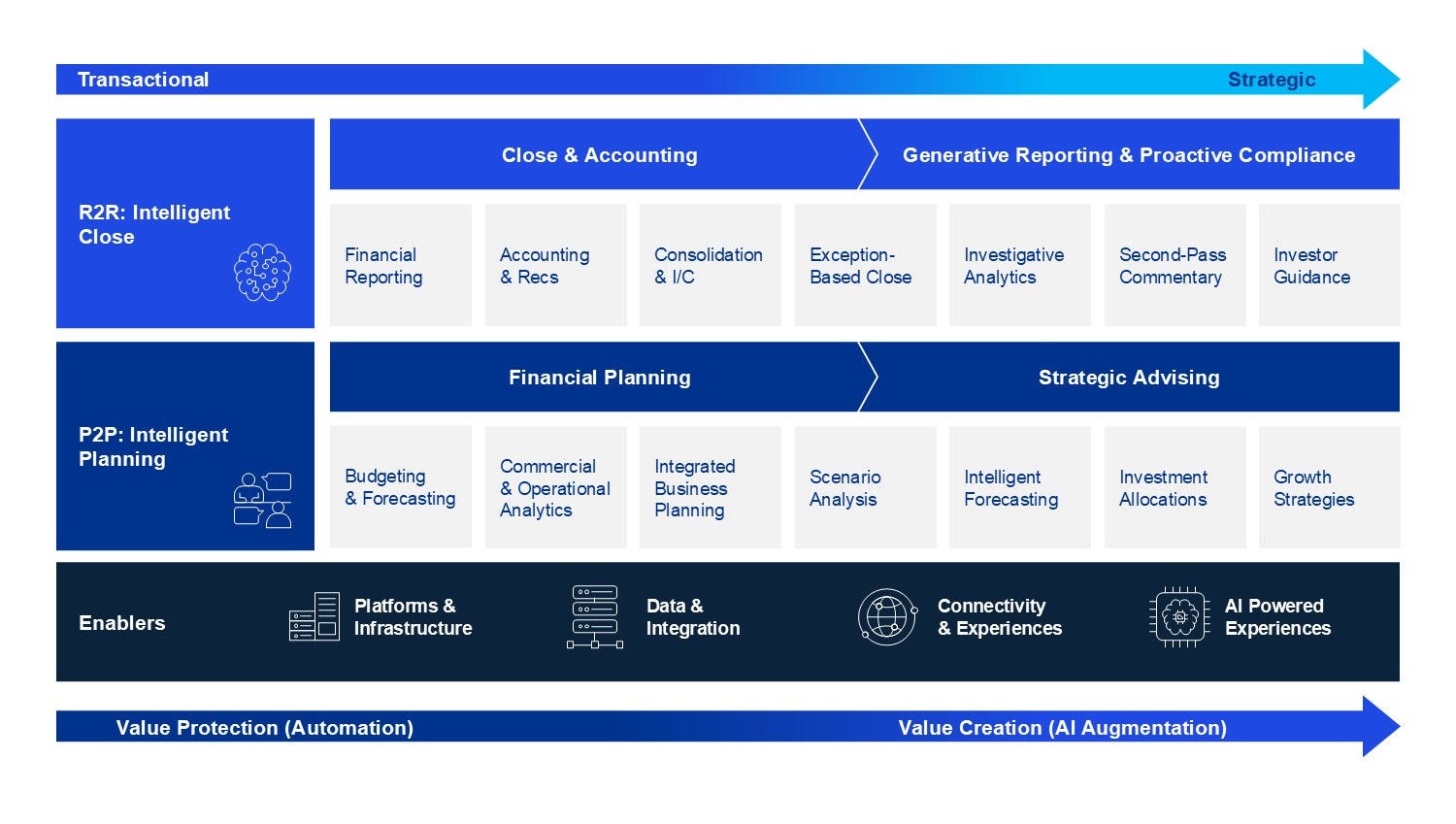
      As Finance shifts from a transactional service provider to a true value‑creation partner, core processes across Record to Report (R2R) and Plan to Perform (P2P) are being fundamentally re‑engineered. The question is no longer whether Finance can evolve with AI, but how quickly it can seize this opportunity to lead AI adoption.


      Reinventing record to report through intelligent close

      The shift to an Intelligent Close represents a fundamental reset of Record to Report (R2R). Rather than operating around a fixed, month‑end cadence, AI enables a more continuous, intelligence‑driven way of working. The outcome is not just a faster close, but one that is more accurate, more insightful, and far less dependent on manual effort, freeing Finance teams to focus on understanding and improving business performance instead of assembling data.

      Below are a few examples of how this transformation is taking shape.


      Continuous Financial Close

      Rather than waiting for month‑end, AI supports a steady flow of reconciliation, validation, and commentary throughout the period. Automated reconciliations and journal entry reviews reduce reliance on manual checks, while real‑time data ingestion gives Finance visibility into trends and performance as they develop. Intelligent systems synthesise data across formats and sources, generating financial statements and narrative more quickly and with greater consistency.

      Agentic AI shifts the model further. Instead of following predefined rules, it can identify issues, interpret patterns, and initiate actions through taking on elements of R2R execution autonomously while maintaining human oversight where judgement is required.

      From Reactive to Predictive Controls

      AI strengthens the control environment by spotting anomalies as they occur, rather than after the fact. Transaction‑level analysis, pattern recognition, and predictive models improve audit trails and enhance control precision, enabling Finance teams to intervene earlier and with greater confidence.

      Blurring Traditional Boundaries

      As insight becomes real‑time and embedded in day‑to‑day decision‑making, traditional boundaries between R2R, FP&A, Treasury, and Risk begin to blur. Data flows more seamlessly between processes, and R2R outputs feed directly into planning, liquidity management, and performance decisions. This shifts close activities into an active input to the business, rather than a point-in-time retrospective.


      Plan to Perform: Intelligent planning with AI

      In Plan to Perform (P2P), AI is transforming planning from a static, backward‑looking cycle into a dynamic, insight‑driven discipline. Some examples of this can be seen through accelerated budget cycles and enhancing both speed and precision of outputs.

      Accelerating budgeting cycles

      Rather than relying on static assumptions or incremental adjustments to prior‑year plans, AI agents can analyse spending patterns, historical performance, and the expected return on investment across initiatives at scale.

      Planning shifts from a fixed annual exercise to a continuous, intelligent forecasting model. Rolling forecasts, supported by automation, replace static budget cycles and create a self‑reinforcing feedback loop between performance and planning. Intelligent forecasting draws on multiple internal and external data sources, improving the speed, accuracy, and relevance of insights.

      These capabilities are underpinned by automated data processes that significantly reduce manual effort and delays. Rapid data processing accelerates planning cycles and improves the reliability of outputs, while integrated systems bring together data from Finance, HR, Procurement, and operational platforms. This integration not only strengthens insight quality but also allows planning outputs to connect seamlessly into broader enterprise planning and decision‑making processes.

      Bridging FP&A and Treasury

      Historically, FP&A has focused on speed and insight while Treasury prioritised regulatory precision. AI helps bring these perspectives together by providing shared, continuously refreshed forecasts that balance accuracy with agility, enabling more effective balance sheet management and capital planning alongside regulatory capital requirements converging regulatory objectives with business performance outcomes.

      By simulating a wide range of regulatory, macroeconomic, and business scenarios using shared assumptions across Finance, Risk, and Treasury capital planning can be transformed from static stress‑testing cycles, to rapid “what‑if” analysis that show the capital impact of emerging risks, shifts in portfolio performance, or strategic decisions under different market conditions. This improves the precision of regulatory capital and liquidity reporting process, enhances stress‑testing readiness, and supports more confident capital allocation decisions. By unifying insight across business performance, liquidity needs, and regulatory capital requirements, AI enables organisations to steer the balance sheet with greater agility, foresight, and resilience.


      Rethinking Finance roles in an AI era

      As AI takes on more executional tasks, Finance roles shift towards higher‑value activities such as interpretation, oversight, and strategic direction. We expect to see fundamental changes to the roles and processes that Finance performs, leading to drastic changes in profile and career path with more agile teams and human oversight required over AI outputs.

      The changing CFO mandate

      The rise of AI demands greater automation, stronger controls, and the expansion of processes that enable richer insights from the Finance function. These developments ultimately elevate the CFO’s role, which is shifting towards strategic value creation. The CFOs remit will expand two-fold into establishing a trusted and ethical AI ecosystem (Chief Trust Officer) and driving AI growth and innovation (Chief Value Officer).

      • Chief Trust Officer (CTO): This role relates mainly to Record to Report, with a focus on control, accuracy, and enhanced data management strategies.

      • Chief Value Officer (CVO): This role feeds into new remits of increasing strategic capacity of Plan to Perform, largely focused on capital allocation, strategic financial planning, and investment strategies.

      The entire value chain of Finance is re-imagined and digitally enabled from processing, close, to planning & reporting.


      Finance in an AI‑enabled operating model

      Through intelligent close cycles, real‑time insights, automated controls, and dynamic planning, Finance is stepping into a new era where it converts data into direction, and direction into decisive action.

      As roles shift and processes accelerate, Finance teams gain the capacity to move far beyond reporting and towards shaping strategy, influencing investment, and steering enterprise value creation. Alongside this, the CFO remit is expanding into new territories of trust, ethics, innovation, and growth, cementing Finance’s position at the heart of organisational decision‑making.

      Our transformation insights

      The impact of AI on service delivery models in Finance

      The impact of AI on people in Finance

      The impact of AI on governance in Finance

      The impact of AI on MI & reporting in Finance


      MTD

      Get in touch


      Discover why organisations across the UK trust KPMG to make the difference and how we can help you to do the same.