error
Subscriptions are not available for this site while you are logged into your current account.
close
Skip to main content

Loading

The page is loading.

Please wait...


      Finance service delivery models have never stood still. Over the years, the function has continually adapted; moving from traditional onshore teams to offshore centres, embracing shared services, and expanding self-service capabilities. Each wave of change has been driven by new technologies, global economics and shifting business priorities.

      Today, artificial intelligence is accelerating this evolution, blurring the boundaries between established delivery models. As automation takes over routine tasks and moves further up the value chain, CFOs are being prompted to reconsider What, Who and Where, setting the stage for a smarter, more agile, and more influential Finance function.

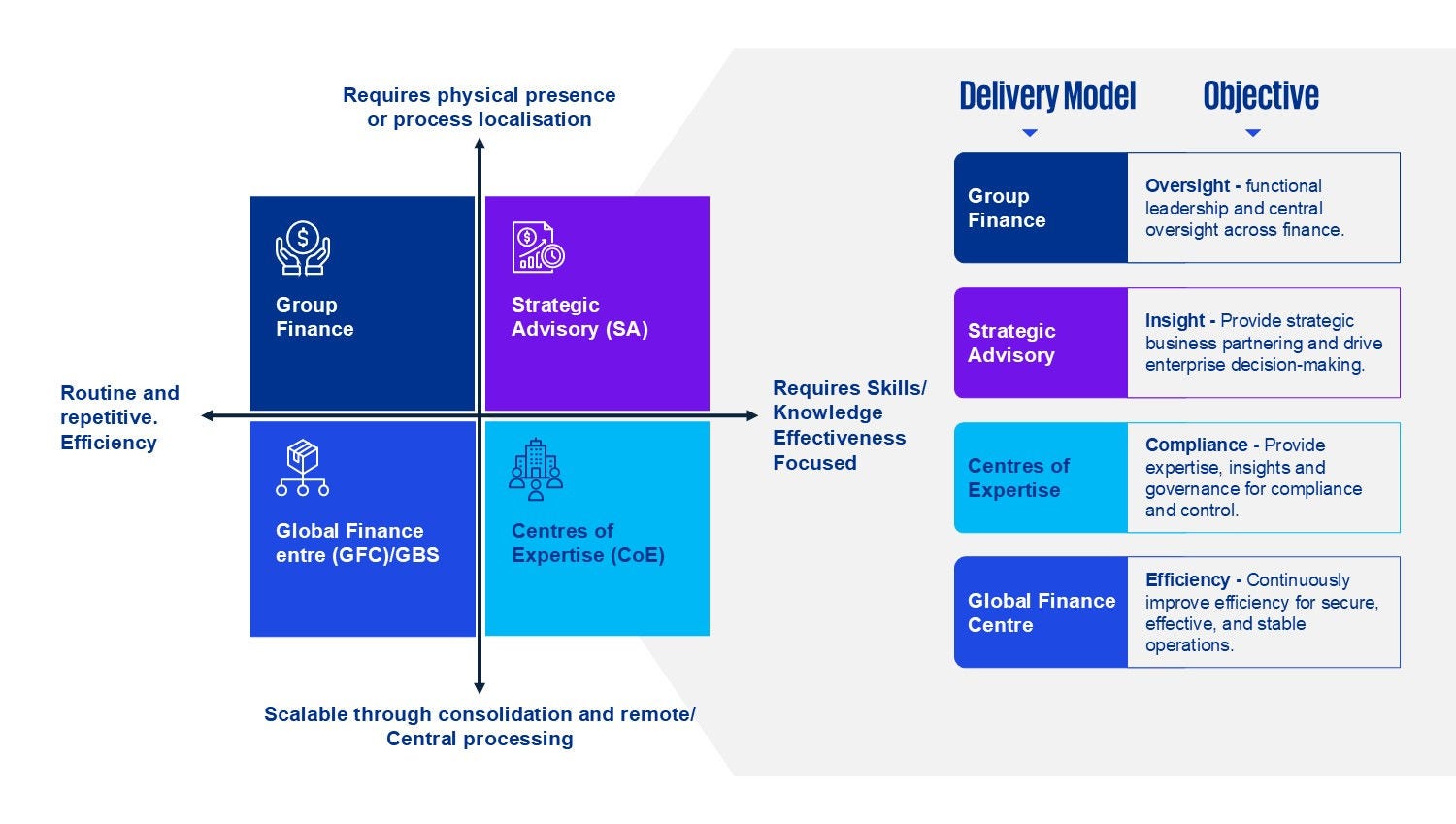
      In a typical Finance service delivery model, activities fall into four quadrants. However, in recent times technology and now AI have dramatically shifted the balance.

      Maurice Lips

      Partner - Head of Finance Transformation, KPMG UK

      KPMG in the UK


      Christopher Checkley

      Partner, Finance Transformation

      KPMG in the UK


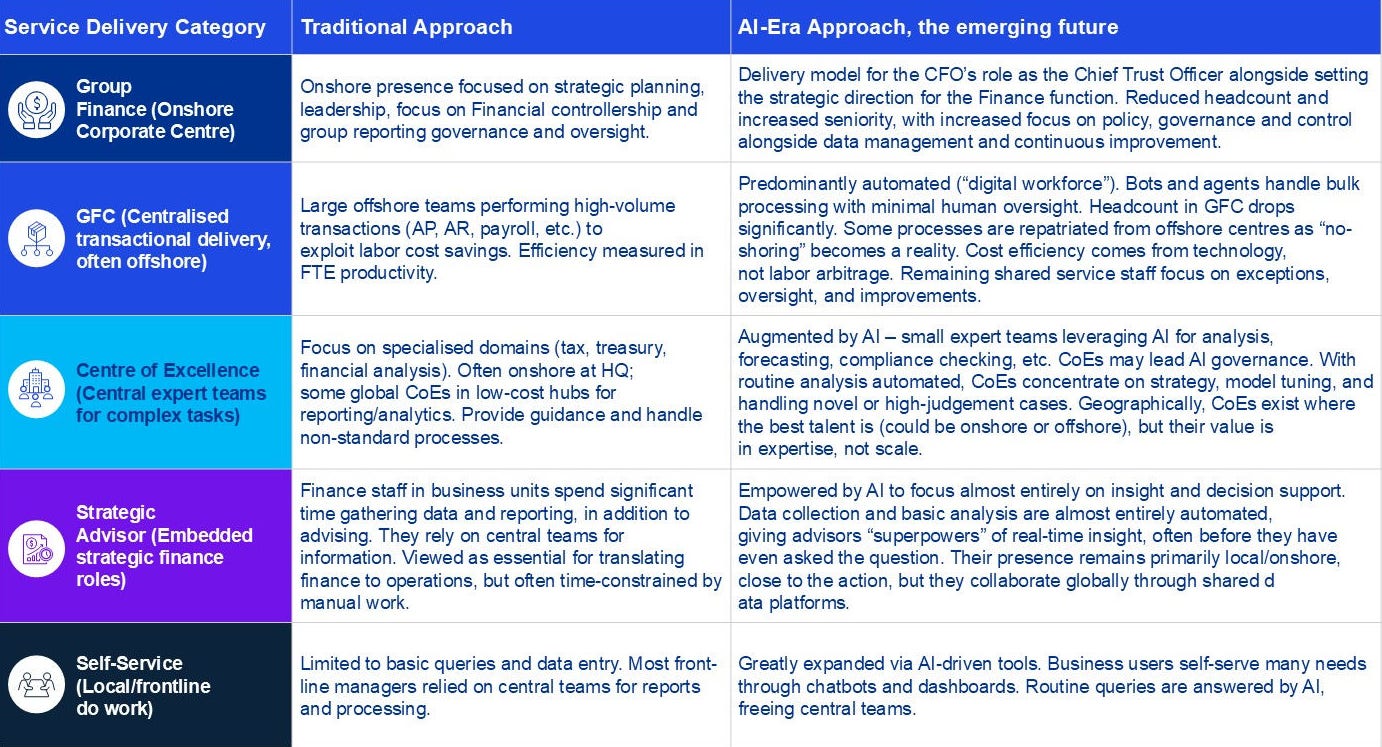
      Historically: Offshoring dominated transactional work

      Finance functions have relied heavily on offshoring and outsourcing as a cost-saving strategy. For those that invested heavily in offshoring the Global Finance Centre became the workhorse: high-volume processes were relocated to lower-cost countries to arbitrage labour costs. If a task didn’t require being done onshore, it would be offshored. Either an extension of an onshore team, or for more mature firms, to a centralised Global Finance Centre.

      During this period, the Strategic Advisory and CoE roles remained largely onshore. Critical finance leadership, high-sensitivity tasks, and expert analysis were kept in Group Finance or centres of expertise.

      Whilst this approach did result in reduced costs, very limited gains in efficiency or effectiveness were seen as deficient processes were simply lifted and shifted from one location to another. The argument that moving the ‘broken’ or inefficient process to a low-cost location would result in the same cost savings as fixing and automating it, was hampering any long-term investment in process improvement and modernisation.

      The full promise of technology was not yet realised, and offshoring had become a default.


      Recent shift: Digitally augmented service delivery

      In the last few years, cost drivers and technology developments have upended traditional service delivery models. Companies began to recognise that outsourcing/offshoring is not the only lever for efficiency. Three interrelated shifts emerged:

      • Global Finance centre maturity

        Finance offshoring has evolved into broader GFC organisations, integrating multiple processes and subfunctions and aiming not just for cost savings but for effectiveness providing services back to the rest of Finance through SLAs. Processes were standardised globally, and centres of excellence were distinguished for high-value work. Instead of only “lift and shift” to low-cost locations, organisations looked at where work is best done (onshore vs offshore) based on complexity, risk, and needed skills. The result was a more nuanced approach: routine transactions in offshore GFCs, CoEs for specialist work (sometimes onshore, sometimes offshore), and empowering business-facing finance roles.

      • Automation “No Brainers”


        A wave of process modernisation has swept through Finance operations. Through investment in technology and automation, firms have sought to unwind their complex and often duplicate processes to become more automated and streamlined. For those that took this route, it became clear that many tasks once offshored for cheap labour could be optimised for greater efficiency and better enabled by technology. We typically observe that best value sourcing ratio sits between 35-50%. Sourcing levels greater than 65% create a disincentive for digital transformation. Simply moving inefficient processes to lower cost delivery models.

      • Value over cost, some rebalancing onshore

        With automation taking over routine tasks, Finance leaders refocused on value-add activities. The role of the Business Partner has been elevated to Strategic Adviser – finance staff are expected to spend more time on analysis, forecasting, and decision support for the business. This shift effectively re-centres some activities back onshore. We also see self-service capabilities expanding with user-friendly analytics and AI assistants, frontline managers can query financial data or run scenarios themselves.


      The AI-enabled future: Fewer offshore FTEs, more “Digital Reshoring”

      Looking forward, the service delivery model of the future in Finance can be described as smaller, smarter, more agile and critically; more influential. One recurring prediction is that Finance functions will be “40-60% smaller”, as automation takes on 80%+ of current tasks. This doesn’t mean Finance will do less – it will do more, the expectations for Finance are not just increasing but they’re changing shape and the service delivery model must morph to enable success.


      The traditional large offshore GFC may become an endangered species. Transactional work will be highly automated, and what remains might be consolidated in a few global hubs or even centralised back to the Group Finance. With the majority of activity expected to be automated, we may see the introduction of “no-shore” or location-agnostic processes, a cloud-based AI doesn’t mind if it’s “onshore” or “offshore.” This opens the possibility for companies to rethink location strategy. Activity that was offshored can effectively be repatriated not to onshore people, but to onshore systems. The result is fewer people offshore, and those that remain are managing exceptions, complex cases, and providing niche expertise moving such centres higher up the value chain.

      There is also a risk and resilience angle expected drive increased appetite for reshoring. Regulators are wary of over-reliance on complex offshore/outsourcing and the criticality of controls increases as AI agents amplify Enterprise risk. Frameworks like the EU’s DORA (Digital Operational Resilience Act) push financial institutions to ensure critical operations can be maintained and controlled. New processes and activities will be designed with an AI-first approach. We also anticipate incremental onshoring of control through technology and broader management oversight to avoid loss of explainability and maintain accountability. Such activities will move back to the Group Finance quadrant, supporting the CFO in their efforts as Chief Trust Officer.

      In the future model, the CoE and Strategic Advisory quadrants take centre stage. Routine work minimised, Finance will be judged on how well it guides strategy and manages performance. CoEs will likely expand in areas like data science, AI model management, and complex analytics. Strategic Advisory will further double down ondriving value: scenario planning, investment decisions, risk management enabling the CFO to become the Chief Value Officer.


      All these trends suggest a future finance function that is far more digitally global, but physically streamlined.


      AI is fundamentally reshaping finance service delivery models. the traditional service delivery model quadrants remain but their composition and interplay will shift. CFOs should still be asking: “What, by whom, and where?” In the AI era, the answers are: Automate a lot of the “what,” augment the “who” with new skills and AI agents, and make “where” a strategic choice rather than a cost necessity. It’s not all about cutting, it’s about reskilling and repositioning to fit the new model. This is a profound change from five years ago and it’s happening now.


      Our transformation insights

      The impact of AI on governance in Finance

      The impact of AI on people in Finance

      The impact of AI on MI & reporting in Finance


      MTD

      Get in touch


      Discover why organisations across the UK trust KPMG to make the difference and how we can help you to do the same.