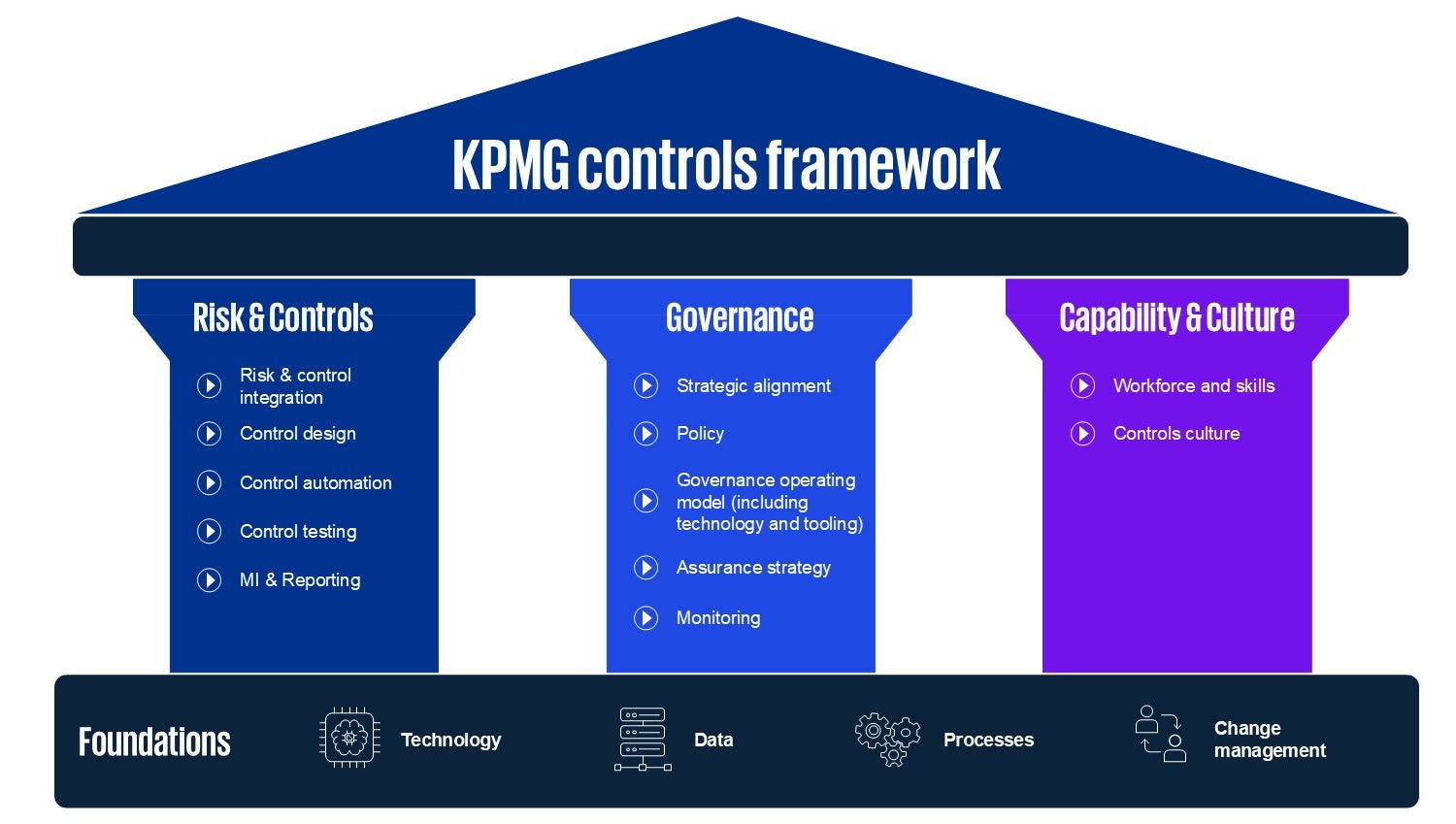
Diving into the first pillar of the KPMG controls framework, AI within Finance has emerged in core control activities. AI can analyse vast volumes of structured and unstructured data at speeds that no human review cycle could replicate. Instead of periodic sampling, Finance can operate with a continuous lens where risks are detected not just at month‑end but in real time when they first appear.
As these models integrate deeper into daily operations, they begin to reshape Finance’s control. The old control taxonomies of manual vs automated, detective vs preventative start to blur. Controls become adaptive, re‑training as they encounter new behaviours, spotting patterns, and surfacing anomalies with context rather than merely flagging exceptions.
In this new world, compliance stops being a set of static rules. It becomes an intelligent layer woven throughout Finance operations. Policies can be translated directly into machine‑readable logic, creating consistent, automatic enforcement. Variations in control descriptions are normalised by AI into singular, auditable standards. What once took teams months to rationalise can now be achieved in hours.
One of the most powerful shifts is in management review. Traditionally one of the most judgement‑heavy control classes, management review often suffers from inconsistency, excessive manual work, and the inherent limits of human error. Instead, AI can spot out‑of‑tolerance reconciliations, surfacing root‑cause insights and pre‑triaging anomalies. Human judgement will always be required in management review, but the level of judgement required is minimised by AI surfacing all of the facts with supporting context.
As testing becomes more automated, AI gradually assumes the heavy lifting that once consumed auditors and controllers. Process walkthroughs are enhanced by AI‑generated maps derived from documentation and transcripts. Finance’s focus shifts from documentation to insight, from proving that controls are operated to understanding what the controls are telling us. With evidence gathering and documentation largely automated, up to 80% of controls testing could be executed by AI. This repositions Finance as supervisors of exceptions, complexity, and judgement.