

AI in Finance is often framed as a technology story; new tools, new data, more automation. But the Finance function only really changes when its people do; what work exists, who does it, how it’s supervised, and how value is created (protected and re-invested) day to day. To maximise the value of AI, organisations need to redesign workflows end-to-end and create an environment where people learn, adapt, and use new tools with confidence.
The shift has already started: From teardrop to diamond
KPMG’s banking benchmarks show Finance moving from a “teardrop” structure, heavy on junior, transactional roles, towards a “kite”, with more senior, strategic positions. Between 2019 and 2024, Analyst roles in large banks dropped from 41.9% to 33.5%, while Director/Executive Director roles nearly doubled (BFFB 2025).

Evolution of the best practice shape:
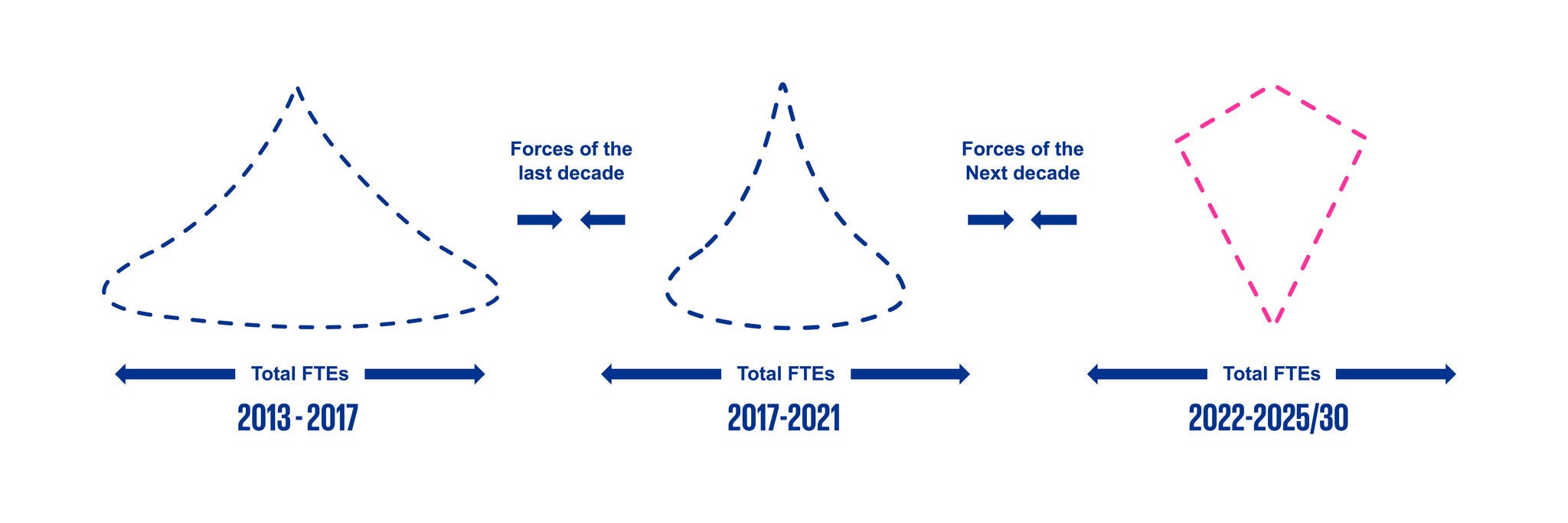
This matters because the future of Finance is about where judgement sits. Finance still leans towards value protection (controls, assurance) over value creation (insight, business partnering), but the ideal is to shift more effort to value creation.
Spans and layers are key structural levers. Too many layers add cost and slow decisions. Simplifying means fewer layers and wider spans. Typically, we see ranges from 8-12+ for lower complexity activities (more operational and customer service support) and 5-9 for moderate – high complexity activities (specialist roles). Success depends on upskilling and cultural change, not just org-chart redesign. Flattening the structure is more feasible because information moves faster and exceptions surface earlier, shifting human effort away from coordination and towards expert, outcome‑oriented roles.
AI accelerates these shifts, by compressing transactional work and reducing the coordination overhead that historically justified layers. But new operating models only succeed when structural changes are matched with redesigned governance. AI‑enabled workflows require clearer ownership, explicit escalation routes, and decision rights that reflect the speed and granularity at which AI agents operate. Without this, organisational design changes risk becoming theoretical rather than lived.
How the “AI workforce” becomes part of the team
With AI-empowered Finance teams, where faster decision-making, lower costs, and improved compliance are on the horizon, work needs to be analysed at the task level rather than just by job or skill. By mapping the specific tasks within Finance roles, leaders can pinpoint exactly where AI Finance Agents add value, and highlight which skills are required to what proficiency. This task-level insight helps organisations with strategic workforce planning where humans and AI agents operate side by side, and enable leaders to have more meaningful, data informed conversations about time saved, capacity gains, value creation and cost saving initiatives.
Our workforce AI analysis shows that GenAI can potentially unlock 25% of CFO capacity, 27% for Chiefs of Staff, and 28–38% for core Finance roles including Business Partners, Controllers and Analysts. Additionally, at the task level, GenAI can automate 40–52% of effort on budgeting, forecasting preparation and KPI maintenance, and 32–48% of time on reporting, audit preparation and variance analysis. These task-level gains shift time away from summarisation, content creation, preparation and checks toward higher value judgement –reinforcing that AI agents are a structural redesign lever, not a marginal add-on. In a future Finance model, humans and AI agents operate in sync; agents manage volume work such as first drafts, pattern recognition and monitoring, while people focus on validation, interpretation and stakeholder influence.
AI impact is rarely isolated to Finance. The biggest productivity gains occur when Finance and adjacent functions (Procurement, Risk, HR and Operations) “rewire and scale” to adopt Agentic AI together. As processes like forecasting, investment appraisal, month end and procurement-to-pay span multiple teams, coordinated adoption drives step changes in cycle times and quality. Cleaner, AI validated inputs upstream mean Finance spends less time correcting data, while faster Finance analysis enables downstream teams to receive insight faster.
AI productivity gains:
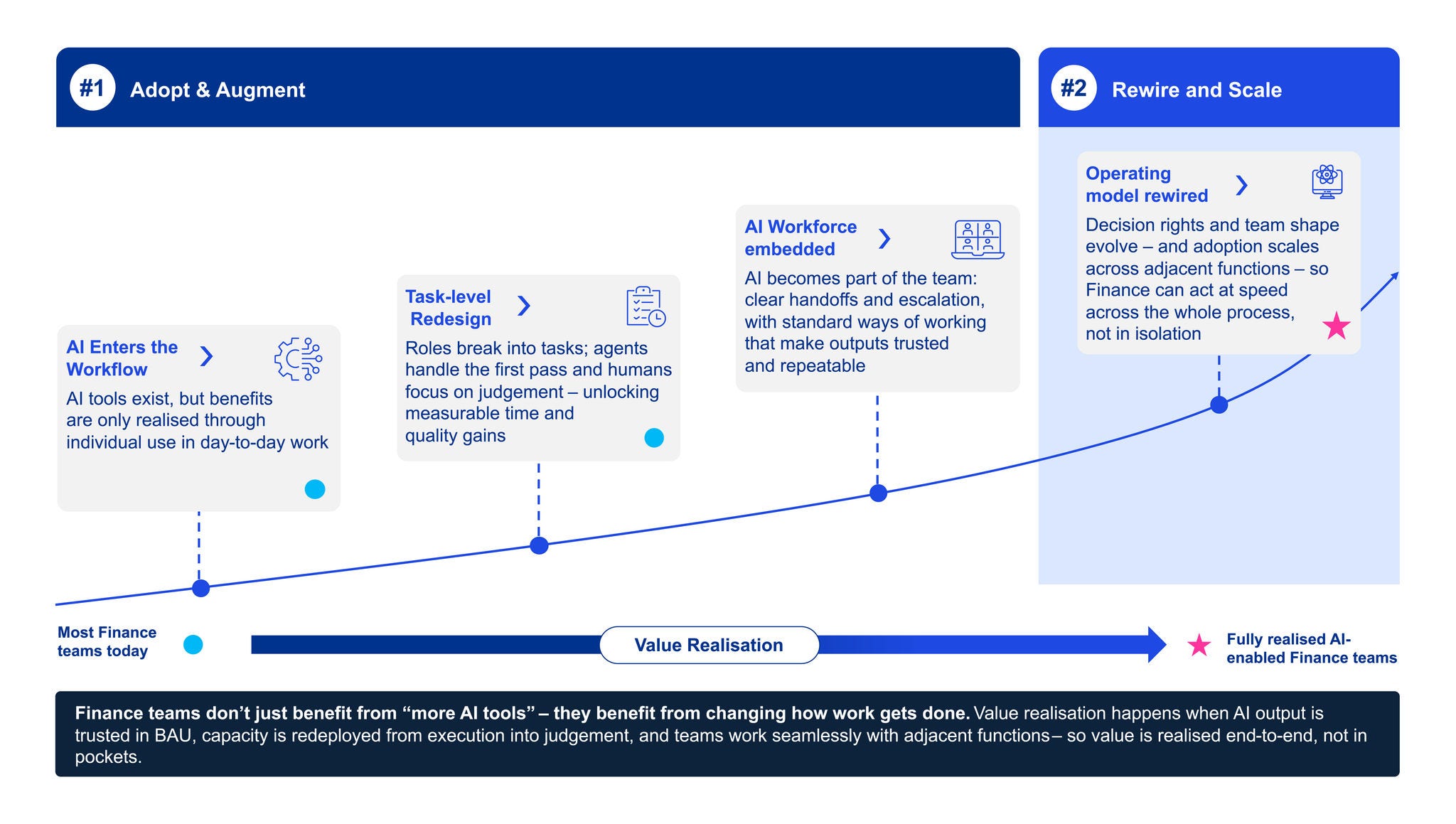
Once AI is embedded in the workforce, upskilling strategy shifts to building the ability to use, challenge and translate AI-driven outputs into decisions. The emphasis moves from producing analysis to shaping it; from technical execution to judgement, influence and business understanding.
What grows in value is the capability to work across ambiguity; exercising judgement under uncertainty, triaging exceptions and the ability to interrogate AI outputs with confidence. But crucially, as technical tasks become automated, Finance professionals will increasingly define themselves by the soft skills that always differentiate great practitioners: communication, creative problem-solving, designing workflows and orchestrating outcomes. These skills become the core of the redesigned Finance role in an AI-enabled operating model – a shift in professional identity as much as a shift in capability.
Culture is ultimately where ROI is won or lost. Today, only 42% of UK workers who use AI say they trust it, even as 81% of CEOs prioritise AI investment. Many transformations fail by “forgetting the human side”; adoption sticks only when people see meaningful change, feel safe to learn, and develop new habits supported by the operating environment. Teams that succeed approach AI with openness, redesign workflows to remove bottlenecks, and reallocate time to higher value work.
For AI to embed successfully, Finance cultures need colleagues who:
- feel confident that processes are well governed with clear accountabilities.
- recognise the shift from static reporting to faster, continuous decision support;
- embrace ongoing learning as part of day-to-day work; and
- trust that AI removes low value tasks without threatening their roles, enabling a move toward higher impact, strategic work.
The risk is clear: if organisations invest in training but Finance culture fails to shift, AI ROI for the Finance function quickly becomes light.
Done well, organisations can unlock an often overlooked‑ but powerful benefit:; a wellbeing dividend. As agents take on repetitive, cognitively draining tasks employees regain bandwidth for work that requires expertise, creativity and judgement. Early deployments show lower stress during peak cycles, higher role satisfaction, and a sense of “doing the job they were hired to do.” When people spend less time on routine tasks and more on influencing decisions, problem-solving‑ and partnering with the business, wellbeing and retention improve as natural outcomes of the redesigned workflow.
KPMG’s Global AI-in-Finance Report points to new roles emerging, as AI becomes embedded in finance. These span from AI-enabled operating roles to more formalised roles around oversight, ethics and assurance. KPMG also highlights AI Finance Agents, shifting teams from end-to-end task execution towards orchestrating combined human and AI outcomes across workflows.
As this shift takes hold, a new type of leadership role emerges. Finance professionals increasingly act as ‘agent bosses’, responsible for managing blended teams of people and AI agents. Accountability no longer sits with how work is done, but with whether outcomes are delivered, regardless of whether those outcomes are produced by digital or human teammates. This reframes management itself, placing greater emphasis on judgment, prioritisation, and outcome ownership rather than task supervision.
This is why the emerging roles go beyond ‘prompt engineers’, and toward positions that combine technical fluency with the soft skills that differentiate great practitioners, for example:
- Finance Agent Orchestrator / Workflow Owner: Designs and oversees AI-led workflows, ensuring clear escalation and reliable outcomes.
- AI Assurance & Attestation Lead: Owns evidence trails, controls, and audit readiness for AI-enabled outputs.
- Decision Intelligence Lead: Turns AI-driven scenarios into actionable decisions for leaders.
Closing thought
AI doesn’t change Finance, Finance teams do. Evidence already suggests finance structures are shifting, AI is moving from pilot to embedded capability, and organisations are investing in both training and hiring to close capability gaps. Yet productivity gains don’t come from adding tools alone – they come from redesign and adoption; rewire the work, upskill the team, and make judgement the differentiator.
Our transformation insights

Get in touch
Discover why organisations across the UK trust KPMG to make the difference and how we can help you to do the same.