In 2022, global economic growth moderated amid the continuing impact of the Covid-19 pandemic, coupled with elevated inflationary pressures and a higher interest rate environment. Hong Kong’s economy also experienced a notable slowdown with a contraction of 3.5 percent in 20221 compared to a 6.4 percent expansion in 2021.
Despite these headwinds, Hong Kong’s banking sector saw moderate growth in its overall balance sheet in 2022. The total assets of all licensed banks expanded by 2.5 percent to HK$23 trillion. There was a slight decrease of 0.6 percent in loans and advances and a decrease of 0.2 percent in deposits. In line with our prediction in our 2022 Hong Kong Banking Report, the effect of the rising interest rate environment benefited the earnings of the city’s banks, with a notable increase in net interest margins (NIM). The NIM for all licensed banks increased by 24 basis points in 2022 to 1.55 percent. Operating profit before impairment charges for all licensed banks increased by 24.3 percent to HK$220 billion in 2022.
Following seven interest rate rises in 2022, the US Federal Reserve again raised the Federal Funds Rate by 25 basis points each in February, March and May 2023. In tandem with the Federal Funds Rate increases, the Hong Kong Monetary Authority raised the base rate from 0.5 percent to 4.75 percent during 2022, and further increased to 5.5 percent during January to May 2023. We also observed a sizable increase in the Hong Kong Interbank Offered Rate (HIBOR) in 2022 from 0.26 percent to 4.99 percent2 (for three-month HIBOR). The composite interest rate, which is a measure of the average cost of funds of banks, increased by 190 basis points from 0.21 percent in December 2021 to 2.11 percent in December 2022.
Moving into 2023, uncertainties about the future interest rate pattern remain high, but the reducing aggregate balance indicates that HIBOR and LIBOR should converge as banks offer more attractive rates to attract Hong Kong dollar funding. The Hong Kong (SAR) Government has forecast the city’s economy to grow by 3.5 to 5.5 percent in 2023, after a 3.5 percent contraction in 2022. The consumer price inflation is forecast to be 2.5 percent in 2023, up from 1.7 percent in 20222.
Looking ahead, the performance of the Hong Kong banking sector in 2023 is likely to be linked closely to the speed and extent of the economic recovery in Hong Kong and also the growth of the Chinese Mainland economy, and in particular the health of its real estate sector. While the high interest rate environment could bring an opportunity to improve profitability, it is imperative for banks to closely monitor and manage the credit risk of their loan portfolios.
Hong Kong’s eight virtual bank were all active in the market during 2022: please refer to the section on virtual banks for more details.
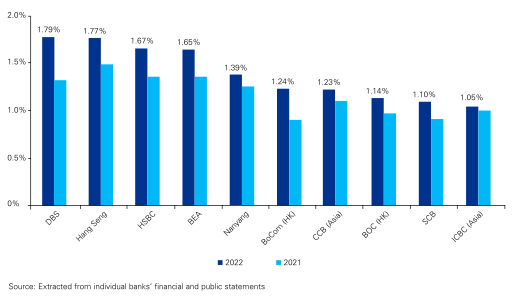
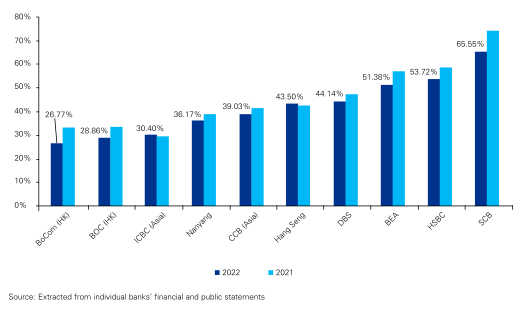
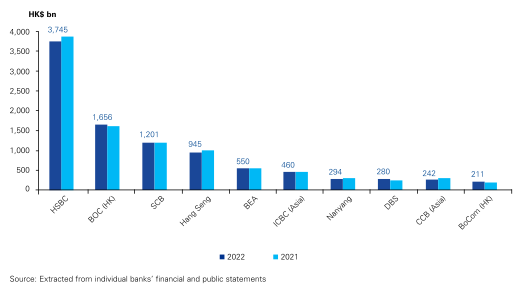
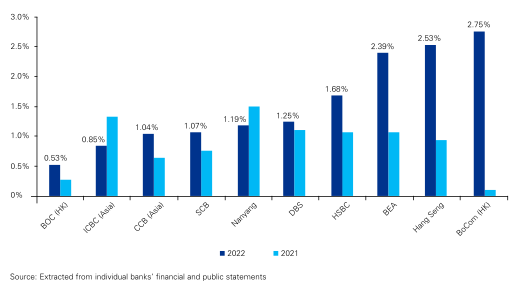
In this report, we present an analysis3 of key metrics for the top 10 locally incorporated licensed banks4 in Hong Kong. While some banks have a dual entity structure in Hong Kong (eg a branch and an incorporated authorized institution), we have not combined their results. The analysis is performed on a reporting entity basis.