
      Many companies are locked in an AI spending race, hoping that better tools will give their employees an advantage over competitors, who are themselves spending like mad thinking the same thing. Employees of early-adopting companies saw productivity surges and could power through analysis and drafting faster than previously possible, but longer-term institutional-level benefits have been slower to materialize while token costs have skyrocketed.  Intelligence edge has become a function of budget allocation and is rapidly converging on the industry average as market players buy ever-larger service packages from the same small set of vendors.

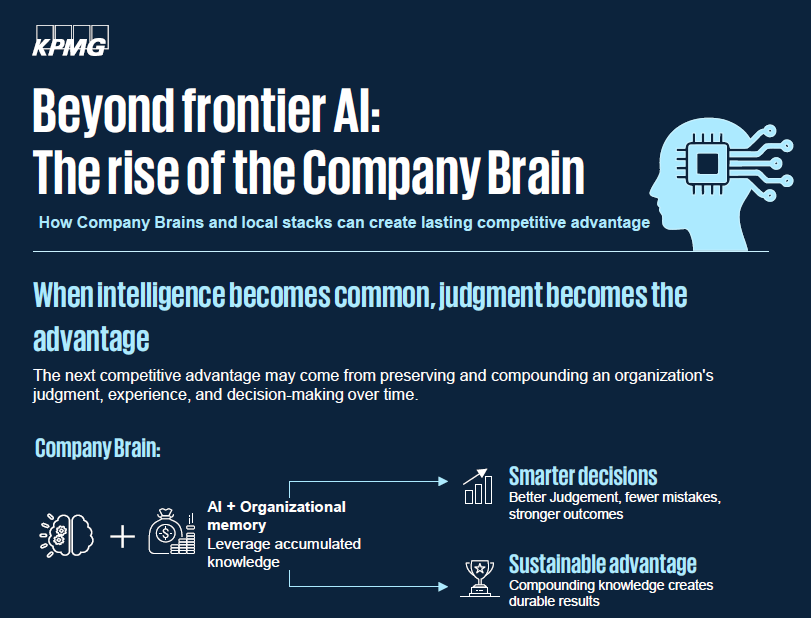
      Lasting and differentiable advantage will likely consolidate around systems inside the company that preserve the reasoning and evidence behind a decision and its consequences, making those lessons available when a problem returns.  As this body of judgment accumulates with each user and is made searchable, it becomes specific to the institution as the “company brain”, creating an asset that improves with use and cannot be purchased from the same vendors that serve its competitors.  This structure enables a Two-Stack operating model that cost-effectively leverages leading emergent AI technology while helping maximize data sovereignty and the snowball effect of captured internal judgments.  External frontier models are powerful productivity tools, but a local stack built on self-hosted, open-weight models will eventually grow into an in-house intelligence, with the potential aim to operate at near-electricity costs.
      The Time-Sharing Phase

      We have been here before. In the 1960s, computers were too large and expensive for most companies to own, so institutions rented fractions of a centralized machine through terminals that gave each user the illusion of having one of their own. Time-sharing, as the name implies, divided access into units of time; modern AI services do the same with quantities of computed content, metered in units called tokens. Either way, the underlying principle is the same.

      As hardware improved and computing costs fell, institutions moved capacity in-house and applied it to a wider range of work. This transition from centralized mainframes to minicomputers and later personal computers gave companies options over what information should be processed under their control, and what could be centralized.

      Enterprise AI is now passing through a similar stage. Leading models, often called “frontier models,” to this point have been far too expensive and complex for most companies to build or operate independently, and the marginal benefit of doing so was limited. As a result, most companies have rented access to the same set of centralized model providers for all their AI needs. These models continue to improve and remain among the best tools for a growing range of tasks, but falling inference costs and cheaper, more capable hardware now allow companies to run more systems within their own environments, unlocking the next wave of enterprise AI capabilities. 

      Chesterton’s Fence

      Chesterton’s Fence is the principle that a fence should not be torn down until someone can explain why it was put up in the first place. Applied more broadly, it means that the logic and judgment behind an existing rule or practice should be understood before it is changed. Modern companies are filled with inherited fences in the form of policies, mandatory thresholds, and approval requirements created to protect against a specific risk that most impacted employees can no longer explain. Changing the fence, to keep with the analogy, requires an understanding of present conditions and the original logic that produced the rule. Most companies retain or maintain one or the other, but rarely both.

      Every company has some version of this problem, but it is easiest to see in regulated industries like financial services. An insurer may stop covering a category of property after a series of costly claims, or a bank may demand more collateral from a sector after a wave of defaults. Years later, the market and the institution’s own exposure may have changed, but the rule remains because nobody can reconstruct the evidence and judgment that produced it. Management must therefore decide if the original risk still justifies the rule, or if the evidence now supports narrowing, removing, or even expanding it.  Absent countervailing evidence, the default is normally to allow rules to persist or multiply.

      In a Two Stack model, management has the option to have the frontier stack analyze current market conditions and external evidence, while the local stack can review the claims, defaults, and exceptions that shaped the original decision. Used together, they can reconstruct the original logic that created a rule and update it with real-time circumstances.

      The Red Queen’s Race

      Now, here, you see, it takes all the running you can do, to keep in the same place. If you want to get somewhere else, you must run at least twice as fast as that!

      Lewis Carroll

      Through the Looking-Glass


      The first wave of enterprise AI arrived as chat-based tools designed to improve the productivity of individual employees. These tools accelerated familiar forms of knowledge work, giving early adopters momentary superpowers. In a randomized field experiment involving 791 professionals of a large FMCG company, individuals using generative AI performed as well on real product-development challenges as two-person teams working without it. Unsurprisingly, KPMG's survey found that 79 percent of organizations will continue to make AI their top investment priority, even if a recession occurs in the next 12 months. Companies are racing to extend these productivity gains across their workforces.2

      These individual-level gains have been impressive, but many organizations are still not seeing the uplift flow through to company-level financial performance. As per KPMG International Global AI Pulse Q2 2026 survey, organizations adopting AI programs have nearly doubled in Q2 2026 to 22 percent (from 13 percent in Q1), however only 7 percent reported established ROI and meaningful business outcomes (down from 8 percent in Q1).3 Companies and their employees are clearly running faster, but industry-wide access to the same tools has raised the pace of business without yet making it more profitable.

      The Fox and the Firm

      Isaiah Berlin made famous a line attributed to Archilochus, a Greek soldier and poet writing in the seventh century BC: “The fox knows many things, but the hedgehog knows one big thing.” Frontier models are foxes that move across subjects that would normally require several specialists.  In one working session they can summarize regulations, compare commercial strategies, review contracts, and effortlessly turn the work into a presentation. They process enormous quantities of information, but their answers are probabilistic and can sound convincing, even when completely wrong. Hedgehogs by contrast work within a narrower field, drawing on a defined body of knowledge and applying it with greater consistency and depth.

      For a company, the hedgehog’s one big thing is the company itself, including the history of its clients, its dealings with regulators, and the consequences of decisions that no written policy anticipated. Much of this knowledge lives inside the brains of the employees who acquired it and is unlikely to be written down or searchable in any practical way.

      Until now, the most reliable way for a company to retain this knowledge was to retain the person who carried it. When that employee retired, resigned, or joined a competitor, much of the reasoning behind earlier decisions left with them.  The local stack can be designed so that their reasoning can remain with the company after the employees who produced it have gone.

      The House View

      Companies regularly confront decisions that cannot be resolved by policy, published evidence, or formal analysis alone. The rules may establish what is permissible, but rarely define what the company should actually do when facts are incomplete, risks conflict, or a technically defensible choice could produce an unacceptable result. Experienced employees develop judgments for these situations through repeated exposures to clients, markets, regulators, and mistakes. We will call these accumulated judgments “house views”.

      A house view is not another policy. Policies establish the boundaries within which employees must act, but they cannot resolve every judgment made therebetween. The house view is the space between what the rules allow and what experience has taught seasoned employees to do. As a working example, a company may reject a product claim that is legally defensible because of past interactions with regulators on similar topics.

      The local stack can preserve this decision in a form that others can use by recording the circumstances that triggered it, the evidence and assumptions considered, the alternatives rejected, and the conditions attached. The aim is to retain enough context for someone facing a similar decision to understand why the earlier judgment was made and whether it still applies.

      Consider again the previous example of a company preparing to make a stronger claim for a product sold across several markets. The frontier stack can review the published regulations, compare competitor language, and propose wording that appears legally defensible. An experienced internal compliance leader may still reject it because a regulator previously objected to similar wording, even though the official rule has been satisfied. The company already knows how that regulator treated their earlier claim and may simply decide the outcome is not worth the effort.

      In similar situations, a local stack can create a file for an event that includes the earlier regulatory interactions, the reviewer’s reasoning extracted from communications and notes, and the final wording eventually approved. When another market encounters the same question, the team can see why the original claim was rejected rather than simply being told to avoid. If the regulation, product, or evidence is different, it may reach a different answer without having to reconstruct the earlier decision from scratch.

      An experienced reviewer with local-environment AI assistance can then take this information and decide which circumstances were essential to the outcome, and which were incidental. A judgment can remain local in scope when it depends on conditions unique to one market or event, or it can be made part of the wider house view if the same reasoning continues to hold across different settings. 

      Where the Advantage Accumulates

      The capabilities of frontier models will continue to grow, and their adoption will likely expand among companies able to buy access. The comparative advantages early adopters may have enjoyed for task productivity will hold for some specific use cases but soon may become the industry standard and part of the rented common infrastructure of business. The lasting difference will likely be built in the local stack, where each company can create an environment that is unique to its house views developed through real work.

      The value of a company’s set of house views can increase recursively as more employees draw on the accumulated judgment and refine those views through real-world use. Each participant can inherit the experience developed before them while adding evidence that may confirm or challenge an existing view. Since the local stack preserves both the reasoning behind a decision and the associated results, leadership can determine if issues recur elsewhere or are unique to one product, market, or regulator, allowing them to make specific interventions and set better-informed internal policies.  Companies that preserve what they learn from each decision can build a lasting advantage while their competitors may spend ever-greater sums renting intelligence just to keep up.

      1 Carroll, Lewis. Through the Looking-Glass, and What Alice Found There. London: Macmillan, 1871.
      2 Fabrizio Dell’Acqua et al., “The Cybernetic Teammate: A Field Experiment on Generative AI and Teamwork,” Organization Science, published online June 12, 2026, https://doi.org/10.1287/orsc.2025.20702; Global AI Pulse Q2 2026, KPMG
      3 KPMG International, Global AI Pulse Q2 2026: From deployment to value realization, June 2026.


      AI second great shift

      Beyond frontier AI: The rise of the Company Brain

      How Company Brains and local stacks create lasting competitive advantage


      Our insights

      The graduate handbrake meets the demographic time-bomb

      A new lens for assessing enterprise value

      What the Industrial Revolution can teach us about the future

      Our people

      Luke Treloar

      Partner, Head of Strategy Group | Head of Infrastructure, Government & Healthcare (IGH)

      KPMG in Vietnam