
      Foreword


      This publication aims to provide insights from our analysis, based on the financial statements published by 20 life insurers in Thailand for the year ended 31 December 2025.

      We have evaluated disclosures and key metrics under TFRS 17, with a focus on insurers’ long-term business.
      1. Discount rates

      Discount rates vary between insurers by 1-2% across tenors.

      • Disclosed rates show a 100-180 basis points range across life insurers, with variation likely due to differences in illiquidity premia, and business profiles.
      • Disclosed rates are higher than the risk-free rate1 benchmark (Thai zero-coupon bond yields).

      Note: If disclosed discount rates are presented as a range, the simple average is used to represent the discount rate.


      2. Contractual service margin (CSM)

      Industry CSM shows modest growth to be earned over the next decade and beyond. 

      • Over 60% of in-force CSM is expected to be released as revenue within 10 years from the reporting date.
      • Normalised CSM growth2 reached 5.0%, bolstered by NB CSM and IFE, and partially offset by CSM release.

      3. Risk adjustment (RA)


      Risk adjustment varies by the approach and by the numbers. 

      • Risk adjustment ratio, as % of the present value of future cash flows (“PVFCF”)3, commonly ranges between 1.5% - 3.4%.
      • The confidence level approach was the most commonly adopted, with some insurers specifically referencing OIC provisions for adverse deviation (PAD) parameters.
      • The most commonly disclosed confidence level was at the 75th percentile.

      4. Expenses and insurance acquisition cash flows (IACF)

      Other operating expenses comprised small share of insurers’ revenue.4

      • For most insurers, other operating expenses range from 4% to 11% of insurance service revenue, with a few insurers having ratios outside of this range.
      • A lower ratio may generally be expected for a dedicated life insurer with a focus on core business.

      New business insurance acquisition cash flows (“NB IACF”) comprised 10-20% of expected premiums.3

      • Present value of inflows (“PV inflows”) is used to represent the total expected premiums, adjusted for the time value of money.

      Note: Based on 19 insurers, as one insurer did not separately disclose IACF.


      5. Performance drivers

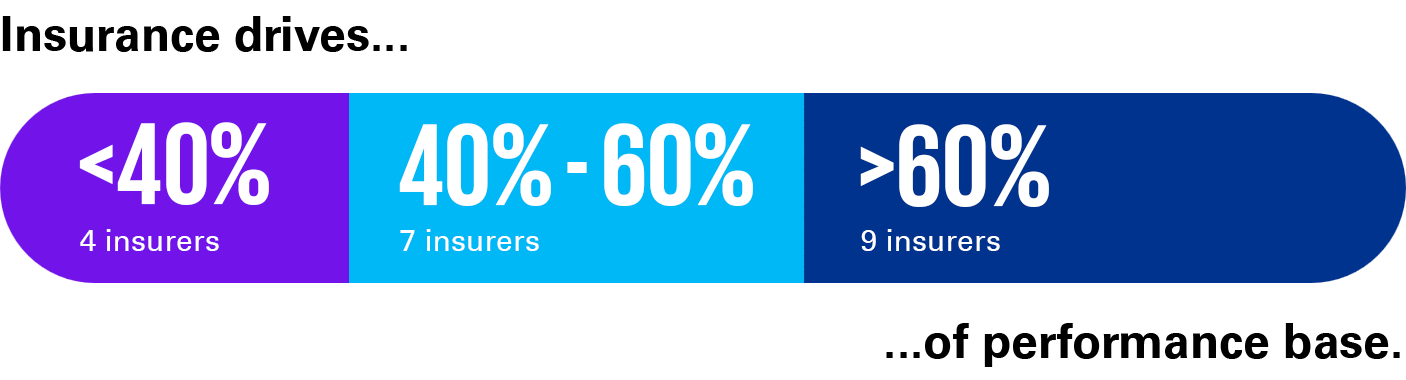
      insurance performance driver

      Insurance is the primary driver of results for most insurers.

      • Insurance service result is taken as representing the core business.
      • Insurance business is supported by investment-related activities, providing an additional performance driver.

      Note: The ratio is obtained by dividing the insurance service result by “performance base”, defined as the sum of (i) the insurance service result and (ii) net investment result and insurance finance expense.


      6. Changes in estimates


      Future earnings absorb changes that affect future service.

      • Changes in estimates which reflect future services adjust future earnings (CSM).
      • It is broadly observed that a 1% increase in the FCF (from changes in estimates which adjust CSM) corresponds to an approximate 6% decrease in CSM.4

      Note: The ratios are obtained by dividing (i) the sum of changes in estimates that adjust the CSM and changes in estimates that result in losses and reversals of losses on onerous contracts, by (ii) the net opening insurance liabilities, separately for the Fulfilment Cash Flows (FCF) and CSM.


      Key takeaways

      Discount rates remain a key comparability driver, and a major component of the life insurance business.

      In addition to the risk-free benchmark, illiquidity premia can materially affect an insurer’s resultant discount rates applied under TFRS 17. 

      Existing CSM supports medium-term profit emergence; normalised CSM growth is modest.

      As CSM growth and sustainability may become a key focus for stakeholders, an insurer should be equipped to monitor and manage this.

      RA practice among insurers shows convergence, but calibration differences remain.

      Across the range of results, risk adjustment varies between insurers, even those disclosing similar approaches. 

      Sustainable performance depends on operating discipline and assumption management.

      A sign of a healthy core business for an insurer may be indicated by insurance service results comprising the main portion of the overall results. 


      1. Risk-free rates are based on the ThaiBMA zero-coupon bond yield curve as of 30 December 2025.
      2. Normalisation of CSM growth takes into consideration new business CSM, CSM release and expected return (represented by IFIE to CSM) during the period. Using IFIE to CSM to represent expected return may not be appropriate for the VFA measurement model. Nonetheless, only a small proportion of the industry employs VFA.
      3. Excluding outliers identified using the 3× interquartile range (IQR) approach; observations below Q1 - 3×IQR or above Q3 + 3×IQR were excluded from the reported statistics.
      4. Excluding outliers identified using the 1.5× interquartile range (IQR) approach; observations below Q1 - 1.5×IQR or above Q3 + 1.5×IQR were excluded from the reported statistics.

      Analyses were based on 20 life insurers out of the 22 member companies reported by the Thai Life Assurance Association (TLAA). Two entities were excluded based on data availability and business scope considerations. Accordingly, the analysis covers 100% of Thailand’s FY2024 direct life insurance market. The list of insurers included in the analysis is presented below.

      AIA Co., Ltd.

      Allianz Ayudhya Assurance Public Co., Ltd.

      Bangkok Life Assurance Public Co., Ltd.

      BUI Life Insurance Public Co., Ltd.

      Chubb Life Assurance Public Co., Ltd.

      Dhipaya Life Assurance Public Co., Ltd.

      FWD Life Insurance Public Co., Ltd.

      Generali Life Assurance (Thailand) Public Co., Ltd.

      Krungthai – AXA Life Insurance Public Co., Ltd.

      Muang Thai Life Assurance Public Co., Ltd.

      Ocean Life Insurance Public Co., Ltd.

      Phillip Life Assurance Co., Ltd

      Prudential Life Assurance (Thailand) Public Co., Ltd.

      Rabbit Life Insurance Public Co., Ltd

      Samsung Life Insurance (Thailand) Public Co., Ltd.

      T Life Assurance Public Co., Ltd.

      Thai Life Insurance Public Co., Ltd.

      The South East Life Insurance Public Co., Ltd.

      Tokio Marine Life Insurance (Thailand) Public Co., Ltd.

      Union Life Insurance Public Co., Ltd.


      Download the publication

      TFRS 17 first reporting insights - Life insurers

      A look at the first full-year financial reporting for life insurers in Thailand

      Key contacts

      Kelvin Yeong

      Partner, Actuarial, Risk and Regulatory Advisory

      KPMG in Thailand

      Thanakrit Inkaratana

      Associate Director, Advisory

      KPMG in Thailand

      Jedsada Leelawatanasuk
      Jedsada Leelawatanasuk

      Director, Audit

      KPMG in Thailand

      Abdul Ahad Sakrani
      Abdul Ahad Sakrani

      Director, Audit

      KPMG in Thailand

      Related content

      Manage the regulatory landscape and mitigate risks

      KPMG Consulting professionals work with some of the world’s leading organizations to help create and protect sustainable value. Combining the right technology with leading insight and world-class processes, we help to power continuous improvement and responsible growth.

      KPMG professionals are helping transform the audit experience with fully integrated auditing and ESG assurance for many of the world's leading organizations to inspire client confidence and help build public trust in the capital markets.