

With Europe’s new AML Regulation due to take effect next year, the EU Anti-Money Laundering Authority (AMLA) is in a critical phase of preparing for the new regime. Over the summer, AMLA has made further progress in both drafting rules to complete the AML single rulebook and developing its supervisory framework.
Rulemaking: (mostly) on track
In its Single Programming Document (SPD), published in February, AMLA set out an ambitious plan to finalise 24 ‘level 2’ regulatory or implementing technical standards (RTS / ITS) and guidelines by mid-2027. Over the last 4 months, AMLA has completed 10 more technical standards. These include RTSs on key topics such as customer due diligence, group-wide requirements (both published on 1 Oct), penalties sanctions and administrative measures for non-compliant firms (published 8 July) and inter-agency cooperation to underpin direct AMLA supervision (published 21 July). This brings the total number of level 2 rules completed by AMLA up to 12. These now only need confirmation from the European Commission to become legally binding.
Further back in the rulemaking pipeline, AMLA has also closed consultations on another five technical standards and guidelines on issues including business-wide risk assessments, suspicious transaction reporting and the ongoing monitoring of business relationships. These will now be finalized in the light of feedback from industry and other stakeholders in the coming months. Most recently, on 7 October, AMLA published a draft technical standard on the establishment of a central AML/CFT database, a core element of its supervisory architecture. AMLA will gather feedback on this instrument via a public hearing on 3 November.
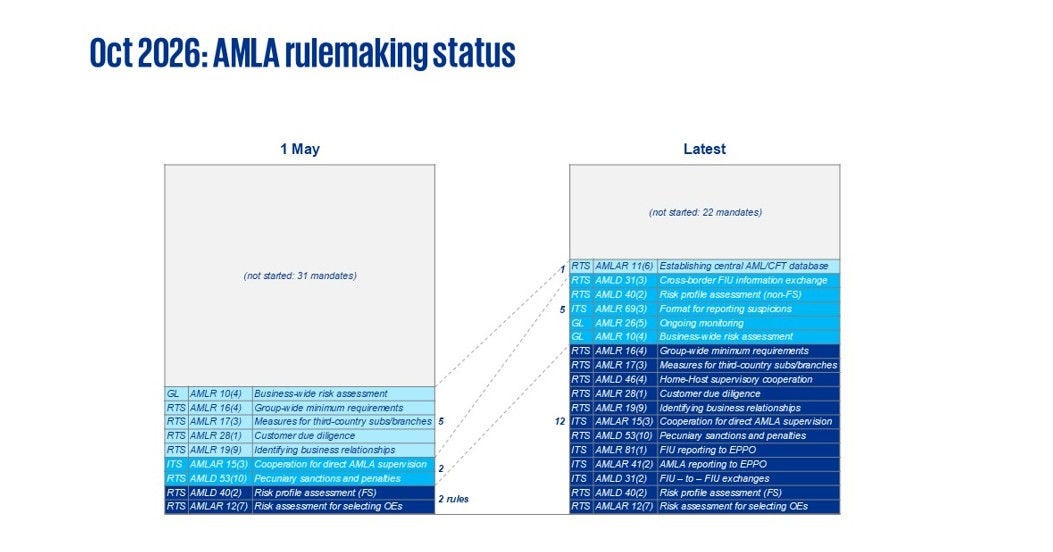
AMLA’s progress means it is largely sticking to the rulemaking schedule set out in the SPD. This is a notable achievement given the volume and complexity of the mandates assigned to the authority. The significant exception. Nevertheless, AMLA remains behind the statutory deadlines set out in the underlying legislation for many of its rulemaking responsibilities. As a result, both supervisors and firms continue to face some uncertainty regarding the final form of important implementing measures.
The most significant departure from AMLA’s planned timetable concerns the politically sensitive guidelines on the base amounts used by supervisors when calculating financial penalties for AML breaches. According to the SPD, AMLA intended to consult on these Guidelines during the second quarter of 2026 and finalise them during the third quarter. However, these plans encountered a substantial obstacle at a meeting of AMLA’s General Board on 1 July, when representatives of national supervisory authorities declined to support the draft Guidelines prepared by AMLA staff.
According to the published General Board minutes, many national supervisors considered that the draft proposals went too far in harmonising the calculation of enforcement penalties across the EU. In their view, national authorities should retain greater discretion in determining sanctions, reflecting differences in domestic legal systems and enforcement traditions. Several supervisors argued that sanctioning frameworks are closely linked to broader national legal arrangements and therefore cannot easily be standardised through a single European methodology. Faced with this opposition, AMLA Chair Bruna Szego agreed that the draft Guidelines would be revised to focus more narrowly on determining the base amount from which penalties are calculated. AMLA has yet to announce when the updated draft will be published for consultation.
The General Board’s intervention represents an important reminder that the creation of a truly harmonised European AML framework remains a work in progress. While the legislative package establishes a common set of rules, achieving convergence in supervisory practice requires national authorities to move away from long-established approaches and accept a greater degree of coordination at European level. The debate over financial penalties suggests that there may be limits to how far some authorities are willing to go.
Supervision: preparing for selection
AMLA will begin direct supervision of 40 entities in 2028. This summer, AMLA completed a further important preparatory step towards selecting the first cohort of firms for direct supervision. Working through national authorities, AMLA collected further data on which firms do enough cross-border business to meet the legal criteria for potential AMLA supervision. This followed on from AMLA’s previous data collection exercise (in March), that was intended to calibrate AMLA’s internal risk assessment models.
Based on the data gathered, AMLA is looking to finalise its long list of entities that would be eligible for direct supervision. As Chair Szego confirmed at a 15 July hearing before the European Parliament economic affairs and justice committees, AMLA will make its first formal selection of firms in the second half of next year, to be ready to start supervision in 2028.
Getting Ready
There is now under a year left until the AML Regulation takes effect. Most firms in the financial sector already have well-developed plans to implement the new rules, and are pressing with putting these into practice. AMLA’s progress on rulemaking has brought greater clarity on the details of what will be required: but given the lead-times needed to update internal policies and systems, in many areas firms must implement on the basis of their basis estimates of what the final regulatory requirements will be. This creates some risk that further adaptation will be needed in the future: firms will no doubt hope that AMLA and other supervisors will allow some leeway for institutions to catch up once the final rules are settled.
Meanwhile, firms should look out for the new supervisory handbook and methodology that AMLA is developing. If implemented consistently by national authorities, this promises to align supervisory expectations and interpretations. Together with the harmonization of rules, this could significantly reduce differences between national regimes that can create substantial compliance costs, as well as posing the risk of gaps and ‘blind spots’ for bad actors to exploit. A key question, however, is how far AMLA will succeed in getting national authorities to adopt a common supervisory approach: the pushback against AMLA’s penalty harmonization proposals suggests that AMLA may need to show some flexibility to secure approval for new rules. Firms, especially those operating in multiple EU countries, should follow the rulemaking process closely to assess the impact on their businesses.

