

- ECB announced key milestones for the implementation of the Integrated Reporting Framework (IReF).
- A one-year pilot phase will start in Q2 2030, with official IReF reporting scheduled to commence in Q2 2031.
- A public consultation on the draft IReF Regulation is planned for the second half of 2027.
- The revised timeline provides additional time for implementation and represents, for the first time, a realistic implementation window of approximately 2.5 years rather than merely a postponement.
Key facts
This marks the beginning of a new era in regulatory reporting for banks, and the implementation timeline is becoming increasingly tangible. European credit institutions should now focus on the standardisation of regulatory reporting based on IReF and BIRD. Both the start of the pilot phase and the go-live date have now been defined, while the preparatory work required remains substantial.
What are IReF and BIRD?
The Integrated Reporting Framework (IReF) is a framework developed by the European Central Bank (ECB) to simplify and harmonise statistical reporting across Europe. It introduces a more granular approach to a significant share of existing reporting requirements.
The objective of IReF is to standardise statistical reporting across euro area banks, reduce the reporting burden, and improve data quality for various stakeholders, including monetary policy authorities and analysts.
BIRD stands for the Banks’ Integrated Reporting Dictionary. This central data dictionary is a key enabler for the implementation of IReF, as it establishes a common vocabulary and enhances data comparability. It helps banks prepare and manage their data consistently and efficiently for IReF and other reporting requirements. While IReF will become mandatory through regulation, BIRD remains available to banks on a voluntary basis.
What are the benefits of IReF and BIRD?
Today, banks are required to submit statistical data to various institutions on a regular basis, in addition to prudential reporting requirements. Preparing and delivering these reports is both time-consuming and resource-intensive.
IReF will harmonise reporting obligations across statistical domains, thereby reducing the overall reporting burden. Combined with the central data dictionary BIRD, it has the potential to significantly improve both data preparation processes and data quality. In the long run, this can lower costs within institutions while enhancing transparency, efficiency and consistency in reporting.
What is the current implementation timeline?
Based on the ECB press release of 8 June 2026, the following key milestones have been announced for the implementation of IReF:
- Second half of 2027: Public consultation on the draft IReF Regulation. The consultation will contribute to shaping the final legislative proposal. In addition, supervisors are expected to publish further key information regarding IReF requirements ahead of the consultation.
- Q2 2030: Start of the one-year pilot phase. Reporting agents will be invited to test their ability to meet the new IReF data reporting requirements and reporting processes towards supervisors.
- Q2 2031: First official reporting of IReF data. An initial one-year parallel reporting phase is planned, during which existing statistical reporting within the scope of IReF must continue alongside IReF reporting.
Based on these milestones, a set of implementation activities and phases leading up to go-live and the parallel reporting period can be derived for institutions:
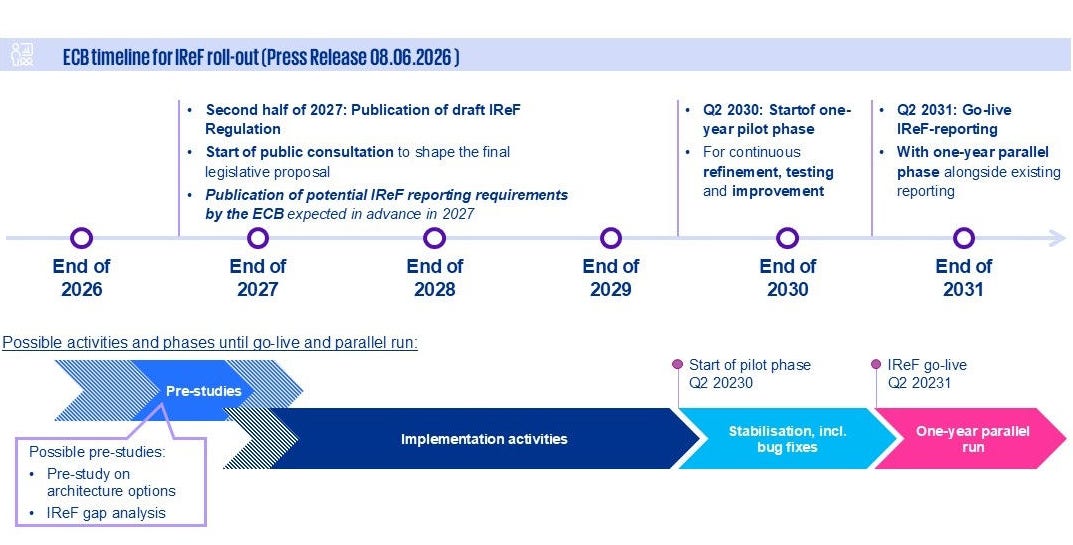
Source: KPMG analysis and illustration based on information provided by the ECB.
What does the ECB expect – what do banks need to do in practice?
Banks should now address five key areas of action, ranging from data management and IT architecture to organisational and governance-related aspects:
How are banks preparing for IReF?
The new reporting processes introduced by IReF will require significant changes to both systems and operating models. Across the market, initial target architecture blueprints and implementation approaches are already beginning to emerge.
As a first step, institutions should define a target operating model for granular reporting, covering the dimensions of IT architecture, data management, processes, organisation and management. This target state can then be used to identify gaps between the current state and the future vision.
A pragmatic approach is to begin with the target architecture and data management dimensions. Once the draft IReF Regulation is published in 2027, the remaining dimensions can be further elaborated and finalised.
Implementation can likewise be structured in several stages. A detailed roadmap aligned with the implementation timeline outlined above will enable stakeholders to translate the target vision into concrete work packages across each dimension and execute them in a controlled and efficient manner.


