AI has transformed financial services, from optimising internal processes to managing different elements of the customer engagement and risk management lifecycles. According to the FCA and Bank of England (BoE), 86% of firms now use AI. Banks have been embedding AI in their operational and wider risk management frameworks, for example in credit risk management and fraud detection, while insurers are increasingly using it in claims-handling. In the capital markets, AI is helping to optimise portfolios and analyse alternative data, and payments firms are using it to process customer behavioural analytics.
While firms are benefitting from the opportunities presented by AI, FS regulators are alert to the risks it may present. A quick horizon scan of announcements reveals that AI risks are consistently high on supervisory agendas, with frequent speeches and warnings in the UK, EU, US and internationally (see AI Regulatory Radar for more information). And yet, while AI risks attract significant attention, there are no regulatory regimes dedicated specifically to AI governance in financial services. Regulators have emphasised that existing frameworks should be used to manage AI risks and have stopped short of introducing new FS-specific policy or legislation. This is understandable: there are challenges in developing prescriptive regulation of a fast-paced technological change, and in an environment of growth, competitiveness and simplification, there is limited appetite from both firms and supervisors to develop additional regulatory regimes.
However, relying on existing frameworks can present its own difficulties. As highlighted in the UK Mills Review earlier this year, existing accountability, model risk management and consumer protection frameworks were designed for primarily human interactions. As AI becomes a core operational capability, firms should evolve their approaches and address AI risks such as model drift, data bias, hallucinations, AI agents, and other behaviours – many of which are not captured in traditional validation approaches. As highlighted by the UK Parliamentary Treasury Committee and the BoE’s Financial Policy Committee, there are potential consequences for financial stability and spillover effects into the wider economy if AI-driven FS risks crystallise, including financial impacts for consumers, policyholders and investors. Firms may therefore require more dynamic approaches to AI governance, and they are seeking practical guidance from regulators on how existing frameworks can help achieve this.
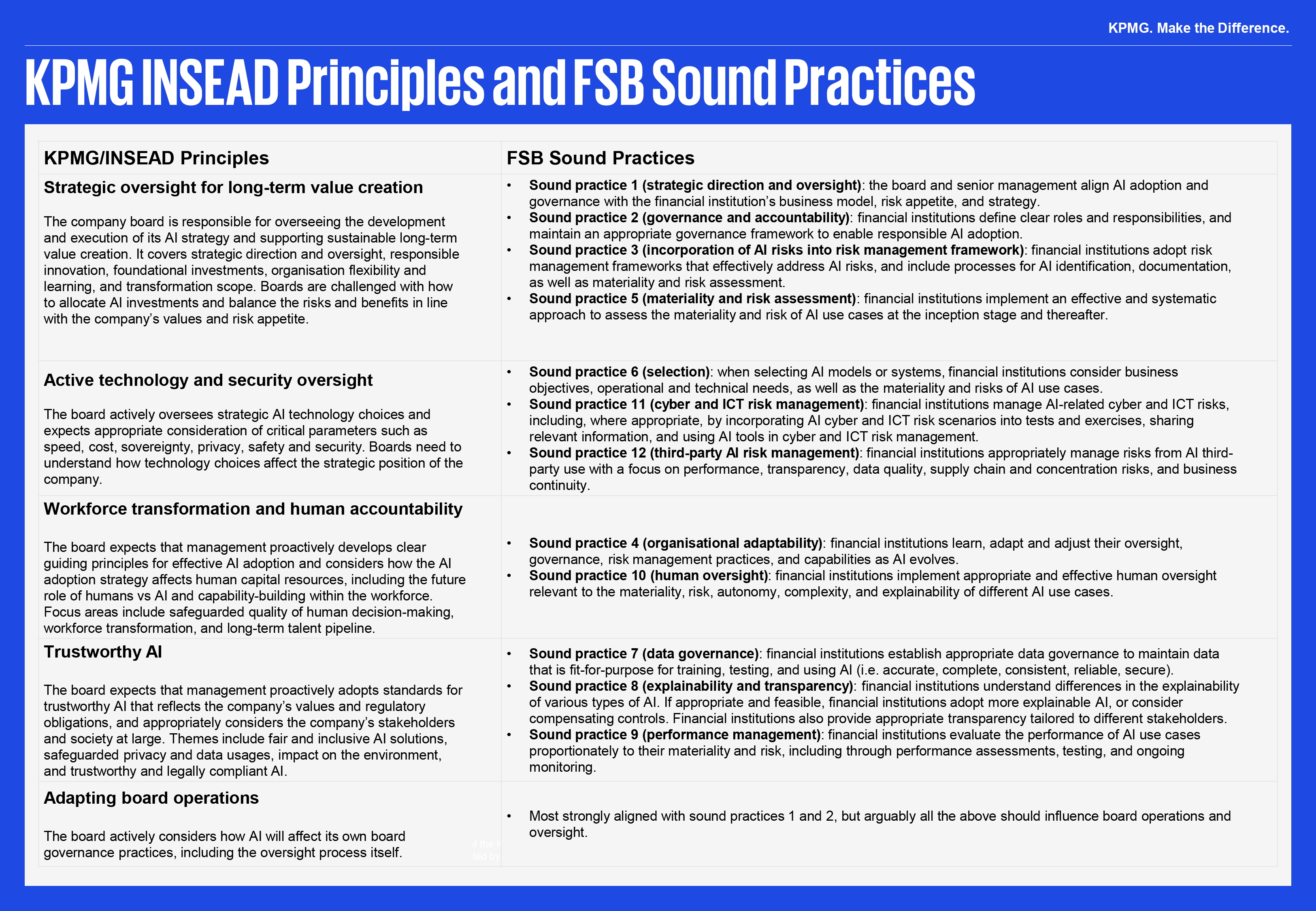
At an international level the Financial Stability Board (FSB) has finalised Sound Practices for responsible AI-adoption. These are the closest development so far to an internationally-agreed AI governance approach specifically for FS firms, but the FSB is clear that while boards are ‘strongly encouraged’ to adopt the practices, they ‘do not constitute a binding international standard’.
The FCA recently published good and poor AI practices on consumer centricity, accountability and governance, and operational resilience. The publication includes case studies alongside guidance on how to apply the practices to smaller firms. The FCA has been clear that it supports innovation and will update its guidance as technology evolves.
At KPMG in the UK, we often hear from firms that the lack of guidance around AI adoption can make it harder to manage risks appropriately, proportionally, and consistently with market peers. The FSB and FCA publications are therefore welcome interventions, and firms are likely to use them to guide their AI governance practices. Firms can also look to the AI Governance Principles for Boards developed jointly by KPMG International and INSEAD in 2026. Whilst these principles are sector-agnostic, they can be mapped neatly to the FSB sound practices, providing a prototype framework for AI governance in FS firms.