

Highlights
From 2028, non-EU companies and groups with significant operations in the EU will need to provide impact information for their entire global group in their sustainability reporting. An estimated 1,2001 companies could be impacted.
The proposed requirements, which are set out in the so-called European Sustainability Reporting Standards for certain
non-EU companies (ESRS-40a2), are open for comment until 31 October 2026.

What’s the issue?
The CSRD3 requires certain non-EU companies to publish a sustainability report covering their group-wide impacts. This applies when the group generates more than EUR 450m net turnover in the EU and has either a subsidiary or branch in the EU with a net turnover of at least EUR 200m.
The proposals set out what would be the detailed reporting requirements for disclosing material impacts on people and the environment. EFRAG (the EU’s advisory group on corporate reporting) has asked stakeholders to comment on:
- how the proposed requirements differ from full ESRS;
- the extent of information a company would be required to report and its choice of approach (global vs mixed);
- the references to specific EU laws and regulations; and
- the use of cross-referencing and interoperability with other sustainability reporting frameworks.
Simultaneously, EFRAG has selected certain companies to field test the feasibility and relevance of the proposals.
What’s the impact?
Non-EU companies in scope of the CSRD can choose to:
- prepare a consolidated sustainability statement voluntarily under full ESRS, which would exempt EU subsidiaries of the group from producing their own sustainability statements;
- prepare a sustainability report under ESRS-40a covering the group’s impacts – the EU subsidiaries (or subgroups) would also prepare their own sustainability statement; or
- apply a framework that will be considered equivalent to full ESRS.
The table below compares the reporting options available to non-EU companies. Differences can significantly affect reporting processes, particularly for materiality assessments, data collection and reporting responsibility.
| Reporting under full ESRS | Reporting under proposed ESRS-40a | |
| Reporting boundary | The parent company and all its subsidiaries | The ultimate non-EU parent’s global perspective |
| Materiality basis | Double materiality, covering impacts, risks and opportunities | Impact materiality only, covering impacts on people and the environment |
| Extent of reporting | All material information about relevant topics | All material information about relevant topics. Option to limit reporting on topics other than climate to EU-related impacts only (mixed approach) |
| Reporting format | Sustainability statement forms part of the management report | Sustainability report to be published and made available |
| Value chain | Upstream and downstream | |
| Transitional provisions | Phase-in reliefs for first-time reporters | |
What’s next?
Companies need to assess the impact on their reporting strategy and governance, including the challenge of navigating multiple reporting regimes in different jurisdictions.
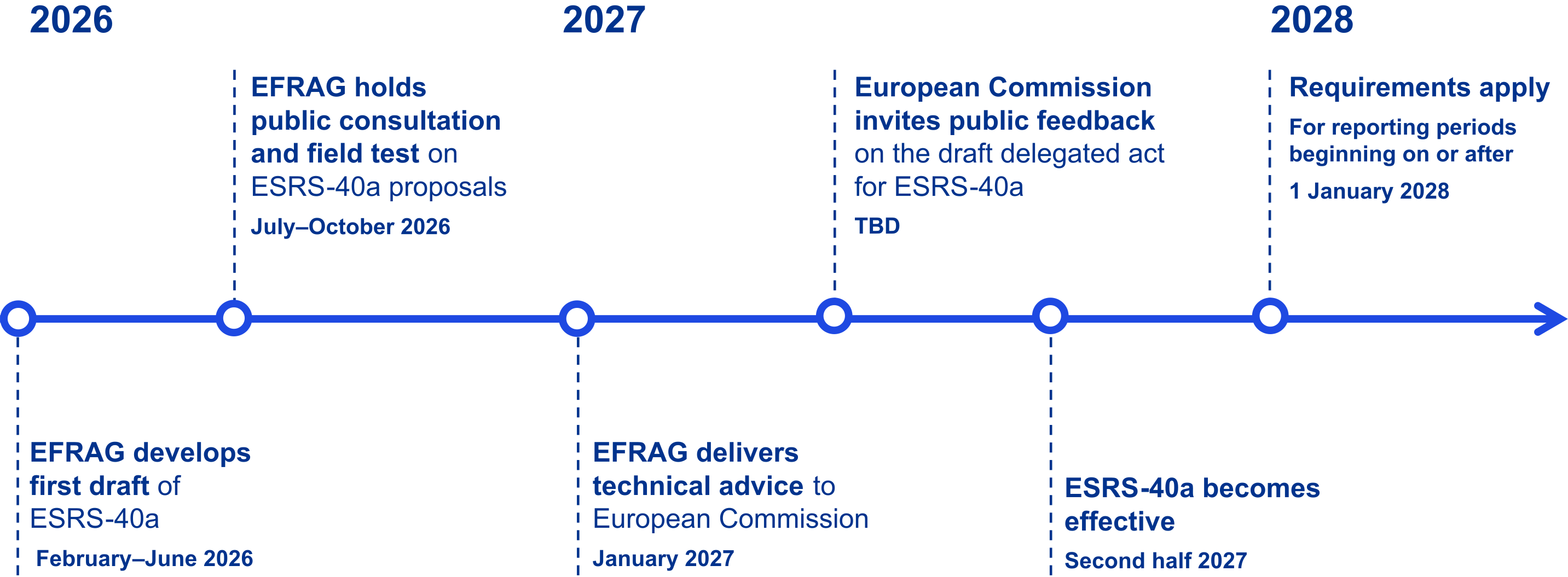
Under the CSRD, the requirements in ESRS-40a will apply for the financial periods beginning on or after 1 January 2028, with first reports due in 2029. The timeline below outlines the key milestones.
Actions for management
- Understand the proposals and how they could affect your company.
- Have your say by commenting on the proposals before 31 October 2026.
- Determine your CSRD reporting strategy if your company operates across multiple jurisdictions, considering where reporting obligations arise and the exemptions available under the CSRD.
- Speak to your KPMG contact for further information on the proposals and visit Sustainability reporting in the EU to keep up to date with the latest news and discussion.

1 EFRAG’s Sustainability Reporting Board public meeting held on 3 June 2026.
2 ESRS-40a refers to Article 40a of the Accounting Directive introduced by the CSRD. It establishes the sustainability reporting requirement for non-EU companies.
3 EU Corporate Sustainability Reporting Directive.
© 2026 KPMG IFRG Limited, a UK company, limited by guarantee. All rights reserved.